


SiteGPT and Tidio both put an AI agent on your website, and both hand the conversation to a person when the AI runs out of road. They were built from opposite ends. Tidio started as live chat and added an AI agent as a paid add-on. SiteGPT started with your content and assumes you already have somewhere for a human to take over.
iShort answer
Tidio sells a complete service desk: live chat, ticketing, email, Messenger, Instagram, and WhatsApp, with 10 seats on every self-serve plan including the free one. Tidio bills Meta's WhatsApp fees at cost, and those rates are in WhatsApp Business API pricing. Its Lyro AI agent is priced separately at $39 a month for 50 conversations, rising to $700 for 1,000. That is $0.70 to $0.78 per AI conversation. SiteGPT sells only the answering layer, at $59 to $429 a month billed monthly ($39 to $259 billed yearly), metered in messages.
The biggest published gap is content. Lyro's priority website scan is capped at 60 pages, and SiteGPT plans cover 1,000 to 500,000 pages across 12 or more source types. Tidio wins outright on the free plan, on seats, on ecommerce, and on review evidence, where it holds 1,880 G2 reviews against SiteGPT's 12.
For healthcare, Tidio does not sign a BAA. Its terms state that Tidio is not a HIPAA business associate. SiteGPT signs a BAA on Enterprise only, not on Starter, Growth, or Scale.
Key takeaways
| Question | Answer | Evidence |
|---|---|---|
| Same product category? | No | Tidio is a help desk with AI. SiteGPT is an AI layer for a desk you already have |
| Content the AI can read | SiteGPT | 60-page priority scan against 1,000-500,000 pages by plan |
| Cost per AI conversation | Depends | $0.70 on Tidio. $0.08 to $0.77 on SiteGPT depending on the model split |
| Free plan | Tidio | $0 with 50 conversations and 10 seats. SiteGPT has no free tier |
| Seats included | Tidio | 10 on every self-serve plan against 1, 4, or 10 by SiteGPT plan |
| Ecommerce fit | Tidio | Shopify and WooCommerce catalogue sync, 4.8/5 from 1,241 Shopify reviews |
| Review evidence | Tidio | 4.6/5 from ~1,880 G2 reviews against 4.8/5 from 12 |
| Human handoff | Both | Documented and included on both platforms |
Decide first whether you are buying a service desk or an answering layer for the desk you already run.
Count your pages first
Tidio scans up to 60 priority pages. SiteGPT starts at 1,000 and goes to 500,000. Page count settles most evaluations.
Price one resolved conversation
A Lyro conversation and a SiteGPT message are different things. Convert both to cost per resolved conversation before comparing.
Check what you already pay for
If you have Zendesk or Crisp, a bundled help desk is a second subscription for a job already done.
Weigh the review counts
Tidio has about 1,880 G2 reviews and SiteGPT has 12. Similar scores carry very different weight.
43%
of failed self-service journeys failed because the customer could not find content relevant to their issue, the single most common cause in a Gartner survey of 5,728 customers. Only 14% of issues were fully resolved in self-service at all, despite 73% of customers starting there. The limiting factor is how much content the AI can reach.
Source: Gartner survey of 5,728 customers, conducted December 2023What is the difference between SiteGPT and Tidio?
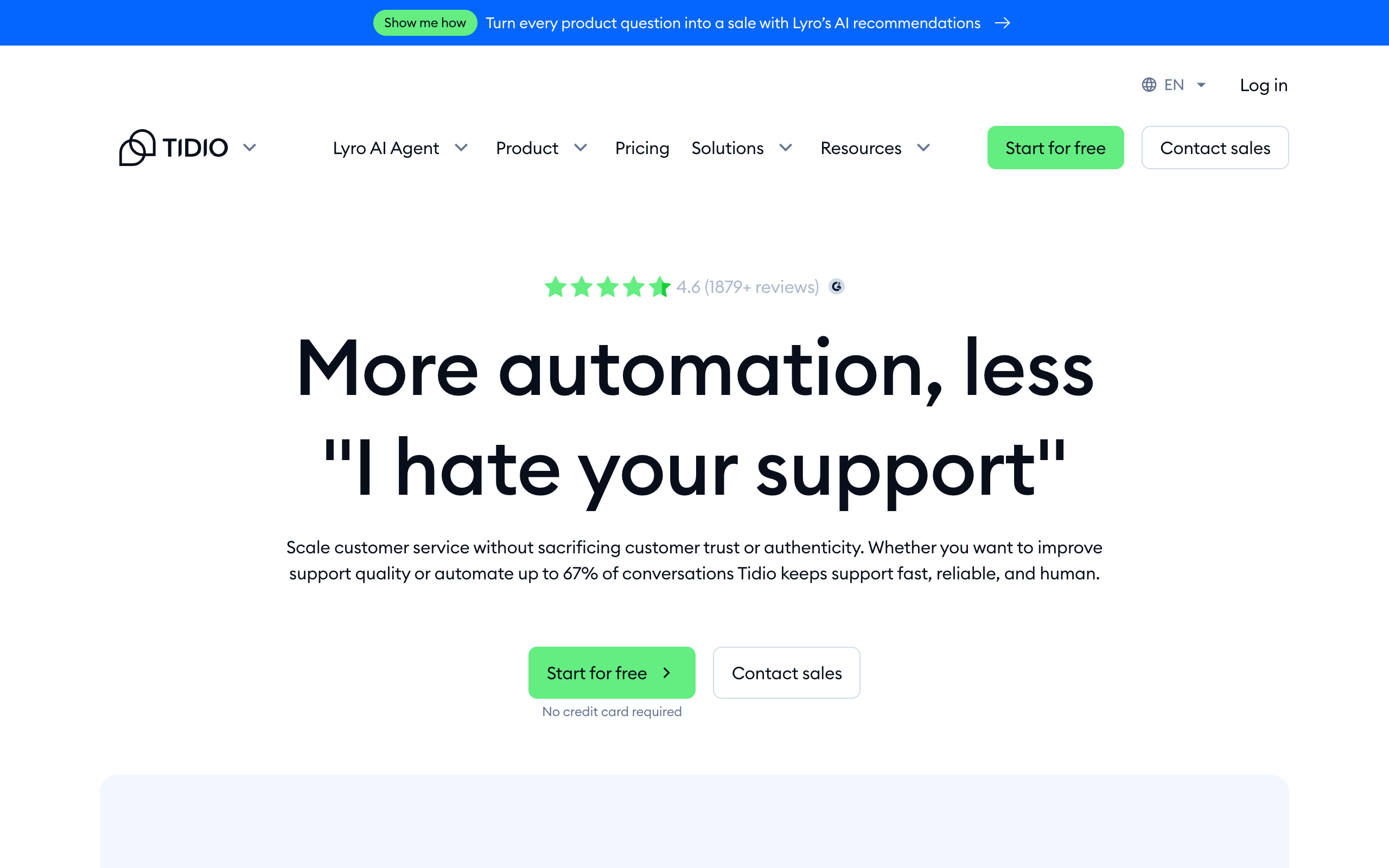
Tidio is a service desk with an AI add-on, and SiteGPT is an AI answering layer for a desk you already run. Tidio handles chat, tickets, email, Messenger, Instagram, and WhatsApp in one panel and adds no-code automation through Flows. Its pricing page sells the AI agent, Lyro, as a separate line item.
Tidio is also one of the best-maintained WordPress plugins in its category, at 70,000 active installs and a 94% rating. If the decision is specifically which plugin to run on a WordPress site rather than which platform to standardise on, that comparison is in best chatbot for WordPress website. SiteGPT's own plugin, its script-tag alternative, and the sources it trains on are covered in SiteGPT for WordPress.
SiteGPT ingests your content, answers questions from it, and escalates to a person on demand. It connects into the chat tools a service team already runs instead of replacing them.
A team without a help desk is comparing one subscription against two. A team that already pays for Zendesk or Crisp is comparing an AI add-on against an AI product, and the desk half of Tidio's bundle is a duplicate.
Disclosure: SiteGPT publishes this page. Every Tidio figure below comes from Tidio's own pricing page, help center, or app store listing, all linked in the Sources section.
How does each platform learn your content?
Lyro stores its knowledge as question-and-answer pairs, and SiteGPT retrieves from the content itself. Tidio's help center documents six ways to create Lyro's pairs: website URLs, manually written pairs, CSV and PDF import, a Zendesk help center import, webstore product sync, and pairs extracted automatically from solved live chats. Plus subscribers can add HTML sources through Tidio's OpenAPI. When you point Lyro at a site, it scans the pages and extracts the knowledge into pairs you can browse and edit.
SiteGPT's documented source list runs to 12 or more types. They include websites, sitemaps, YouTube, GitHub, raw text, and file uploads (CSV, TXT, PDF, DOCX, PPTX, MD). Cloud sources are Google Drive, Notion, Dropbox, OneDrive, SharePoint, and Box, plus help centers on Zendesk, Freshdesk, Intercom, Confluence, and Gitbook.
Both platforms keep their knowledge current automatically. Tidio offers automatic website synchronization and a re-synchronize control on each data source.
SiteGPT publishes a refresh cadence by plan: manual on Starter, monthly on Growth, weekly plus a daily auto-scan on Scale, and daily on Enterprise. Freshness does not separate them. Volume does.
How much content can each one read?
Lyro's priority scan reads up to 60 pages. SiteGPT plans read 1,000 to 500,000 pages. Both vendors publish these limits.
SiteGPT sells page volume as a headline plan limit, where roughly 2,500 cleaned characters count as one page and uploaded files go up to 10 MB.
| Plan | Monthly | Annual (per mo) | Pages | Chatbots | Team | Refresh |
|---|---|---|---|---|---|---|
| Starter | $59 | $39 ($468/yr) | 1,000 | 1 | 1 | Manual |
| Growth | $129 | $79 ($948/yr) | 10,000 | 2 | 4 | Monthly |
| Scale | $429 | $259 ($3,108/yr) | 50,000 | 3 | 10 | Weekly + daily scan |
| Enterprise | Custom | Custom | 500,000 | up to 10,000 | up to 10,000 | Daily |
A store with a 30-page site and a tight FAQ does not need 10,000 pages, and capacity you never fill is wasted money. The gap matters when the answers live in a documentation set, a large help center, a GitHub repository, or a video library. Gartner's 43% figure describes that case.
What does one AI answer cost on each platform?
Both vendors publish their meters, and the units are not the same. Tidio counts a Lyro conversation, which is one customer interaction with at least one AI reply, no matter how many messages it contains. SiteGPT counts a message, and a message is both the customer's question and the AI's reply.
Tidio's own pricing calculator gives the full Lyro ladder on monthly billing:
| Lyro conversations/mo | Price | Per conversation |
|---|---|---|
| 50 | $39 | $0.78 |
| 100 | $75 | $0.75 |
| 500 | $350 | $0.70 |
| 750 | $525 | $0.70 |
| 1,000 | $700 | $0.70 |
Above 1,000 a month, Tidio directs you to sales. Annual billing takes the entry tier to $32.50 a month.
To compare the two, a resolved conversation has to be converted into messages. Assume six messages per resolved conversation, which is three customer questions and three AI replies. At four messages the SiteGPT figures improve by a third. At ten they worsen by around 40%. The assumption is stated so you can move it.
| Split | SiteGPT Growth, $129/mo | Messages | Six-message conversations | Per conversation |
|---|---|---|---|---|
| All GPT-4.1-mini | $129 | 10,000 | ~1,667 | ~$0.08 |
| All GPT-4.1 | $129 | 1,000 | ~167 | ~$0.77 |
At the premium-model end of SiteGPT's range, the two products cost about the same per resolved conversation, within a few cents of each other. At the mini end, SiteGPT is roughly nine times cheaper. The variable is the model split, which SiteGPT exposes in billing settings and you can change at any time.
All three figures are on monthly billing. The Tidio figure is Growth at $59 plus the 500-conversation Lyro add-on at $350. It buys a help desk with 250 billable human conversations and 10 seats alongside the AI.
The SiteGPT figures buy the answering layer only, so a team without a desk has to add one. $409 against $129 is like for like only if you already pay for a help desk.
It also depends on which desk. SiteGPT Growth hands off into Slack or Crisp. The Zendesk integration needs Scale at $429 billed monthly ($259 billed yearly), $20 a month more than Tidio's $409.
$280 a month, but only if your desk is Slack or Crisp
For 500 AI conversations a month, Tidio Growth plus the Lyro add-on is $409 a month on monthly billing. SiteGPT Growth is $129 a month and covers roughly 1,667 six-message conversations at the GPT-4.1-mini end of its range, a difference of $280 a month or $3,360 a year. That comparison holds only for teams that already hand off into Slack, Crisp, or another Growth integration, because Tidio's price includes the desk and SiteGPT's does not. Teams on Zendesk need SiteGPT Scale at $429 billed monthly, $20 more than Tidio. On an all GPT-4.1 split the equivalent SiteGPT plan is also Scale, and the saving disappears. Tidio rates verified 29 July 2026 and re-checked 27 September 2026. SiteGPT rates verified 27 September 2026.
Both vendors publish their rates. The units do not convert directly.
Tidio: Lyro conversations
- $39/mo for 50, rising to $700/mo for 1,000
- A conversation is one interaction with at least one AI reply
- Message count inside a conversation does not matter
- Above 1,000 conversations a month, contact sales
- Billed on top of a Customer Service plan from $29/mo
- Human conversations metered separately as billable conversations
SiteGPT: messages
- $59/mo for 400-4,000, $129/mo for 1,000-10,000
- A message is the question plus the reply
- Long conversations consume more of the quota
- Extra 5,000 messages add-on at $39/mo
- No separate charge for human conversations
- Model split adjustable from billing settings at any time
When is Tidio better than SiteGPT?
When you need a free plan, many seats, a full help desk, or Shopify catalogue sync. Tidio wins those categories outright.
Pros
- Tidio: a free plan at $0 with 50 billable conversations, 10 seats, and 50 one-off Lyro conversations. SiteGPT has no free tier at all.
- Tidio: 10 seats on every self-serve plan, including Free, against 1, 4, or 10 seats by SiteGPT plan.
- Tidio: a complete help desk with live chat, ticketing, email, Messenger, Instagram, and WhatsApp in one subscription.
- Tidio: Shopify and WooCommerce catalogue sync, plus native Shopify actions, which SiteGPT does not offer.
- Tidio: a Premium tier with a guaranteed 50% Lyro resolution rate and pay-per-resolution billing.
- Tidio: roughly 1,880 G2 reviews and 1,241 Shopify App Store reviews, against 12 G2 reviews for SiteGPT.
Seats are the clearest case. A five-agent team on SiteGPT needs Growth at four seats or Scale at ten. The same team gets ten seats on Tidio's free plan, so if seats are the constraint, choose Tidio.
Tidio's Premium tier also carries a guarantee. A contractual 50% resolution rate with pay-per-resolution billing shifts risk from the buyer to the vendor, and SiteGPT publishes no equivalent commitment.
Can Tidio and SiteGPT hand off to a human?
Yes, both can, so handoff will not decide between them. The difference is where the human sits.
Tidio documents configurable handoff and escalation rules, automatic forwarding when a question falls outside Lyro's knowledge, real-time conversation monitoring, and the ability for an agent to jump into any conversation. Because the inbox is Tidio's own, the handoff is a zero-integration path from AI to human.
SiteGPT escalates when the visitor asks for a person, then notifies the team with the transcript and captured contact details. Email and dashboard notifications work on every plan, Slack needs Growth, and webhooks need Scale. The specifics are documented at SiteGPT's human support docs.
From Growth, the escalation can land in Slack, Crisp, Messenger, Google Chat, Freshchat, or Zoho SalesIQ. Zendesk needs Scale and Zendesk Suite Professional or above. Starter has no chat integrations. One SiteGPT customer describes the Zendesk setup directly:
"We've got the bot dialled in, we're using GPT-4, have an avenue for escalations to Zendesk, and so far I have no complaints."
Brent Burrows II, Vice President of Retail and Sales at CBS Bahamas
For a scored field of platforms compared on handoff specifically, see the AI chatbots with human handoff roundup.
Neither vendor locks its AI to its own inbox. Tidio sells a Lyro AI Agent only configuration that adds the agent to Zendesk, Intercom, or Salesforce.
SiteGPT also publishes a remote MCP server with OAuth, so an assistant can operate the chatbot itself. The SiteGPT agents page covers what an assistant can run end to end, and MCP for customer service covers the service-specific case. Claude is the confirmed MCP client, and SiteGPT publishes setup guides for Claude Code and Cursor.
Tidio publishes no comparable MCP interface today. The AI agents hub covers the wider field of AI agents for customer service.
Which is better for an ecommerce store?
Tidio, for most stores. Lyro syncs product catalogues directly from Shopify and WooCommerce, so it answers stock, variant, and product questions from live store data rather than from a written FAQ. Native Shopify actions and Flows add proactive conversion paths on top, and Tidio cites a 26% conversion lift for Flows.
Tidio holds 4.8 out of 5 from 1,241 reviews on the Shopify App Store. For a merchant, that is deeper and more relevant evidence than any general software directory.
SiteGPT does not match that. It has no Shopify or WooCommerce catalogue sync and no equivalent app store standing, and a merchant whose top questions are "where is my order" and "is this in stock" should weight that heavily.
Where SiteGPT holds ground in ecommerce is the other half of the queue. Sizing guides, returns policies, care instructions, warranty terms, and shipping rules usually live across a help center, a set of PDFs, and a documentation site. That is content-shaped work, and it is where a 60-page priority scan starts to strain. Which half of the queue a store should automate first, with the patterns behind ten real deployments, is worked through in ecommerce chatbot examples and use cases.
How are Tidio and SiteGPT rated?
Close on score, far apart on review count.
4.6/5·G2(1,880) 4.8/5·G2(12)Tidio also holds 4.7 out of 5 on Capterra and 4.8 out of 5 from 1,241 reviews on the Shopify App Store.
SiteGPT's 4.8 comes from 12 reviews. Tidio's 4.6 rests on roughly 1,880. A buying committee that treats review volume as a proxy for risk should treat that gap as the more meaningful number on this page.
Cons
- SiteGPT: 12 G2 reviews is a thin evidence base for a buying committee.
- SiteGPT: no free plan, so the 7-day trial is the only way to test it.
- SiteGPT: 1 seat on Starter against 10 on every Tidio self-serve plan.
- SiteGPT: no help desk, no ticketing, and no Instagram or WhatsApp channel today.
- SiteGPT: the headline message count assumes a mini-heavy model split.
- Tidio: Lyro's priority website scan is capped at 60 pages.
- Tidio: Lyro file import covers CSV and PDF only.
- Tidio: AI is a separate line item, so the real monthly cost is the plan plus the add-on.
- Tidio: above 1,000 Lyro conversations a month there is no published price.
Full side-by-side table
| Feature | SiteGPT | Tidio |
|---|---|---|
| Category | AI answering layer for customer service | Live chat and help desk with an AI add-on |
| Free plan | None | $0 with 50 conversations and 10 seats |
| Entry paid plan, monthly | $59 | $29 |
| Entry paid plan, annual | $39/mo, $468/yr | $24.17/mo, $290/yr |
| Second tier, monthly | $129 | From $59 |
| Top published tier | Scale, $429/mo | Plus, from $300/mo plus usage |
| AI priced separately | No | Yes, from $39/mo |
| AI metering unit | Message (question plus reply) | Conversation with at least one AI reply |
| AI volume at entry | 400-4,000 messages | 50 conversations |
| Published AI ceiling | 40,000 messages on Scale | 1,000 conversations, then contact sales |
| Cost per AI conversation | ~$0.08 to ~$0.77 by model split | $0.70 to $0.78 |
| Website scan limit | 1,000-500,000 pages by plan | 60 pages on a priority scan |
| Content sources | 12+ including GitHub, YouTube, cloud drives, help centers | Website, manual Q&A, CSV, PDF, Zendesk, store sync, chat extraction |
| Auto-refresh | Manual, monthly, weekly, or daily by plan | Automatic website synchronization |
| Chatbots or agents | 1 / 2 / 3 by plan | 1 project, multiproject on Plus |
| Team seats | 1 / 4 / 10 by plan | 10 on all self-serve plans, custom on Plus |
| Live chat and ticketing | Not included | Included on all plans |
| Channels | None on Starter. Slack, Crisp, Messenger, Google Chat, Freshchat, Zoho SalesIQ from Growth. Zendesk from Scale | Live chat, email, Messenger, Instagram, WhatsApp |
| Add AI to another desk | Yes, via integrations | Yes, via Lyro AI Agent only |
| Ecommerce | No catalogue sync | Shopify and WooCommerce sync, native Shopify actions |
| MCP server | Yes, remote with OAuth | Not published |
| Languages | 95+ | 48 |
| Remove branding | $59/mo billed monthly, or $39/mo billed yearly | $16.67/mo add-on |
| Resolution guarantee | None published | 50% guaranteed on Premium |
| Free trial | 7 days, all self-serve plans, credit card required | 7 days, no credit card |
| HIPAA | Signed BAA on Enterprise only, terms published | No BAA. Tidio's terms state it is not a HIPAA business associate |
| G2 rating | 4.8/5 (12 reviews) | 4.6/5 (~1,880 reviews) |
| Shopify App Store | Not listed | 4.8/5 (1,241 reviews) |
Should you choose SiteGPT or Tidio?
Choose Tidio if you are buying a service desk. Choose SiteGPT if you already have one and need an AI that reads a large body of content.
Pick Tidio if you are buying a service desk. It suits a team with no inbox, a need for ten seats, or a Shopify or WooCommerce store. It also covers Instagram and WhatsApp in the same panel and offers a free plan. SiteGPT sells no shared inbox, no Instagram channel, and no free plan. It does answer on WhatsApp through a paid add-on. Tidio's review base and Premium guarantee lower the risk for a buying committee.
Pick SiteGPT if you are buying an answering layer. It fits when the desk already exists and the answers live across documentation, a help center, GitHub, cloud drives, or video. A 60-page priority scan will not reach that content. At the GPT-4.1-mini end of its range SiteGPT is roughly nine times cheaper per conversation, and you do not pay twice for a desk.
Run both trials if the volume is uncertain. Tidio's trial is 7 days with no credit card and its free plan continues afterwards. SiteGPT's trial is 7 days on all self-serve plans and requires a credit card. Put the same 100 real customer questions through both, count how many resolved without a human, and compare what each one consumed. No other method converts a Lyro conversation into SiteGPT messages reliably.
Best forTeams that already run a help desk and need an AI that can read a large content estate, rather than a second subscription that duplicates the inbox they already pay for.
Do you already pay for a help desk or live chat tool?
- If yes, Crisp, Slack, or similar→SiteGPT Growth adds the AI without duplicating the desk
- If yes, Zendesk Suite Professional or above→SiteGPT Scale adds the AI with handoff into Zendesk
- If no, you need the inbox too→Tidio bundles both in one subscription
How many pages of content hold the answers?
- If a tight FAQ under about 60 pages→Lyro's priority scan covers it
- If a documentation set or large help center→SiteGPT plans run from 1,000 to 500,000 pages
How many people need inbox access?
- If five or more→Tidio gives 10 seats on every plan including Free
- If one to four→Either works. Compare on content volume and price
Do you sell on Shopify or WooCommerce?
- If yes, and order questions dominate→Tidio syncs the catalogue and ships Shopify actions
- If no, questions are about docs and policies→SiteGPT reads the content those answers live in
| Scenario | Best pick | Why |
|---|---|---|
| Shopify store, mostly order and stock questions | Tidio | Catalogue sync, native Shopify actions, and 4.8/5 from 1,241 Shopify reviews |
| SaaS with a large documentation site | SiteGPT | 10,000 pages on Growth against a 60-page priority scan |
| Team of 6 agents that needs a shared inbox | Tidio | 10 seats plus ticketing on every self-serve plan |
| Already paying for Zendesk Suite Professional+ | SiteGPT Scale | Adds AI with Zendesk handoff and no second help desk. Scale is $259/mo billed yearly ($429 monthly) |
| Already paying for Crisp or running handoff in Slack | SiteGPT Growth | Both integrations start on Growth, $79/mo billed yearly ($129 monthly) |
| No budget at all this quarter | Tidio | A $0 plan with 50 conversations. SiteGPT has no free tier |
| Content lives in Notion, Google Drive, and GitHub | SiteGPT | 12+ source types against CSV, PDF, website, and Zendesk |
| Volume above 1,000 AI conversations a month | SiteGPT | Scale publishes up to 40,000 messages. Tidio routes to sales |
| Committee wants a deep review base | Tidio | ~1,880 G2 reviews against 12 |
| Procurement wants a contractual resolution rate | Tidio | 50% guaranteed on Premium with pay-per-resolution billing |
| Docs change weekly and must stay current | SiteGPT Scale | Weekly refresh plus a daily auto-scan on a published schedule |
| Patients may share health details in the chat | SiteGPT Enterprise | Signed HIPAA BAA on Enterprise only. Tidio signs no BAA and its terms say it is not a business associate |
On that last row, read the conditions. A SiteGPT BAA is Enterprise-only and is executed during onboarding, so no PHI should reach the chatbot until enablement is confirmed in writing.
A covered workspace also narrows: connected apps and third-party chat integrations are switched off, PHI stays confined to end-user conversations, training content stays PHI-free, and conversation text is redacted 7 days after last activity by default.
The HIPAA page carries current status, the docs describe day-to-day behavior, and the standard BAA is published for legal review. If the bot only answers from public information, no BAA is needed on either platform.
For Tidio assessed on its own terms rather than head to head, see the Tidio review, and for the wider field see the best Tidio alternatives. For the same evaluation against content-trained platforms rather than a live chat suite, see SiteGPT vs Chatbase and SiteGPT vs CustomGPT. Teams weighing a per-seat incumbent will find that math in SiteGPT vs Zendesk and SiteGPT vs Intercom.
Frequently asked questions
Basics
What is the main difference between SiteGPT and Tidio? Tidio is a live chat and help desk product with an AI agent, Lyro, sold as an add-on. SiteGPT is an AI answering layer trained on your content that plugs into the help desk you already run. If you need the inbox, the seats, and the ticketing as well as the AI, Tidio sells all of it in one subscription. If you already have a desk and want the AI to read more of your content, SiteGPT is built for that job.
Does Tidio have a free plan? Yes, and SiteGPT does not. Tidio's Free plan costs $0 and includes 50 billable conversations a month, 10 seats, 100 Flows visitors, and 50 Lyro AI conversations as a one-off lifetime allowance rather than a monthly refresh. SiteGPT has no free tier and offers a 7-day free trial on all self-serve plans, with a credit card required. Tidio also offers a 7-day trial with no credit card required.
How many seats does each product include? Tidio includes 10 seats on every self-serve plan, including the Free plan, with custom seat counts on Plus. SiteGPT includes 1 seat on Starter, 4 on Growth, and 10 on Scale. For a team of five agents that need inbox access, Tidio's seat allowance is the more generous one at every price point. Seats are one of the clearest reasons to choose Tidio.
Pricing
How much does Tidio's Lyro AI agent cost per conversation? Tidio's own pricing calculator prices the Lyro AI Agent add-on at $39 a month for 50 conversations, $75 for 100, $350 for 500, $525 for 750, and $700 for 1,000, on monthly billing. That works out to $0.78 per AI conversation at the entry tier and $0.70 at 500 and above. Above 1,000 Lyro conversations a month, Tidio directs you to sales for a custom plan. Figures verified on tidio.com/pricing on 29 July 2026.
Is SiteGPT cheaper than Tidio? It depends entirely on which model answers your questions. SiteGPT Growth is $129 a month on monthly billing for 1,000 to 10,000 messages, and a message counts both the customer's question and the AI's reply. At the GPT-4.1-mini end that is roughly $0.08 per six-message conversation, about nine times cheaper than Tidio's $0.70. At the all GPT-4.1 end it is roughly $0.77 per conversation, which is within a few cents of Tidio. The model split is set in SiteGPT's billing settings and can be changed at any time.
Content and capabilities
How much of my website can each product read? This is the largest published gap between them. Tidio's help center documents that Lyro's Scan priority pages option is limited to scanning up to 60 pages. SiteGPT's plans include 1,000 pages on Starter, 10,000 on Growth, 50,000 on Scale, and 500,000 on Enterprise, where roughly 2,500 cleaned characters count as one page. For a small site with a tight FAQ, 60 pages is enough. For a documentation set or a large help center, it is not.
What content sources can Lyro be trained on? Tidio's help center documents six routes: website URLs (a single page, or a priority scan capped at 60 pages), manually written question-and-answer pairs, CSV and PDF file import, a Zendesk help center import, webstore product sync for Shopify and WooCommerce, and question-and-answer pairs extracted automatically from solved chats. Plus subscribers can also add HTML sources through Tidio's OpenAPI. SiteGPT documents 12 or more source types including sitemaps, GitHub, YouTube, Google Drive, Notion, Dropbox, OneDrive, SharePoint, Box, and help centers from Zendesk, Freshdesk, Intercom, Confluence, and Gitbook.
How many languages does each one support? Tidio's help center lists 48 supported languages for Lyro, and states that Lyro answers natively in the customer's language rather than translating to English internally first. SiteGPT documents 95 or more languages. Both cover the major European and Asian markets, so the count only matters if a specific language is missing from Tidio's published list.
Do both platforms hand off to a human agent? Yes, so handoff does not separate them. Tidio documents configurable handoff and escalation rules, automatic forwarding when a question falls outside Lyro's knowledge, real-time conversation monitoring, and the ability for an agent to jump in at any point. SiteGPT escalates when the visitor asks for a person, then notifies the team with the transcript and captured contact details. Email and dashboard notifications work on every plan, Slack needs Growth, and webhooks and Zendesk need Scale. The real difference is where the human sits: inside Tidio's own inbox, or inside whichever desk SiteGPT is connected to.
Can Lyro be used without the rest of Tidio? Yes. Tidio sells a Lyro AI Agent only configuration that adds the AI agent to Zendesk, Intercom, Salesforce, or another help desk, so Tidio is not locked to its own inbox. SiteGPT works the same way, integrating with Slack, Crisp, Messenger, Google Chat, Freshchat, and Zoho SalesIQ from Growth, and with Zendesk from Scale (on Zendesk Suite Professional or above). On the specific question of adding an AI agent to an existing desk, neither product forces you to replace what you have.
Choosing
Which is better for an ecommerce store? Tidio, in most cases. It syncs Shopify and WooCommerce product catalogues directly into Lyro's knowledge, ships native Shopify actions, sells Flows for proactive conversion paths, and holds 4.8 out of 5 from 1,241 reviews on the Shopify App Store. That is specific, verifiable ecommerce evidence that SiteGPT does not match. SiteGPT is the stronger fit when the questions are about documentation, policies, and product knowledge spread across a large content estate rather than about orders and shipping.
What are the third-party ratings for SiteGPT and Tidio? Tidio holds 4.6 out of 5 on G2 from roughly 1,880 reviews and 4.7 on Capterra, with 4.8 out of 5 from 1,241 reviews on the Shopify App Store. SiteGPT holds 4.8 out of 5 from 12 reviews on G2. The scores are close, but Tidio's rests on about 150 times as many reviews. A buying committee that weights review volume should weight it toward Tidio.
When should a team pick Tidio over SiteGPT? When the team needs the help desk as well as the AI. Tidio bundles live chat, ticketing, email, Messenger, Instagram, and WhatsApp with 10 seats from the Free plan up. SiteGPT does not sell a service desk. Tidio is also the better pick for a Shopify or WooCommerce store, for a team that wants a free tier to start on, and for a buying committee that wants a large review base behind the decision.
When should a team pick SiteGPT over Tidio? When the content is large and the answers depend on it. SiteGPT trains on 1,000 to 500,000 pages against Lyro's 60-page priority scan, pulls from 12 or more source types including GitHub, YouTube, and cloud drives, refreshes on a published schedule by plan, and costs roughly nine times less per conversation at the GPT-4.1-mini end of its range. It is the better fit for documentation-heavy products, and for teams that already pay for a help desk and do not want to buy a second one.
Sources
- Tidio pricing, plan rates on both billing cycles, billable conversation and Lyro conversation definitions, seat counts, the Lyro and Flows add-on ladders, and the branding add-on, verified 29 July 2026 (annual Starter, Growth, Plus, and Lyro entry rates and the no-card trial re-checked 27 September 2026)
- Tidio help center: data sources for Lyro, the six knowledge routes and the 60-page priority scan limit, verified 29 July 2026
- Tidio help center: Lyro, the conversational AI agent, handoff configuration, automatic website synchronization, and channel controls, verified 29 July 2026
- Tidio help center: Lyro multilanguage support, 48 supported languages, verified 29 July 2026
- Lyro AI agent, resolution rate claims and the help desks Lyro can be added to, verified 29 July 2026
- Tidio on the Shopify App Store, 4.8/5 from 1,241 reviews and the published app pricing, verified 29 July 2026
- Tidio terms of service, Section 20: "Tidio is not a HIPAA Business Associate", read 27 September 2026
- Tidio on G2, 4.6/5 from approximately 1,880 reviews, verified 29 July 2026
- SiteGPT pricing, plan rates, message ranges from the model-split calculator, page and seat limits, and add-ons, verified 27 September 2026
- SiteGPT human support documentation for escalation and notification specifics
- SiteGPT on G2, 4.8/5 from 12 reviews, verified 29 July 2026
- Gartner, only 14% of customer service issues are fully resolved in self-service, survey of 5,728 customers conducted December 2023, including the 43% content-not-found figure