


The ten examples below are real deployments, grouped by the job each one does. Each shows the conversation pattern behind it and gives a result only where the company published one. Use it as a pattern library to copy.
Amazon, Walmart, and Lowe's built custom assistants on their own catalogs. A lighting retailer and a hardware chain in the Bahamas built theirs on SiteGPT in an afternoon.
The patterns are the same either way, because shoppers ask the same five kinds of questions everywhere.
iShort answer
Ecommerce chatbots do five jobs: answer pre-sale product questions, recommend and help shoppers discover, handle post-purchase service, clear checkout objections, and capture leads. The published results all point the same way.
Lowe's says Mylow users convert three times as often as non-users. Walmart says Sparky users spend 40% more per order. A SiteGPT lighting retailer cut phone calls by a third as revenue grew 12%. Klarna adds the warning: it automated two-thirds of its chats, then hired humans back for the moments that matter.
Pick the job, copy the pattern, train the bot on your own content, and keep a person one click away.
70.22%
Average online cart abandonment rate, across 50 studies. The top reasons are extra costs (40%), slow delivery (20%), required accounts (18%), returns policy (13%), and unclear total cost (12%). Every one of those is a question a chatbot can answer before the shopper leaves.
Source: Baymard Institute, cart abandonment rate statisticsKey takeaways
| Job to be done | Example | Published outcome |
|---|---|---|
| Pre-sale product questions | Lowe's Mylow; SiteGPT lighting retailer; CBS Bahamas | 3x conversion for users (Lowe's); 33% fewer calls, +12% revenue; $5,000 to $500 monthly support cost |
| Recommendations and discovery | Amazon Rufus; Walmart Sparky; Zalando; Sephora in ChatGPT | 250M shoppers, interactions +210% (Amazon); +40% spend per order (Walmart) |
| Post-purchase service | Klarna AI assistant | 2.3M chats in month one, two-thirds of volume, 25% fewer repeat inquiries |
| Checkout objections | Pattern, built on Baymard's abandonment reasons | No reliable public recovery figure; measure in your own funnel |
| Lead capture | Pattern for quote-based and out-of-stock cases | Measured as captured leads and booked follow-ups, not checkouts |
Every example here maps to one of these. Pick the job your queue is heaviest in, then copy that pattern first.
Answer before the sale
Compatibility, sizing, specifications, and how-to questions, answered from product pages and guides. This is the highest-conversion job, and a content-trained bot does it best.
Recommend and discover
Turn a goal ('a gift under $50 for a runner') into products. This needs catalog access and an honest 'we do not stock that'.
Serve after the purchase
Order status, returns, refunds, payments. This needs order data, which is where native commerce integrations matter.
Remove checkout objections
Shipping cost, delivery time, returns policy, total cost. Answer these from your policy pages, at the moment they would otherwise cause abandonment.
Capture the lead
For quotes, bulk orders, made-to-order, and out-of-stock items: collect the details and book the follow-up when a checkout is not possible.
How were these examples chosen?
By three rules. Every example is a deployment that exists, or existed, in public. Every result is attributed to the company that reported it, with a link, and where a company published no numbers the entry says so.
The examples are grouped by job because the job is what transfers to your store.
Two of the ten are SiteGPT customers, and each of those entries says so. Two more are patterns rather than named deployments, because thousands of stores handle checkout objections and lead capture well and none of them do it famously. Those two entries are built from Baymard Institute's abandonment research and the conversation structure the named examples share.
How do chatbots answer pre-sale product questions?
From product pages, spec sheets, and guides, as examples 1-3 show. The pre-sale question is the highest-value conversation in ecommerce. A shopper asking "will this fit my 2019 model" or "is this dimmable" is one answer away from buying. It is also the job a content-trained chatbot does best, because the answer already sits on a product page, a spec sheet, or a guide.
1. Lowe's Mylow: project and product questions before the sale
Lowe's launched Mylow in March 2025, built with OpenAI, as a home improvement adviser. It answers how-to questions and finds the right products for the job. It started as a desktop and mobile web tool for MyLowe's Rewards members, and Lowe's added an in-store version for associates two months later.
What it handles. Project questions ("how do I patch drywall"), product-fit questions ("which primer for a bathroom ceiling"), and, per Lowe's later statements, order status. Lowe's says its assistants now handle nearly 1 million questions a month across product specs, project know-how, and order status.
The conversation pattern. The shopper describes a project, not a product. The bot asks one clarifying question, answers the how-to, then recommends the products that how-to needs, in the order the project needs them.
Shopper: I want to replace a bathroom faucet but I've never done it. Bot: You can do this in about an hour. You'll need a basin wrench, plumber's tape, and the new faucet. First, shut off both supply valves under the sink. Want me to show faucets that fit a standard 4-inch centerset, or do you know your sink's hole spacing?
Published outcome. Lowe's says Mylow has fielded 25 million questions and that its users convert three times as often as non-users. It also says engaging with Mylow online more than doubles the conversion rate (PYMNTS, reporting Lowe's statements. Launch details come from the Lowe's press release).
The pattern to copy. Answer the project first, then recommend the products it needs. Stores that sell components (parts, materials, ingredients, supplies) convert better when the bot solves the job before it sells the parts.
2. A multilingual lighting retailer on SiteGPT: technical pre-sale support in five languages
A lighting and electrical components group selling across five markets built five SiteGPT chatbots, one per language store. Each is trained on that store's product content and given its own persona. Disclosure: this is a SiteGPT customer, and the numbers come from the SiteGPT case study.
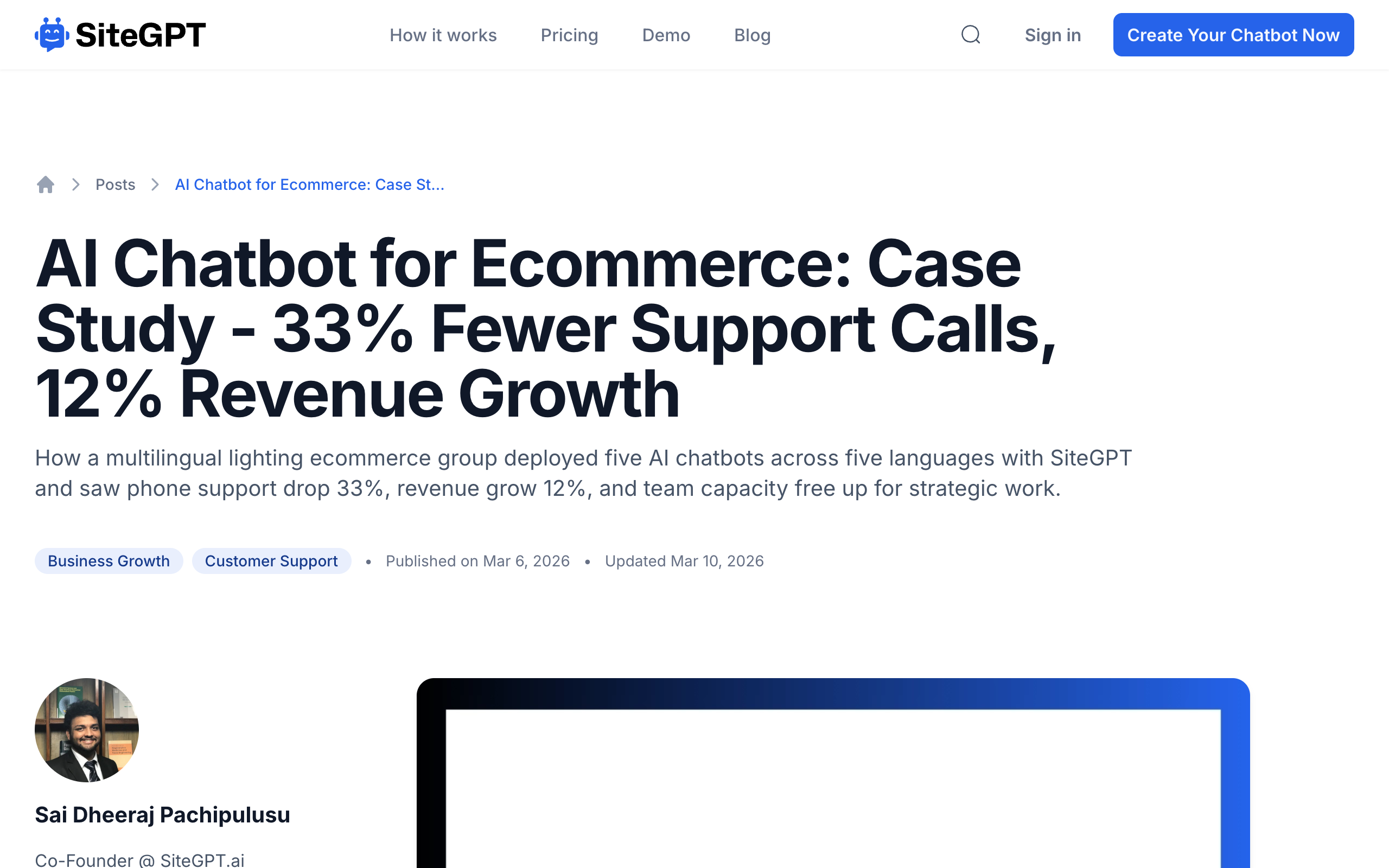
What it handles. Technical specifications, compatibility ("does this driver work with these LED strips"), and installation guidance. These are exactly the questions that used to arrive by phone, because a spec sheet is hard to search.
The conversation pattern. The bot pulls the numbers off the product page, states the compatibility rule, and links the page so the shopper can check it.
Shopper: Kann ich diesen Treiber mit 10 Metern eures 24V-Streifens verwenden? Bot: Der Treiber liefert 100 W bei 24 V. Zehn Meter des Streifens ziehen 96 W, also passt es, mit wenig Reserve. Für mehr als 10 Meter empfehlen wir zwei Treiber. Quelle: Produktseite, Abschnitt "Technische Daten".
Published outcome. Phone calls fell by about 33%, and revenue grew 12% year over year. The client says every improvement they proposed was live within 24 hours, and describes the five bots as "five new virtual colleagues who work 24/7."
The pattern to copy. Run one bot per language store, each trained on its own translated content, instead of one bot translating on the fly. Precise numbers are what make technical pre-sale support trustworthy, and precise numbers come from the source content. Multilingual customer service covers the rest of the setup.
3. CBS Bahamas on SiteGPT: compatibility questions and recovered sales
CBS Bahamas is the largest home improvement retailer in The Bahamas. It sells plumbing, electrical, paint, tools, and building materials online and in stores, and runs a SiteGPT chatbot on its site. Disclosure: SiteGPT customer, numbers from the SiteGPT retail case study.
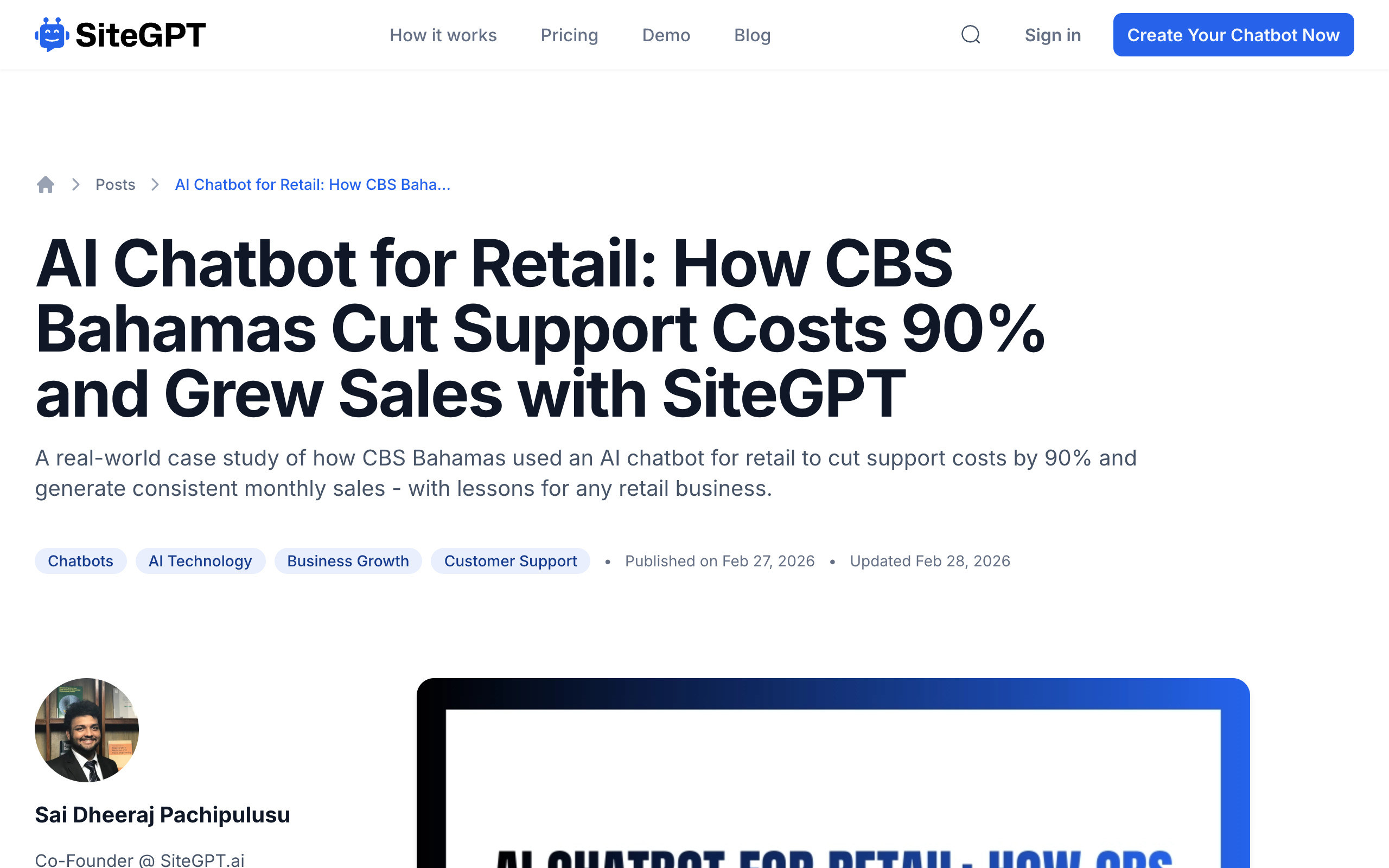
What it handles. Product compatibility, installation guidance, product recommendations, and technical questions, at hours when the store is closed.
The conversation pattern. A shopper who was about to leave over an unanswered question gets the answer and a link to the product. The conversation log then shows the sale that would otherwise have been lost.
Shopper: Do you have a fitting to connect 3/4 PVC to 1/2 copper? Bot: Yes. You need a 3/4-inch PVC to 1/2-inch copper transition adapter. We stock two: a push-fit version (no soldering) and a threaded version. For a quick repair the push-fit is easier. Here is the product page for each.
Published outcome. Monthly support cost fell from $5,000 to $500, a 90% cut, and CBS Bahamas credits the chatbot with about $10,000 in monthly sales. Brent Burrows II, Co-Founder of Starfish Web Ventures, the digital partner behind CBS Bahamas' online presence, says: "The conversations speak for themselves, the positive feedback from the customers go a long way, and the sales both (made & recovered) speak for themselves."
The pattern to copy. Read the transcripts weekly for the phrase "do you have." Each one is either a sale the bot closed or a product page that needs better content.
How do ecommerce chatbots recommend products?
By turning a described need into a short list from the catalog, as examples 4-7 show. Recommendation bots answer "what should I buy" instead of "does this fit." They need catalog access, and the best ones are honest about the edges of that catalog. The four examples here range from a custom assistant over hundreds of millions of products to a retailer living inside someone else's assistant.
4. Amazon Rufus: catalog-grounded recommendations at scale
Amazon launched Rufus in 2024 as a shopping assistant trained on its product catalog, customer reviews, and web content. Shoppers ask in plain language ("what should I consider when buying a running headlamp") and get conversational answers with product recommendations from the catalog.
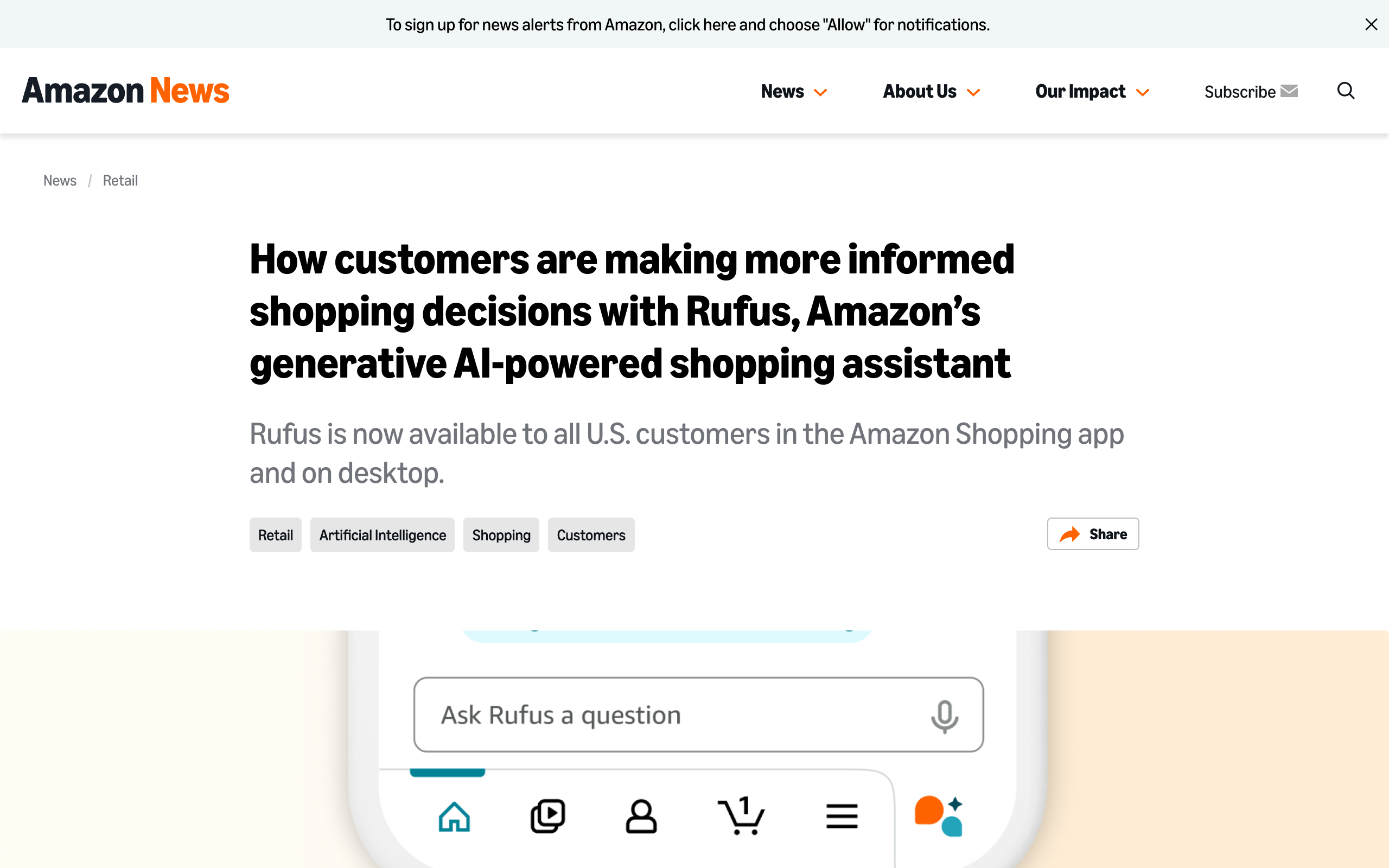
What it handles. Comparison questions across products, "is this good for" questions answered from reviews, and recommendations from a described need.
The conversation pattern. The bot restates the shopper's constraints, proposes two or three products with a reason for each, and offers to narrow the list further.
Shopper: I need a laptop stand for a 16-inch MacBook that folds flat for travel. Bot: Two things matter here: a 16-inch laptop weighs about 2.1 kg, so look for stands rated 4 kg or more, and folding flat usually means an aluminum two-hinge design. Reviewers rate these three highly for both. Want the lightest, the cheapest, or the most adjustable?
Published outcome. On its third-quarter 2025 earnings call, Amazon said 250 million shoppers had used Rufus that year, with monthly active users up 140% and interactions up 210% year over year. It estimated Rufus would add roughly $10 billion in annualized sales (Fortune). A later Modern Retail report put 2025 usage at 300 million customers, with monthly active users up 115% year over year and nearly $12 billion in incremental annualized sales.
The pattern to copy. Ground recommendations in reviews as well as specs. "Reviewers who bought this for X say Y" persuades more than any spec, and most stores already have that content and never surface it in chat.
5. Walmart Sparky: basket building from a natural-language goal
Walmart launched Sparky in June 2025 and now runs it across its website, app, and stores. Its standout job is basket building: a shopper states a goal and Sparky assembles the cart.
What it handles. Multi-item goals ("a week of high-protein dinners"), recipe-to-cart conversion, and duplicate avoidance based on past purchases.
The conversation pattern. The shopper states a goal and the bot builds the cart. In Walmart's own example, a customer asks for a week of healthy, high-protein meals, and Sparky returns recipes and meal kits the customer can add with one click. It also spots ingredients the customer already bought, so they are not duplicated.
Published outcome. On its second-quarter earnings call on August 20, 2026, Walmart said the number of Sparky users was up 70% from a year earlier and that shoppers who use it spend 40% more per order (Digital Commerce 360; Benzinga).
The pattern to copy. Let the shopper add everything in one click. A recommendation that makes the shopper open a link, add the item, then come back leaks at every step. Bundles, kits, and "add all" turn a good recommendation into a bigger basket.
6. Zalando Assistant: discovery in the shopper's own words
Zalando announced its ChatGPT-powered fashion assistant in April 2023 and launched a beta in Germany, Austria, the UK, and Ireland, in English and German. Shoppers describe what they want in their own words or in fashion terms, get relevant products, and refine the results in conversation (Zalando corporate release).
What it handles. Vague, contextual queries that keyword search cannot parse: "something for a wedding in Sicily in July that is not a suit."
The conversation pattern. The bot proposes a set, the shopper reacts ("less formal," "in green," "under 150"), and each turn narrows the results without starting over.
Published outcome. Zalando has not published usage or conversion figures for the assistant, so none are reported here.
The pattern to copy. Design for the second and third messages. Most shoppers cannot say what they want in one query, so the bot does its real work as it refines the results.
7. Sephora in ChatGPT: the retailer inside the assistant
On March 24, 2026, Sephora launched a Sephora app inside ChatGPT, piloting in the United States. Shoppers get product recommendations in plain language, connect their Beauty Insider loyalty account to unlock benefits, and can get a skin analysis from a selfie. Checkout currently redirects to the Sephora site, with in-app payment planned (Sephora newsroom).
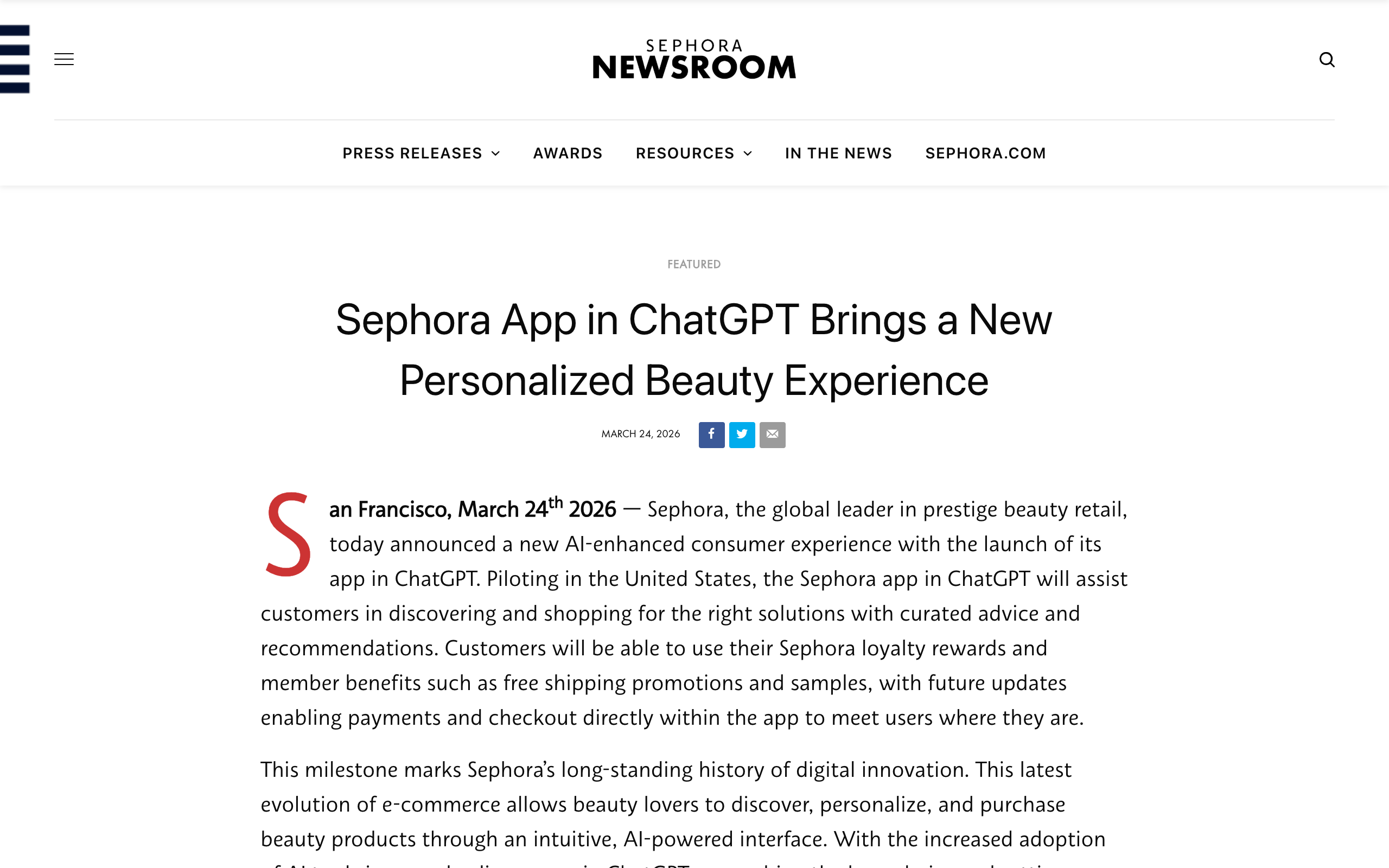
What it handles. Recommendations from a described skin type or goal, loyalty-aware offers, and a handoff to the site to buy.
The conversation pattern. The retailer does not own the assistant. It publishes into one to meet the shopper there, and the sale happens at the handoff back to its own site.
Published outcome. None published at launch. The app is a pilot.
The pattern to copy. Make your store's content available to the AI assistants shoppers already use. For a mid-size store, that means a chatbot trained on your content that tools like Claude can also reach through the SiteGPT MCP server. A shopper then gets the same answers inside an assistant as on your site. The SiteGPT agents page covers what an assistant can operate end to end, and the AI agents hub covers the wider field.
Can a chatbot handle orders, returns, and refunds?
Yes, if it is connected to order data, as example 8 shows. Post-purchase is where chatbots first proved themselves in ecommerce, and where the volume is: order status, returns, refunds, and payment questions. It needs order data as well as content, and it has the most public lessons.
8. Klarna's AI assistant: post-purchase service, and the lesson about humans
Klarna launched its OpenAI-powered assistant globally in early 2024 to handle customer service for its payments and shopping app: refunds, returns, payment issues, cancellations, disputes, and invoice questions.
What it handles. The full post-purchase queue for a payments company, in 23 markets and more than 35 languages.
The conversation pattern. The bot identifies the order, applies the policy, takes the action (checks a refund, sends a return label, moves a payment date), and confirms it in writing.
Shopper: I returned the shoes a week ago and my payment is still due. Bot: I can see the return was received on the 3rd. The refund is being processed by the store, which usually takes 5-7 business days. I have paused your payment due on the 12th until the refund posts, so you will not be charged. You will get an email when it clears.
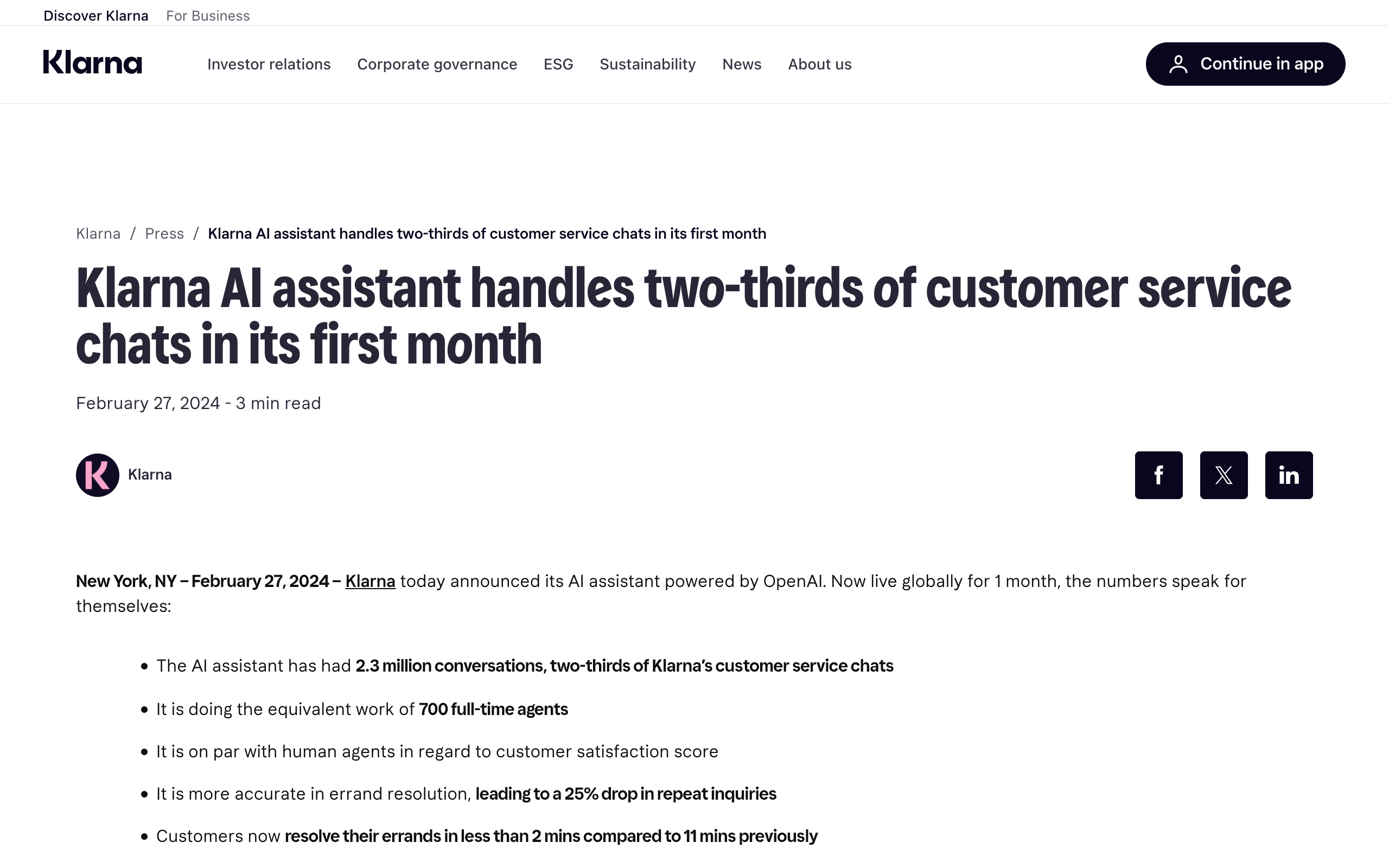
Published outcome. In its first month, the assistant handled 2.3 million conversations, two-thirds of Klarna's customer service chats, doing the equivalent work of 700 full-time agents. Customer satisfaction matched human agents, repeat inquiries dropped 25%, and resolution time fell to under 2 minutes from 11 minutes. Klarna estimated a $40 million profit improvement in 2024 (Klarna press release, February 27, 2024).
The lesson. In May 2025, Klarna said it would hire human customer service back. CEO Sebastian Siemiatkowski said cost "seems to have been a too predominant evaluation factor," which lowered quality, and that "there will be always a human if you want." A spokesperson summed up the new position: "AI solves the easy stuff, our experts handle the moments that matter." The assistant still handles most chats (CX Dive).
2.3M
Conversations handled in month one
2/3
Share of all customer service chats
25%
Drop in repeat inquiries
< 2 min
Resolution time, down from 11 minutes
The pattern to copy. Automate the resolvable majority and make the human route obvious for the rest. Klarna's bot answered well enough. The trouble came when it stood between an upset customer and a person. Which platforms handle that handoff well is the subject of the best AI chatbots with human handoff.
Can a chatbot reduce cart abandonment?
It can answer the questions that cause it, as example 9 shows. No public figure measures how many carts that recovers.
9. The checkout objection handler: a pattern for the 70% who leave
This entry is a pattern rather than a single brand. It is the most widely deployed ecommerce chatbot job and the least publicly measured. It starts from Baymard Institute's research: 70.22% of carts get abandoned. Among shoppers who were not just browsing, the top reasons are extra costs (40%), delivery too slow (20%), required account creation (18%), a poor returns policy (13%), and not seeing the total cost upfront (12%).
Three of those five are questions. Each one already has an answer on the store's shipping or returns page, and that is the page a content-trained bot reads.
What it handles. "How much is shipping to Portugal," "when will it arrive if I order today," "can I return sale items," "is the price including VAT."
The conversation pattern. The bot answers the question from the policy, states the number, and offers the step that clears the objection.
Shopper: What does delivery to Ireland cost and how long does it take? Bot: Standard delivery to Ireland is €6.95 and takes 3-5 working days; it is free on orders over €80. Your cart is at €72, so adding €8 or more makes delivery free. Express is €14.95 for next working day. Source: Shipping policy.
Published outcome. There is no reliable public figure for the share of abandoned carts a chatbot recovers, and the vendor statistics that circulate are not independently sourced, so none are cited here. The cause is easy to verify, though. Baymard's reasons are policy questions, and you can measure the effect in your own funnel by comparing checkout completion for sessions with a chat and without one.
The pattern to copy. Put the bot's trigger on the cart and checkout pages as well as the home page. Keep shipping and returns policies in plain, current text on the site, because the bot can only be as precise as the page it reads. CBS Bahamas's "sales recovered" is this pattern with the numbers attached. The order status and returns template is a ready-made prompt for the policy half of it.
How does a chatbot capture leads?
By answering first, then asking for the one detail it needs to follow up, as example 10 shows.
10. The quote and stock-alert capture bot: lead capture when you cannot sell in one click
Not every ecommerce sale ends in a checkout. B2B stores sell by quote, made-to-order stores need specifications first, and every store runs out of something. In each case the goal is a captured lead with the details attached.
What it handles. Bulk pricing requests, custom orders, out-of-stock alerts, and "do you ship to" questions from markets the store does not serve yet.
The conversation pattern. The bot answers what it can first: lead time, the minimum order, or the item that is in stock. Then it asks for the one detail it needs to follow up. Then it confirms what happens next.
Shopper: We need 400 of the grey ones for an office fit-out in November. Bot: 400 units is above our web checkout limit, so this goes through a quote. Lead time on that colour is currently 4 weeks, which fits November. If you share an email, a sales rep will send a quote with volume pricing within one business day. Would you like the datasheet in the meantime?
Published outcome. You measure this in leads captured and follow-ups booked, not revenue, and you collect those numbers yourself. Three metrics matter: capture rate, qualification rate, and meetings booked. The conversational marketing playbook covers all three.
The pattern to copy. Ask for contact details after giving the shopper something useful, never before.
The ten examples side by side
| # | Example | Job | Answers from | Channel | Published outcome |
|---|---|---|---|---|---|
| 1 | Lowe's Mylow | Pre-sale, project Q&A | Product catalog, how-to content, order data | Web, app, in-store | 25M questions; users convert at 3x |
| 2 | Lighting retailer (SiteGPT) | Pre-sale, technical | Product pages per language store | Website widget | 33% fewer calls; +12% revenue |
| 3 | CBS Bahamas (SiteGPT) | Pre-sale, compatibility | Product and installation content | Website widget | $5,000 to $500 monthly support cost; ~$10,000 monthly attributed sales |
| 4 | Amazon Rufus | Recommendations | Catalog, reviews, web | Amazon app and site | 250M shoppers; interactions +210% |
| 5 | Walmart Sparky | Basket building | Catalog, purchase history | Web, app, stores | Users +70%; +40% spend per order |
| 6 | Zalando Assistant | Discovery | Fashion catalog | Web and app | Not published |
| 7 | Sephora in ChatGPT | Recommendations | Sephora catalog, loyalty data | ChatGPT app | Not published (pilot) |
| 8 | Klarna AI assistant | Post-purchase service | Order and payment data | Klarna app | 2.3M chats month one; 25% fewer repeat inquiries |
| 9 | Checkout objection handler | Objections | Shipping and returns policies | Cart and checkout pages | Measure in your own funnel |
| 10 | Quote and stock-alert bot | Lead capture | Product content plus a capture flow | Product pages | Leads and bookings, not checkouts |
The examples split by what the bot answers from. Most stores end up needing both halves, so start with the half your queue is heavier in.
Content-trained (examples 2, 3, 6, 9, 10)
- Answers from product pages, policies, guides, and help articles
- Strongest on pre-sale, compatibility, and policy questions
- Works on any platform, including custom and headless stores
- Cannot look up a specific order unless integrated
- Set up in hours, and content quality sets the ceiling
Native commerce (examples 1, 4, 5, 8)
- Connected to catalog, inventory, orders, and payments
- Strongest on order status, returns, and basket actions
- Tied to one platform, or built as a custom project
- Can take actions: refunds, label generation, add to cart
- Set up in weeks, or as an engineering program
Which chatbot pattern fits your store?
The one that matches where your contact volume is heaviest.
Where is your contact volume heaviest?
- If Pre-sale questions about fit, compatibility, or specifications→Start with pattern 1-3. Put a content-trained bot on your product pages and guides, one per language store if you sell in several.
- If Post-purchase: where is my order, returns, refunds→Start with pattern 8. You need order data, so pick a native helpdesk for your platform, or pair one with a content bot.
- If Shoppers add to cart and leave→Start with pattern 9. Trigger the bot on cart and checkout pages and keep shipping and returns policies current.
Can a shopper complete the purchase in one click?
- If Yes, standard retail checkout→Once the pre-sale bot is live, the recommendation patterns 4-7 are worth it: bundles, add-all, and review-grounded suggestions.
- If No: quotes, bulk, made-to-order, or frequent stock-outs→Pattern 10. The bot's job is a captured lead with context, and the metric is bookings, not checkouts.
What happens when the bot cannot answer?
- If There is no plan yet→Fix this before launch. Klarna's lesson: an obvious route to a human is part of the product. SiteGPT builds escalation with a transcript into every plan.
- If A human is one click away with the transcript→You are ready. Read the handoff reasons weekly. They are your content backlog.
| Scenario | Best pick | Why |
|---|---|---|
| Parts, components, or supplies with compatibility rules | Pattern 2-3: technical pre-sale Q&A | The question is 'does this work with that,' and the answer is on the spec sheet. CBS Bahamas and the lighting retailer are this exact case. |
| Home, garden, or DIY with project-based shopping | Pattern 1: project-first advice | Lowe's converts by answering the project, then listing what it needs. |
| Fashion or beauty with subjective choice | Pattern 6-7: refine by conversation | The first query is never precise. Design for the second and third turns. |
| Grocery, household, or replenishment | Pattern 5: basket building from a stated goal | Walmart's 40% higher spend per order comes from assembling the basket, not from answering one question. |
| Marketplace or very large catalog | Pattern 4: review-grounded recommendations | Reviews are the content that makes a recommendation credible at scale. |
| Cross-border store with several language sites | Pattern 2: one bot per language store | Precision comes from translated source content, not from live translation. |
| High cart abandonment, policy-heavy checkout | Pattern 9: checkout objection handler | Baymard's top reasons are shipping cost, delivery time, and returns policy. Those are questions. |
| B2B, wholesale, or made-to-order | Pattern 10: quote capture | The conversion is a lead with specifications attached, delivered to a rep within a day. |
| High post-purchase volume on Shopify | Pattern 8 via a native app, paired with a content bot | Order lookups need order data. See the Shopify guide for which apps do it natively. |
| Payments, subscriptions, or anything with disputes | Pattern 8 with a fast human route | Klarna automated two-thirds of chats and still hired humans back for the moments that matter. |
A 90% cut in support cost, from one of the examples above
CBS Bahamas reports monthly support cost falling from $5,000 to $500, or $54,000 a year, alongside roughly $10,000 a month in attributed sales. SiteGPT's Starter plan is $59 monthly, or $39 per month billed annually. Your numbers will differ. Either way, the cost of running the bot is small next to both the money it saves and the sales it brings in.
What do successful ecommerce chatbots have in common?
Four traits, shared by all ten examples. Use them as the checklist for your first bot.
- The bot answers from something real. Catalog, reviews, spec sheets, policies, order data. None of the examples asks a general-purpose model to guess. When a chatbot does guess, the results are public and expensive: a Chevrolet dealership's bot agreed to sell a Tahoe for $1 in 2023, The fix for that class of problem is grounding the bot in your own content through retrieval-augmented generation. The guardrails around it are covered in how to stop a customer service chatbot hallucinating.
- The pattern matches the job. DIY stores answer the project first. Fashion stores refine the choice over several messages. Grocery stores build the basket from a stated goal. Payment and subscription bots resolve the issue and route to a person fast when needed. A single generic "how can I help" flow does none of them well.
- There is a number to watch. Conversion for users versus non-users, contact volume on the channel being relieved, spend per order, repeat inquiries. The companies with results chose the metric before launch.
- A person is reachable. Klarna made this point loudest, but every example here follows it: automate the questions the bot can resolve, and make the route to a human fast and obvious for the rest.
For a store that sells through its own website, the shortest path to traits one and four is a content-trained chatbot with built-in escalation. SiteGPT trains on 12+ content sources, including the website, help center, and product files. It keeps that content synced, answers in 95+ languages, and escalates to a person with the transcript on every plan.
Where your queue is post-purchase heavy on Shopify, pair it with a native app, as the Shopify chatbot guide lays out. If Tidio's catalogue sync is the deciding factor, SiteGPT vs Tidio covers when it wins. On a WooCommerce store, check the WordPress chatbot rankings first, because several popular chatbot plugins have not been updated in over a year.
Frequently asked questions
Basics
What is an ecommerce chatbot? An ecommerce chatbot is a conversational assistant on a store's website, app, or messaging channel that answers shopper questions and handles service tasks without a human agent. In 2026 most are AI chatbots trained on the store's own content (product pages, policies, help articles), and on native platforms they also read live order data. They handle pre-sale questions, recommendations, order status, returns, and lead capture, and they hand the chat to a person when a question falls outside what they can answer.
What are the most common ecommerce chatbot use cases? Five jobs cover almost every deployment: pre-sale product questions (compatibility, sizing, specifications), recommendations and discovery, post-purchase service (order status, returns, payments), checkout objections (shipping cost, returns policy, total cost), and lead capture for stores that sell through quotes or run out of stock. This page groups its examples by those five jobs.
What is the difference between a content-trained chatbot and a native commerce chatbot? A content-trained chatbot answers from what the store publishes: product pages, policies, sizing guides, help articles. It is strongest on pre-sale and policy questions, and it works on any platform. A native commerce chatbot connects to the store's order and inventory data, so it can look up a specific order or check live stock. Many stores run both: a content-trained bot for the pre-sale half of the queue and a native helpdesk for post-purchase automation.
Results
Do ecommerce chatbots actually increase sales? The companies that publish numbers say yes, but the numbers are their own. Walmart said on its August 2026 earnings call that Sparky users spend 40% more per order. Lowe's says Mylow users convert three times as often as non-users. Amazon estimated Rufus would add roughly $10 billion in annualized sales. A SiteGPT ecommerce customer reported 12% revenue growth alongside a 33% drop in phone calls. None of these are controlled experiments, so read them as direction, not a guaranteed lift.
How do ecommerce chatbots reduce cart abandonment? They answer the questions that cause abandonment while the shopper is still on the page. Baymard Institute puts the average cart abandonment rate at 70.22% and names extra costs (40%), slow delivery (20%), required account creation (18%), a poor returns policy (13%), and not seeing the total cost upfront (12%) among the top reasons. A bot that answers "what does shipping cost to Ireland" or "can I return sale items" from the store's own policy removes the reason to leave. There is no reliable public figure for how much of the 70% a bot recovers, so measure it in your own funnel.
What went wrong with Klarna's AI customer service? Nothing in the numbers, and something in the experience. In February 2024 Klarna reported its assistant handled 2.3 million conversations, two-thirds of all chats, in its first month. In May 2025 it said it would hire human agents back because, in its CEO's words, cost had been too dominant a factor and quality had suffered. The assistant still handles most chats. The lesson is that an ecommerce chatbot needs a fast, obvious route to a person for the moments that matter, not that the chatbot failed.
How do you measure whether an ecommerce chatbot is working? Track four numbers. Resolution rate: the share of conversations that end without a human. Conversion rate for shoppers who used the bot versus those who did not, the number Lowe's and Walmart report. Contact volume on the channels the bot was meant to relieve, the number the SiteGPT lighting retailer reports. And handoff rate with reasons, because the questions the bot cannot answer are the content you have not written yet.
Platforms and setup
Can an ecommerce chatbot check order status? Only if it is connected to the order system. A chatbot trained on website content can explain the shipping policy and where to find a tracking number, but it cannot look up order #48213 unless the platform reads the store's order data. Decide which job matters more for your queue, then pick the platform, or the pair of platforms, that covers it.
Which ecommerce chatbot is best for Shopify? It depends on which half of the queue you are automating. For post-purchase questions that need live order data, a native Shopify app like Tidio or Gorgias fits better. For pre-sale and policy questions answered from your content, a content-trained bot like SiteGPT works on Shopify and every other platform, and you can pair it with a native helpdesk. The full comparison is in the Shopify chatbot guide.
Do ecommerce chatbots work in multiple languages? Modern AI chatbots do. Klarna's assistant launched in 23 markets and more than 35 languages. A SiteGPT lighting retailer runs five bots for five language stores. SiteGPT supports 95+ languages, and a bot trained on English content can answer a shopper writing in Spanish or German, though stores with translated content get sharper answers by connecting each language version.
How much does an ecommerce chatbot cost? Content-trained chatbots for small and mid-size stores start at roughly $40 to $60 per month. SiteGPT's Starter plan is $59 monthly, or $39 per month billed annually, with a 7-day free trial on every plan. Native commerce helpdesks price per conversation or per seat, and enterprise assistants like the ones Amazon, Walmart, and Lowe's built are custom projects. Weigh the cost against the two things a bot changes: support hours and conversion rate.
Risk
Can a chatbot hallucinate a discount or a policy? Yes, and it has happened in public. A Chevrolet dealership's chatbot agreed to sell a Tahoe for $1 in December 2023 after a shopper told it to agree with everything. The protection is grounding: answer only from the store's own content, decline when the content does not cover the question, keep prices and policies in the content rather than in the bot's instructions, and send anything binding, like a price match or a refund, to a person.
Sources
- Baymard Institute, cart abandonment rate statistics: the 70.22% average across 50 studies and the ranked reasons for abandonment
- Lowe's press release, March 5, 2025: Mylow launch, built with OpenAI
- PYMNTS, Lowe's AI assistant turns questions into sales (2026): 25 million questions, 3x conversion for users, and the monthly question volume
- SiteGPT ecommerce case study: the lighting retailer's 33% call reduction and 12% revenue growth across five languages
- SiteGPT retail case study: CBS Bahamas support cost, attributed sales, and the Starfish Web Ventures quote
- Fortune on Amazon's Q3 2025 earnings call: 250 million Rufus shoppers, monthly active users up 140%, interactions up 210%, and the $10 billion annualized sales estimate
- Modern Retail: the later update of 300 million 2025 users, monthly active users up 115%, and nearly $12 billion in incremental annualized sales
- Digital Commerce 360 and Benzinga on Walmart's Q2 earnings call, August 20, 2026: Sparky user growth and spend per order
- Zalando corporate release, April 19, 2023: assistant launch, markets, and languages
- Sephora newsroom, March 24, 2026: the Sephora app in ChatGPT
- Klarna press release, February 27, 2024: first-month results
- CX Dive, May 9, 2025: Klarna's reinvestment in human customer service and the CEO's comments
- GM Authority, December 2023: the Chevrolet of Watsonville chatbot incident