


The best AI chatbot with human handoff is the one you rarely need to trigger. A content-trained bot should resolve most questions on its own. When it does escalate, the entire conversation must transfer to the agent so the customer never repeats themselves.
For the most sophisticated native AI-to-human escalation, Fin (formerly Intercom, now owned by Salesforce) and Zendesk lead. For high content-trained deflection plus native handoff at a price a small team can afford, SiteGPT is the best value. For a healthcare team, SiteGPT signs a HIPAA BAA on its custom-priced Enterprise plan only, and every platform here gates HIPAA to its top tier.
iShort answer
Almost every chatbot now has a "talk to a human" button, so compare handoff quality instead. Check whether the full conversation reaches the agent, whether escalation triggers at the right moment, and how many channels it covers. Most of all, check how much the bot resolves before it escalates. This guide compares 7 tools on those points.
If you are in a regulated industry, one more filter comes first and it eliminates most of this list. Every vendor here gates HIPAA to its top tier, but the gates sit at very different prices. A signed BAA also changes what the product lets you build. Start there.
Key takeaways
| Tool | Best for | Handoff strength |
|---|---|---|
| Fin (formerly Intercom) | Most sophisticated native escalation | Best-in-class (AI-decided, shared inbox) |
| Zendesk | Enterprise omnichannel workspace | Best-in-class (ticket + full context) |
| SiteGPT | Content-trained deflection at value (12+ sources, auto-sync) | Native, full transcript, visitor-requested |
| Tidio | SMB / e-commerce, easy setup | Solid (on-demand + AI-decided) |
| Crisp | Affordable flat-rate omnichannel | Solid (context attached) |
| Chatbase | Custom agent with its own Helpdesk | Solid (native Helpdesk + takeover, Standard+) |
| Ada | Enterprise resolution across channels | Strong (deep desk integrations) |
The four things that separate a good handoff from a frustrating one. This guide scores every tool on them.
Context transfer
Does the full conversation (ideally an AI summary) reach the agent, so the customer never repeats themselves?
Trigger intelligence
Does it escalate at the right moment, on demand and automatically, not just when a customer hunts for a button?
Channel coverage
Does handoff work across web, email, WhatsApp, social, and voice, with history that follows the conversation?
Deflection before escalation
How much does a content-trained bot resolve first? The best handoff is the one you rarely need.
Compliance gating
If patients or students can type regulated data into the chat, does the vendor sign a BAA or DPA, on which plan, and what does a covered workspace switch off?
80%
of common customer service issues will be resolved autonomously by AI agents by 2029, cutting support operating costs by 30% (Gartner). The more your bot deflects, the less your handoff has to carry.
Source: Gartner, March 2025What should you look for in a chatbot with human handoff?
Every tool has a handoff button. Six criteria separate a good escalation from a frustrating one, and you can use them on any tool.
- Context transfer. When the bot hands off, does the agent receive the full conversation history, ideally with an AI summary of what the customer wanted and what the bot already tried? If the agent has to ask the customer to start over, the handoff failed.
- Trigger intelligence. Escalation should happen at the right moment, even if the customer never finds the button. The strongest tools escalate on demand and automatically: when the AI detects frustration, a repeated failed answer, or a topic outside its knowledge.
- Channel coverage. Your customers arrive on the website widget, email, WhatsApp, Instagram, and sometimes voice. Handoff should work across every channel you support, with history that persists if the conversation moves between them. For teams whose main channel is WhatsApp, the platforms are compared separately in best WhatsApp AI chatbots.
- Agent notifications and routing. When a conversation escalates, the right agent or team needs to be alerted and assigned (via a shared inbox, Slack, email, or skills-based routing) so nothing sits unanswered.
- Deflection rate before escalation. This is the one most buyers overlook. A bot trained on your own content (a RAG bot) resolves the long tail of questions itself, so you escalate far less. Gartner predicts agentic AI will resolve 80% of common customer service issues without human intervention by 2029. How much of that a bot reaches depends on the breadth and freshness of what it learns from.
- Pricing model. Handoff and AI often sit behind specific tiers, and the model matters at scale: flat per-workspace, per-agent seat, or per-resolution. Check which plan unlocks the bot and live agent handoff, and model your real volume.
How does chatbot to human handoff work?
A handoff fires when a trigger condition is met, then transfers the conversation and its context to a human channel. The mechanics are the same across every tool in this guide, and only the sophistication of each step differs.
- Trigger. The customer asks for a person, clicks an escalation button, or the AI detects a failed answer or frustration.
- Context packaging. The tool bundles the transcript, contact details, and (on Fin and Zendesk) an AI summary, intent, and sentiment.
- Routing and notification. The conversation lands in a shared inbox, a ticket, or a connected tool like Slack or Zendesk, and the right team is alerted.
- Human takeover. An agent replies in the same thread, with the bot standing down so the customer never gets competing answers.
Is human handover the same as human handoff?
Yes. "Human handover", "agent handover", "live agent escalation", and "agent transfer" all name the same feature: the chatbot passing a conversation to a person. Vendors based in the UK and Europe tend to write "handover", US vendors "handoff", and documentation for the tools in this guide uses the terms interchangeably.
How were these chatbots evaluated?
Each tool was scored on the six criteria above. Two carry the most weight because customers feel them: how completely context reaches the agent, and how much the bot deflects before it escalates.
Every factual claim was checked against primary sources. Pricing and plan limits come from each vendor's official pricing page, and handoff behavior comes from official documentation. Ratings come from the G2 and Capterra review pages, with review counts.
Where a figure could not be confirmed first-party, it is labeled that way. SiteGPT's product facts are taken from its official pricing, security, and documentation pages. Fin, Zendesk, Tidio, and Chatbase pricing was re-checked in September 2026. Check each vendor's site for the latest.
What are the best AI chatbots with human handoff?
Each entry covers what the handoff does, pros and cons, pricing, third-party ratings, and who it fits best.
1. Fin (formerly Intercom): best-in-class native AI-to-human handoff
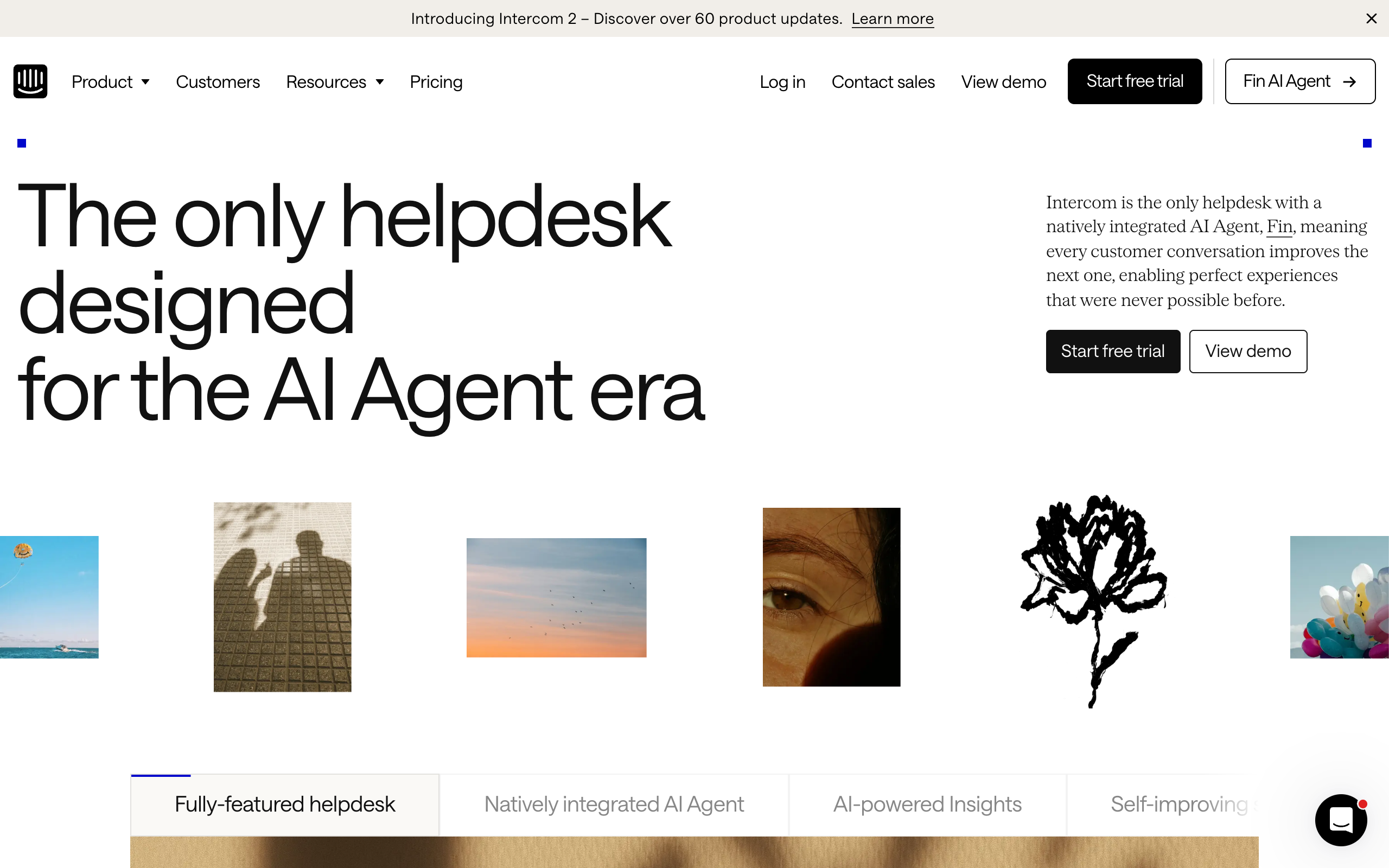
Fin sets the bar for native escalation. The company renamed itself from Intercom to Fin, and Salesforce closed its acquisition on 10 September 2026. Its AI agent and human agents work from the same shared inbox and customer record, so when Fin escalates, the conversation lands in an agent's normal workspace with the full thread and an AI-generated summary. The trade-off is cost and complexity.
Handoff features
- Context transfer: full history plus an AI summary of what the customer asked, what Fin tried, and why it escalated.
- Triggers: the full set: AI-decided (frustration or repeated loops), on-demand, deterministic rules, and natural-language escalation guidance.
- Channels: Messenger, email, voice, WhatsApp, SMS, Instagram, Facebook, and Slack, with history that persists across channels.
- Notifications: escalations route and assign into the shared Inbox with standard team routing.
- Deflection: Fin is a RAG agent trained on your help center. Fin cites customer results up to about 65% resolution (verify current figures on their site).
Pros
- Native AI-to-human handoff in one shared inbox, with full context and an AI summary
- AI-decided escalation triggers, not just an on-demand button
- Broad channel coverage including voice and WhatsApp
- Enterprise-grade compliance (SOC 2 Type II, GDPR, HIPAA via BAA)
Cons
- Costs stack: per-seat pricing plus $0.99 per outcome gets expensive at volume
- More platform to configure and learn than a focused bot
- Premium positioning, so the entry price is only the beginning
Pricing (billed annually):
| Plan | Price | Notes |
|---|---|---|
| Essential | $29/seat/mo | Entry tier ($39 billed monthly) |
| Advanced | $85/seat/mo | More automation ($99 billed monthly) |
| Expert | $132/seat/mo | Largest teams, HIPAA support ($139 billed monthly) |
| Fin AI agent | $0.99 per outcome | On top of seats |
Source: Fin pricing, checked September 2026.
4.5/5·G2(3,800) 4.5/5·Capterra(1,133)Best forTeams that want the most sophisticated native AI-to-human escalation and can absorb combined seat and per-outcome pricing.
2. Zendesk: best for enterprise omnichannel workspace
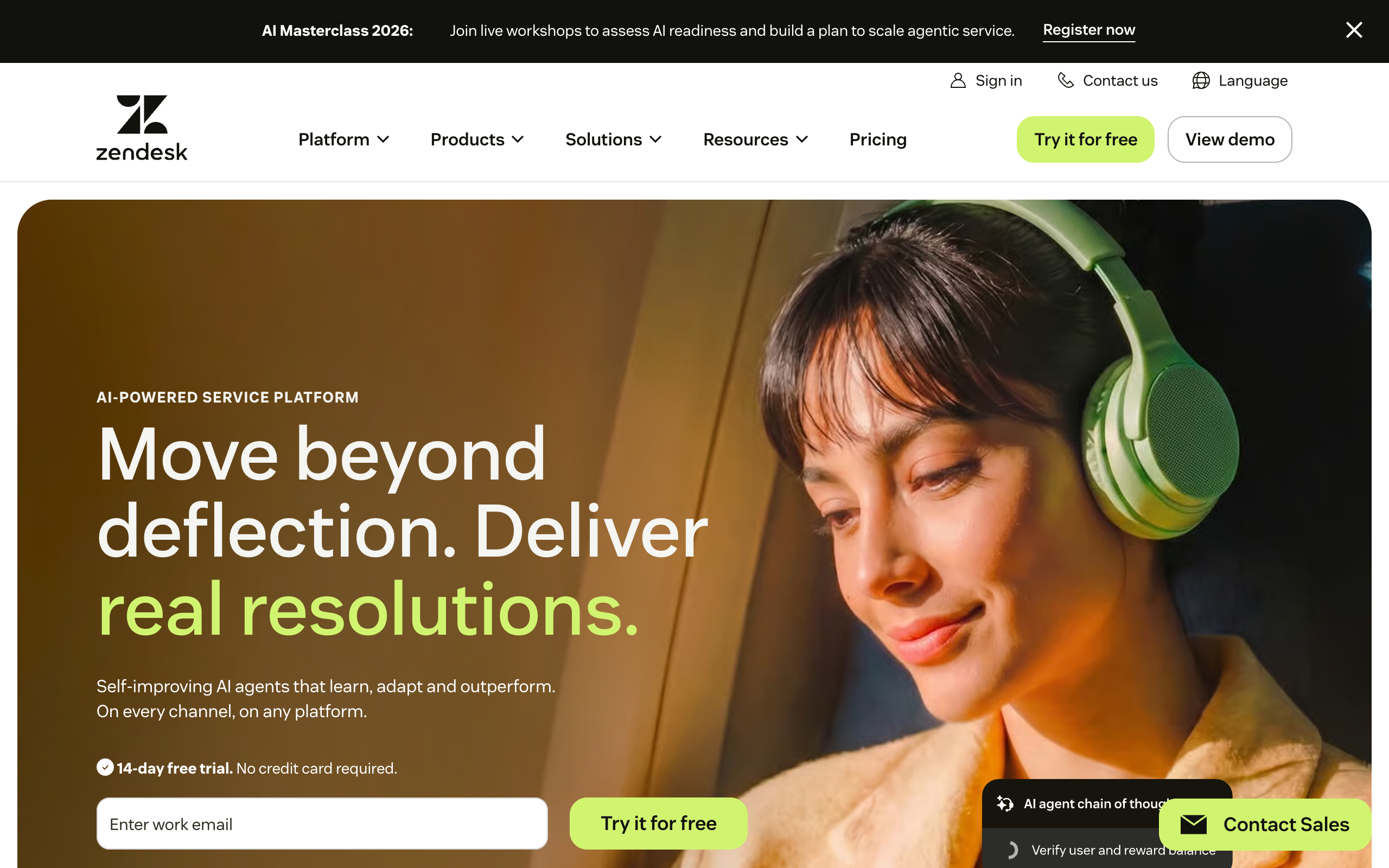
Zendesk is the mature incumbent. Its AI agent opens a ticket that converts into a regular Support ticket in the Agent Workspace on escalation. The human agent inherits the transcript, intent, sentiment, and full customer profile. Its handoff is as strong as Fin's. The cost is per-seat pricing and setup complexity.
Handoff features
- Context transfer: full transcript auto-attached, plus intent classification, sentiment, entities, ticket tags, and prior cross-channel history.
- Triggers: a default "transfer to agent" step, a "talk to a human" option, escalation blocks in the dialogue builder, or a custom API transfer with metadata.
- Channels: web widget, mobile SDKs, and social messaging, with voice AI agents (EAP) that hand off with transcript, AI summary, and intent.
- Notifications: routing driven by ticket fields (group, skills) into standard omnichannel/skills-based routing.
- Deflection: AI agents grounded in your help center, with RAG-style retrieval (reinforced by Zendesk's 2025 acquisition of Unleash).
Pros
- Mature, full-context AI-to-human handoff inside a proven agent workspace
- Deep routing, skills, and omnichannel coverage including voice
- Enterprise compliance (SOC 2 Type II, GDPR, and a BAA through the Advanced Compliance add-on on Suite Professional and above)
Cons
- Per-agent pricing adds up quickly for larger teams
- The autonomous AI Agents Advanced tier is priced per resolution and not published
- More setup and administration than a focused chatbot
Pricing (per agent/mo, billed annually):
| Plan | Price | Notes |
|---|---|---|
| Suite Team | $55/agent/mo | Entry tier |
| Suite Professional | $115/agent/mo | Advanced routing |
| Suite Enterprise | Custom | On request |
| Copilot add-on | $50/agent/mo | Optional |
AI Agents Advanced is priced per automated resolution. Source: Zendesk pricing.
4.3/5·G2(7,100) 4.4/5·Capterra(4,083)Best forMid-market and enterprise teams that need a mature omnichannel workspace with deep routing and full-context handoff, and can absorb per-seat pricing.
3. SiteGPT: best value for content-trained deflection plus native handoff
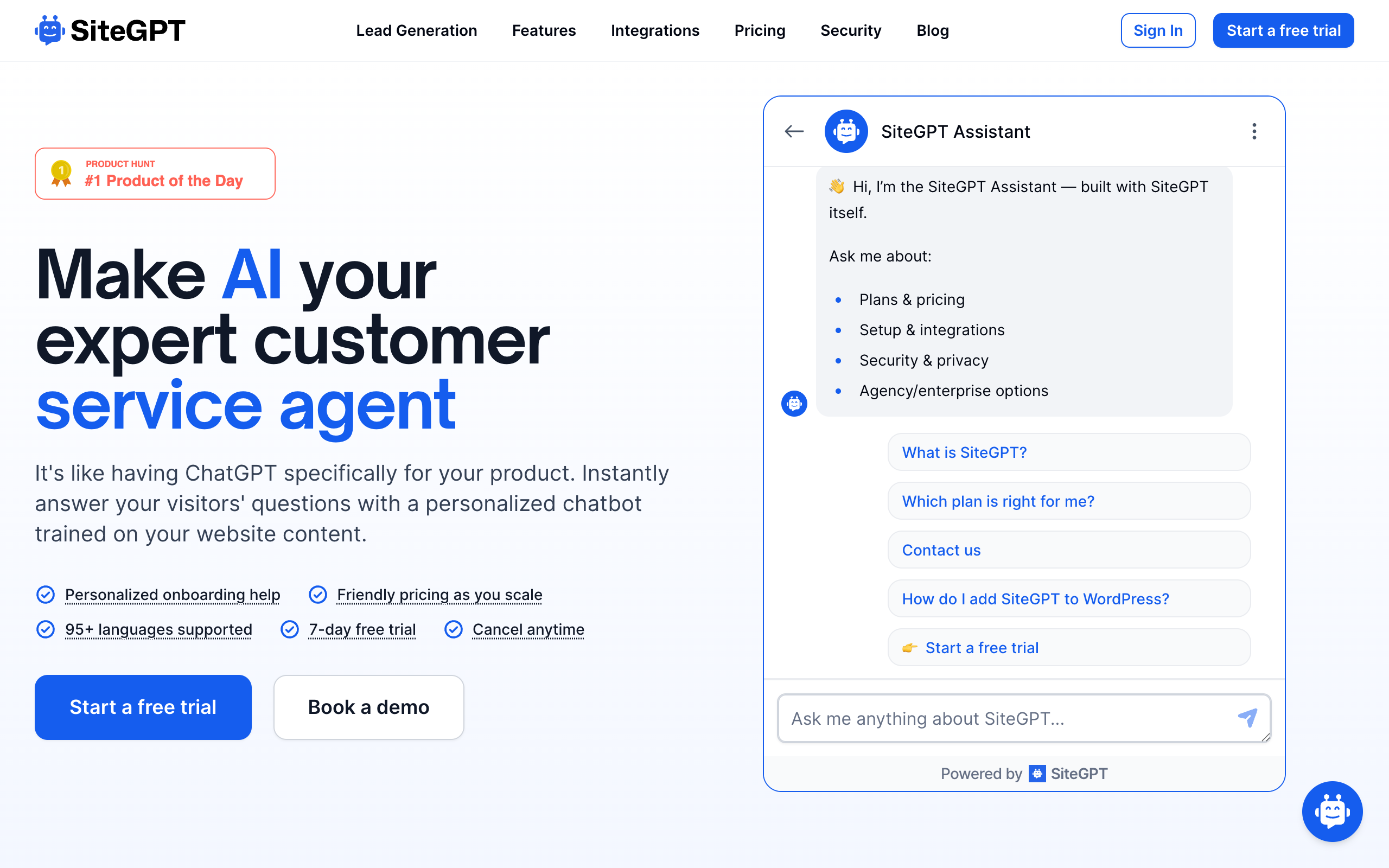
SiteGPT trains a chatbot on your own content so it resolves the bulk of questions before anyone needs a human. Its edge is the breadth and freshness of what it learns from. It reads 12+ content sources (websites, sitemaps, files, YouTube, GitHub, Notion, Google Drive, Dropbox, OneDrive, SharePoint, Box, and help centers). Auto-sync and auto-scan keep answers current as your docs change. Better, fresher answers mean higher deflection, so escalations are rarer. When a customer does want a human, SiteGPT's native escalate-to-a-human feature hands off the full conversation.
Its escalation logic is simpler than Fin's, which offers more trigger types and routing options. SiteGPT competes on value: content-trained deflection, a fully customizable and brandable widget, native handoff, and integration with the tools teams already use, at a flat price a small team can afford.
Handoff features
- Context transfer: full conversation transcript plus captured contact details and a link to the conversation are sent on every escalation.
- Triggers: the customer clicks an escalation button or asks for a person in chat.
- Channels and integrations: website widget as the escalation entry point. Slack, Crisp, Messenger, Google Chat, Freshdesk Messaging, and Zoho SalesIQ integrations start on Growth. Zendesk is Scale and above only and needs Zendesk Suite Professional or higher. The API starts on Growth and webhooks on Scale. WhatsApp is a paid add-on on any plan, at $59 a month billed monthly or $39 a month billed yearly. On WhatsApp a team member takes over from the dashboard, or from the WhatsApp Business app when the business keeps its app number. The setup is on the WhatsApp AI chatbot page. Intercom and HubSpot are not live.
- Notifications: the team is notified when a customer asks for a person, by email and in a Human Support view in the dashboard, plus Slack on Growth and above and webhooks on Scale and above. On Growth and above the same escalation also arrives as a push notification in the SiteGPT iOS app, answerable from the lock screen.
- Deflection: content-trained RAG across 12+ sources, with scheduled auto-sync (monthly on Growth, weekly plus daily auto-scan on Scale) so answers do not go stale.
SiteGPT is also SOC 2 Type II certified, with GDPR compliance and a signed HIPAA BAA available on Enterprise only (security). If HIPAA is a hard requirement, read what a covered workspace turns off before you scope the rollout.
Pros
- Deepest content integration in this list (12+ sources incl. cloud storage, GitHub, YouTube, help centers), so it deflects the long tail before escalation
- Auto-sync and auto-scan keep answers current automatically, which keeps deflection high over time
- Fully customizable and brandable widget, plus 95+ languages out of the box
- Native handoff transfers the full transcript and contact details, with no repeating for the customer
- Flat pricing with AI included: no per-resolution fees or daily caps
Cons
- Fewer escalation trigger and routing options than Fin or Zendesk
- Escalation is centered on the website widget, not a full omnichannel live-agent desk
- No native voice channel, and WhatsApp is a paid add-on that reads text only
- Third-party review volume is still early-stage
Pricing (annual billing saves up to 40%; 7-day free trial, credit card required):
| Plan | Billed yearly | Billed monthly | Messages/mo | Pages | Team |
|---|---|---|---|---|---|
| Starter | $39/mo ($468/yr) | $59/mo | 4,000 | 1,000 | 1 |
| Growth | $79/mo ($948/yr) | $129/mo | 10,000 | 10,000 | 4 |
| Scale | $259/mo ($3,108/yr) | $429/mo | 40,000 | 50,000 | 10 |
| Enterprise | Custom | Custom | Custom | 500,000 | up to 10,000 |
Human escalation is available on every plan, including Starter.
4/5·Capterra (early reviews)"SiteGPT makes it easy & intuitive to get your chatbot setup & working in no time at all - anyone can do it." Verified user on G2
"SiteGPT has proven to be an invaluable tool for providing swift and accurate responses to visitors' inquiries, with seamless integration with website content that effectively mirrors the website's tone and style." Verified user on Product Hunt
SiteGPT was also Product Hunt #1 Product of the Day. Independent review volume is still small compared with the incumbents.
Best forTeams that want to deflect most tickets with a content-trained bot (trained on everything they already have) and hand off with full context, without paying for an enterprise suite.
4. Tidio: best for SMB and e-commerce
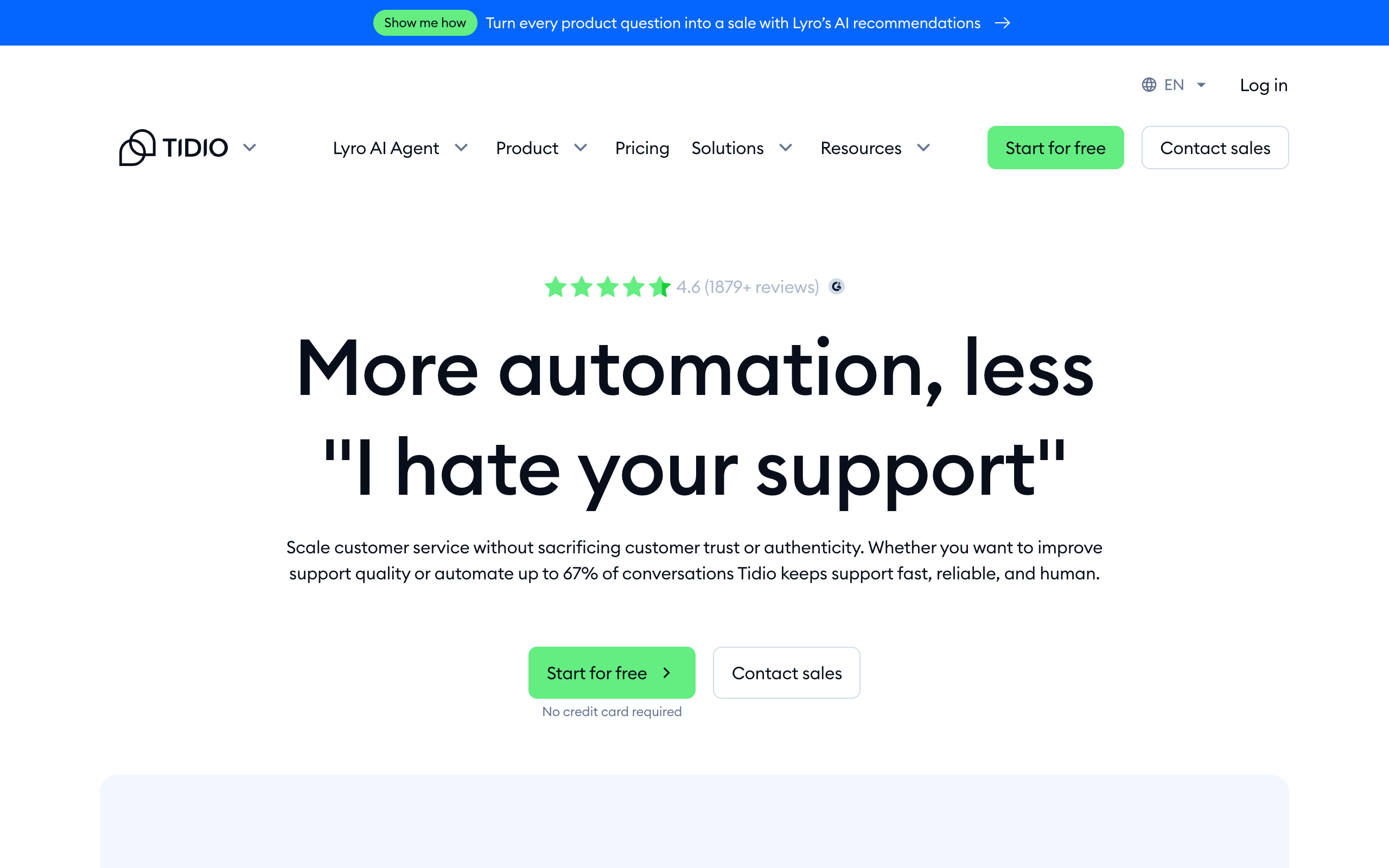
Tidio pairs an easy-to-deploy live chat with its Lyro AI agent. It is a strong fit for Shopify and WooCommerce stores. Lyro deflects well and escalates sensibly (on request, when it cannot answer, or by rule), making it one of the better SMB options for both deflection and handoff.
Handoff features
- Context transfer: conversation context is preserved (roughly the last few hours) so the human agent picks up with continuity.
- Triggers: on-demand, AI-decided (unanswered questions or detected frustration), and rule-based via audiences.
- Channels: website widget, Facebook Messenger, Instagram, WhatsApp, and email.
- Notifications: handed-off chats land in an Unassigned folder for any available agent (auto-assignment on higher tiers).
- Deflection: Lyro is a RAG agent that works only from content you provide, with an advertised up-to-67% resolution rate and a 50% resolution guarantee on higher tiers.
Pros
- Fast to deploy, and a strong fit for e-commerce (Shopify, WooCommerce)
- Lyro deflects well (up to 67% claimed) and escalates on demand or automatically
- Social and WhatsApp coverage plus a free plan to start
- Strong third-party ratings
Cons
- Conversation-based pricing can climb as traffic grows
- Lyro AI is a metered add-on that reviewers find confusing to price
- Does not sign a BAA (its terms say it is not a business associate)
- Less deep routing than Zendesk or Fin
Pricing (paid tiers billed annually):
| Plan | Price | Notes |
|---|---|---|
| Free | $0 | 50 conversations |
| Starter | $24.17/mo | Live chat + basics ($29 billed monthly) |
| Growth | from $49.17/mo | Advanced analytics (from $59 billed monthly) |
| Plus | from $300/mo | Plus usage |
| Premium | Custom | Guaranteed Lyro resolution rate |
| Lyro AI add-on | from $32.50/mo | 50 AI conversations ($39 billed monthly) |
Starter plus Lyro, the cheapest way to get the AI agent and handoff together, is about $57/mo on annual billing. Source: Tidio pricing, checked September 2026.
4.6/5·G2(1,880) 4.7/5·Capterra(590)Best forSmall and mid-size e-commerce teams that want easy setup, social and WhatsApp coverage, and solid AI deflection with handoff.
For what the handoff looks like at ecommerce scale, including Klarna's decision to reinvest in human agents after automating two-thirds of its chats, see ecommerce chatbot examples.
5. Crisp: best for affordable flat-rate omnichannel
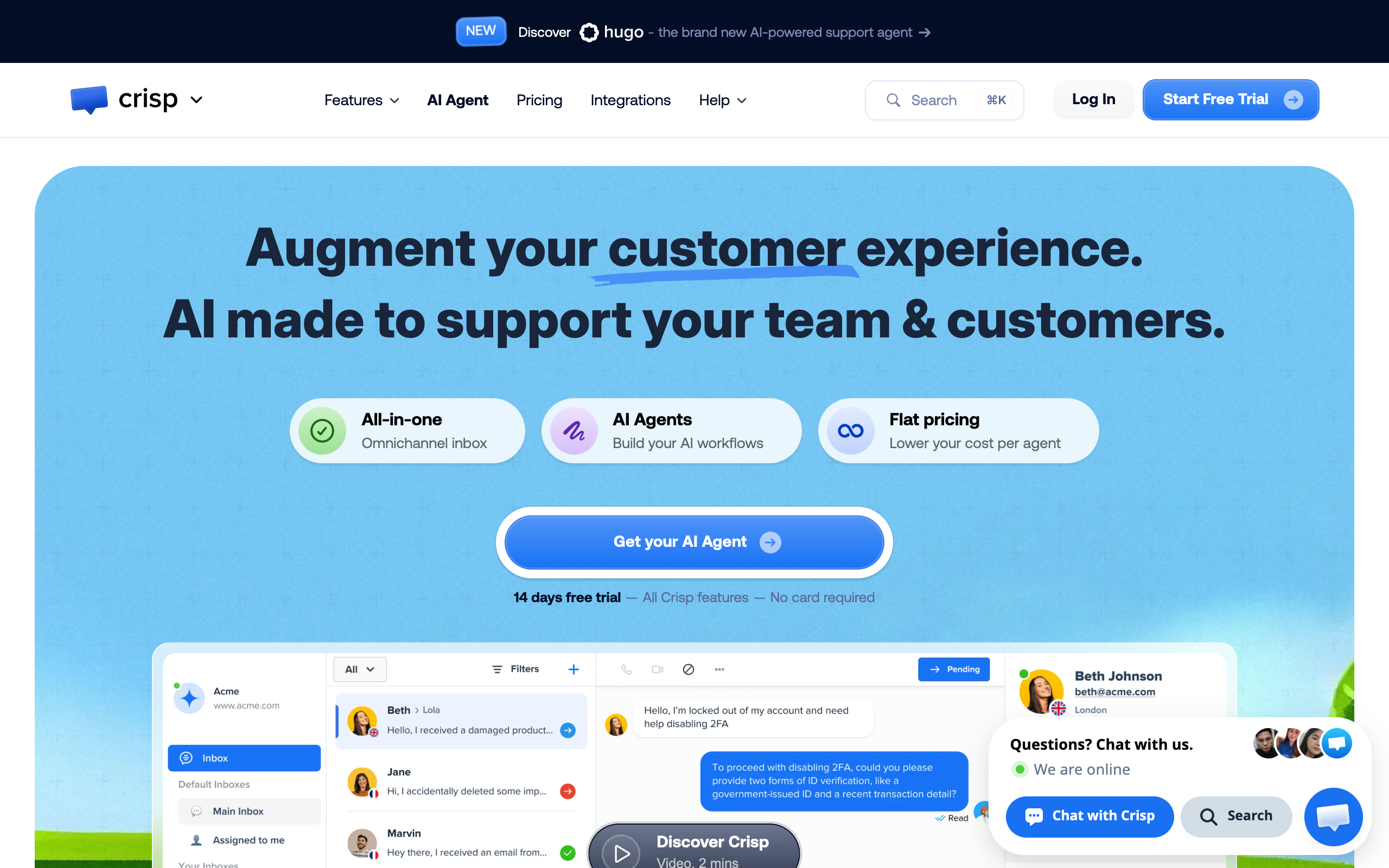
Crisp is a multi-channel shared inbox first, with a content-trained AI agent (Hugo) layered on top. Its flat per-workspace pricing is attractive for startups, and Hugo hands off to a human with context attached. The main caveat is compliance: Crisp's own docs state it has not completed a SOC 2 audit.
Handoff features
- Context transfer: Hugo hands the conversation to a human with the context attached; AI-handled threads live in an automated inbox agents can pick up.
- Triggers: routing rules, escalation settings where Hugo decides it is out of depth, and manual agent takeover, all designed in a workflow builder.
- Channels: website chat, email, WhatsApp, Facebook Messenger, and Instagram in one shared inbox.
- Notifications: escalations surface in the shared inbox.
- Deflection: Hugo is a RAG agent (built on a Claude model) trained on your website, knowledge base, Q&A, and uploaded files.
Pros
- Affordable, predictable flat per-workspace pricing (extra seats just $10/mo)
- Omnichannel shared inbox across web, email, and social
- Content-trained AI (Hugo) hands off with context attached
Cons
- Crisp's own docs state it has NOT completed a SOC 2 audit (self-attested only)
- AI is a paid credit add-on at every tier, and the free plan has no AI
- HIPAA is not substantiated on Crisp's own security docs
- Fewer enterprise routing and admin controls
Pricing (flat per workspace; +$10/mo per extra seat):
| Plan | Price | Notes |
|---|---|---|
| Free | $0 | 2 seats, no AI |
| Mini | $45/mo | AI unlocks here |
| Essentials | $95/mo | More AI credits |
| Plus | $295/mo | Highest credits |
Source: Crisp pricing.
4.5/5·G2(179) 4.6/5·Capterra(148)Best forStartups and SMBs that want an affordable, flat-rate omnichannel inbox with a content-trained AI, where predictable pricing matters more than audited compliance.
6. Chatbase: best for a custom agent into your helpdesk
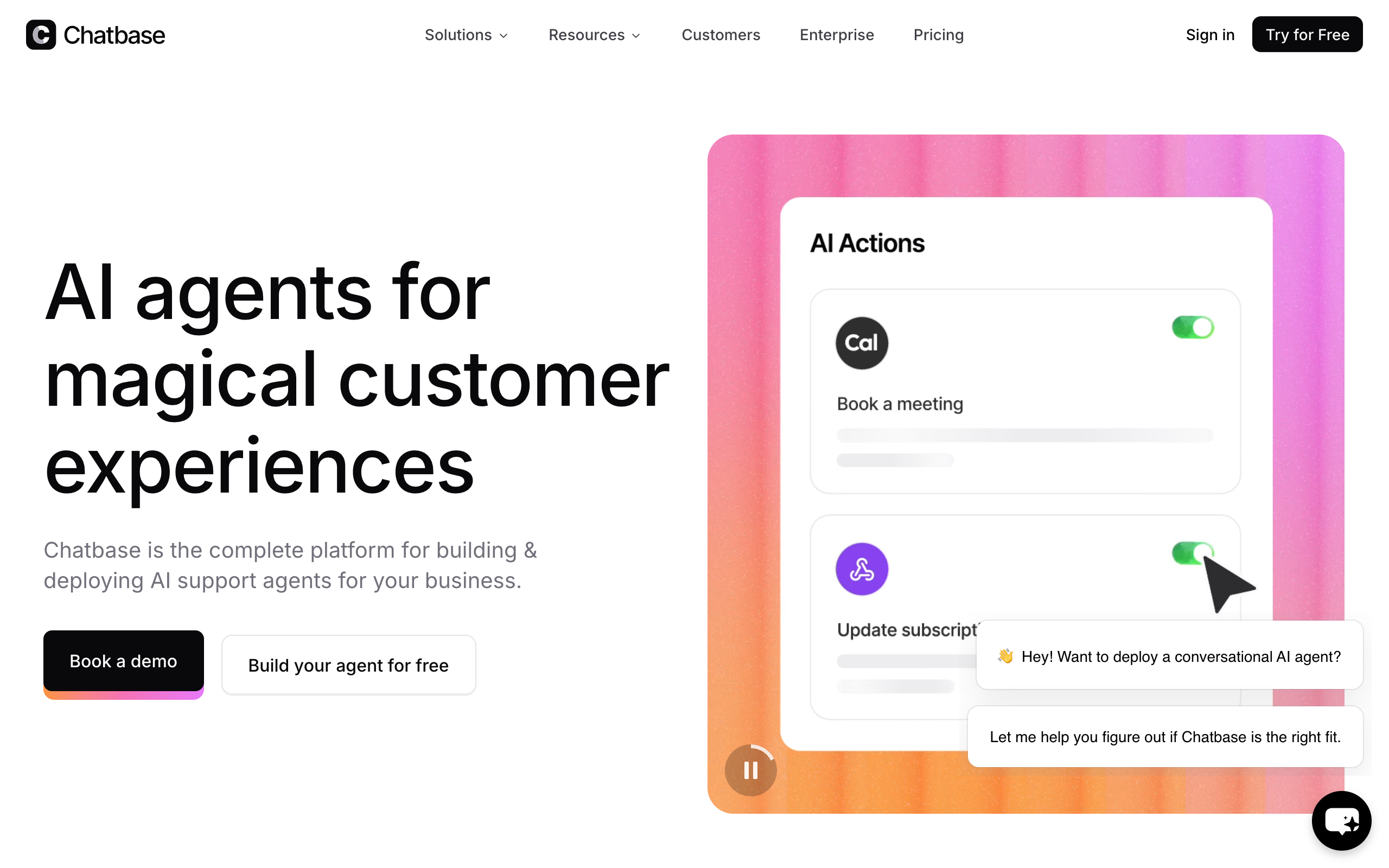
Chatbase is a custom AI-agent builder first, with a native Helpdesk added from the Standard plan up. Its deflection is strong, from a RAG agent trained on your content with real-time data sync. Teams weighing a move off it will find the switching math in the Chatbase alternative guide.
For handoff, the AI can create a ticket in the Chatbase Helpdesk with the full conversation attached, or a teammate can click Takeover to pause the AI and join the live chat. It also escalates into a connected desk (Zendesk, Salesforce, Fin, Freshdesk, HubSpot, Help Scout, Zoho Desk, Gorgias) if you would rather keep the one you have.
The Helpdesk is newer than the dedicated platforms' inboxes, so expect fewer routing and reporting options than Fin or Zendesk.
Handoff features
- Context transfer: escalation creates a Helpdesk ticket with the full conversation attached, and a takeover generates an AI summary of the chat for the agent.
- Triggers: an Escalate to Human action fires when the customer asks for a person or the AI cannot resolve, plus a manual Takeover button that pauses the AI on click.
- Channels: takeover works on the chat bubble, email, WhatsApp, Messenger, and Instagram. Voice and telephony are on Standard and above.
- Notifications: the Helpdesk has statuses, assignment, notes, mentions, custom views, and team auto-assignment rules. Only one agent can take over a conversation at a time.
- Deflection: RAG agent trained on website crawl, uploaded files, and Q&A, with real-time sync to connected systems.
Pros
- Strong content-trained deflection with real-time data sync
- Native Helpdesk with human takeover on chat, email, WhatsApp, Messenger, and Instagram (Standard+)
- Also escalates into 8 major helpdesks if you want to keep yours
- SOC 2 Type II and GDPR compliant; low entry price with a free tier
Cons
- The Helpdesk is newer than dedicated platforms, with lighter routing and reporting
- Helpdesk and voice require the Standard plan ($120/mo billed annually, $150/mo monthly) or above
- Takeover is agent-initiated, so a person has to be watching the inbox
- Message-credit limits by tier, and HIPAA only on Enterprise
Pricing (billed annually):
| Plan | Price | Notes |
|---|---|---|
| Free | $0 | 50 credits |
| Hobby | $32/mo | 700 credits |
| Standard | $120/mo | 4,000 credits; adds Helpdesk, voice, API |
| Pro | $400/mo | 15,000 credits |
Source: Chatbase pricing.
4.3/5·Capterra(73)G2 shows 4.8/5 across a small review base. Check the current count on the G2 page.
Best forTeams that want to build a custom, content-trained AI agent that deflects well, with a native Helpdesk for takeover or escalation into the desk they already run.
7. Ada: best for enterprise resolution across channels
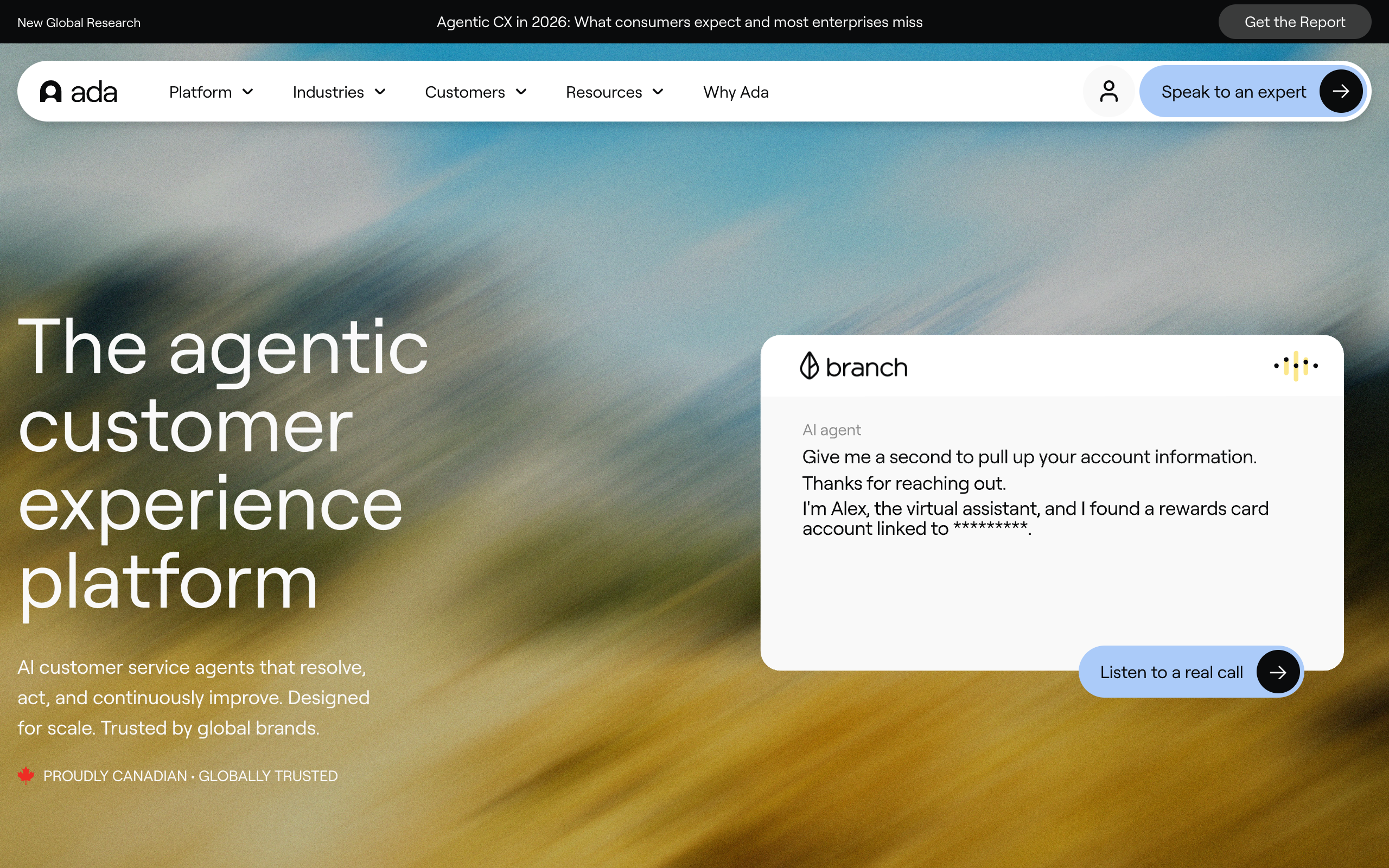
Ada is an enterprise AI-agent platform built around measurable automated resolution across chat, email, and voice. Its handoff is strong through deep native integrations: it transfers in real time (or creates a case) into Zendesk, Salesforce, or Fin with transcript context. The catch is that pricing is custom-quote only, which puts it out of reach for most SMBs.
Handoff features
- Context transfer: transfers the transcript and captured customer data. On Fin, the full transcript is visible to the agent.
- Triggers: real-time live escalation, asynchronous ticket follow-up, off-hours handling, and error-recovery fallback.
- Channels: web/messaging, email, and voice (SMS and social are not explicitly named on Ada's own site).
- Notifications: context-based routing to different handoffs based on conversation variables, with availability rules.
- Deflection: RAG agent grounded in your content and connected systems. Ada frames the metric as "automated resolution" and cites per-customer results rather than one headline number.
Pros
- Enterprise omnichannel automated resolution across chat, email, and voice
- Deep native handoff integrations (Zendesk, Salesforce, Fin) with transcript context
- Strong compliance posture (SOC 2 Type II, GDPR, HIPAA)
Cons
- Custom, quote-based pricing only, with no public numbers and geared to enterprise budgets
- Overkill for SMB and mid-market teams
- Longer deployment and sales cycle than self-serve tools
Pricing:
| Plan | Price | Notes |
|---|---|---|
| All plans | Custom quote | No public pricing. Book a consultation |
Source: Ada pricing.
4.6/5·G2(170) 4.7/5·Capterra(15)Best forEnterprises that want an omnichannel AI agent focused on automated resolution across chat, email, and voice, with deep helpdesk handoff, and can engage a custom sales process.
How do the seven chatbots compare side by side?
| Tool | Context transfer | Trigger intelligence | Channels | Deflection | Entry price (AI + handoff) | SOC 2 / HIPAA |
|---|---|---|---|---|---|---|
| Fin | Full history + AI summary | AI-decided, on-demand, rules, guidance | Web, email, voice, WhatsApp, SMS, social | Fin RAG (~65% cited) | $29/seat + $0.99/outcome (annual) | SOC 2 II / HIPAA (Expert) |
| Zendesk | Full transcript + intent + sentiment | Transfer step, talk-to-human, escalation blocks, API | Web, mobile, social, voice (EAP) | AI agents RAG | $55/seat (annual, + AI add-on) | SOC 2 II / BAA via Advanced Compliance (Suite Professional+) |
| SiteGPT | Full transcript + contact | Visitor asks for a person (button or chat) | Web widget, WhatsApp add-on (+ Slack, Crisp, Messenger on Growth+, Zendesk on Scale+) | Content-trained RAG, 12+ sources + auto-sync | $39/mo billed yearly ($59 monthly) | SOC 2 II / HIPAA (BAA, Ent only) |
| Tidio | Context preserved (~3h) | On-demand, AI-decided, rules | Web, Messenger, Instagram, WhatsApp, email | Lyro RAG (up to 67%) | ~$57/mo annual (Starter + Lyro) | SOC 2 / No BAA |
| Crisp | Context attached | Rules, escalation settings, manual | Web, email, WhatsApp, Messenger, Instagram | Hugo RAG | $45/mo flat | Self-attested (no audit) / No |
| Chatbase | Full conversation + AI summary to ticket | AI Action + manual Takeover | Web, email, WhatsApp, Messenger, Instagram (+ Slack) | Content RAG + sync | $120/mo annual (Standard) | SOC 2 II / HIPAA-eligible (Ent) |
| Ada | Transcript + data | Live, async, off-hours, fallback | Web, email, voice | Content + systems RAG | Custom quote | SOC 2 II / HIPAA |
Prices are not apples-to-apples. SiteGPT, Crisp, and Chatbase are flat per workspace, and SiteGPT Starter is $59/mo on monthly billing.
Zendesk is per agent seat. Fin (from $29/seat) adds $0.99 per outcome on top of seats. Tidio's Lyro is a metered add-on, and Ada is custom-quote.
Fin, Zendesk, Tidio, and Chatbase figures were re-checked in September 2026, so confirm the rest on each vendor's pricing page.
$141/mo less than a 4-seat Zendesk Suite Team (annual billing)
SiteGPT Growth is $79/mo billed yearly ($129 billed monthly) and includes up to 4 team members, 10,000 messages, and native handoff. Four Zendesk Suite Team seats are 4 x $55 = $220/mo billed annually, before Zendesk's per-resolution AI Agents Advanced add-on. That is roughly $1,692/year saved on seats alone, or $91/mo on SiteGPT monthly billing. Zendesk pricing checked September 2026.
Which chatbots with human handoff support HIPAA?
Most tools above say they support HIPAA, but the claim means something different at each vendor. Three things separate them: which plan it sits on, whether the vendor signs a Business Associate Agreement, and what the product stops you from doing after it is signed.
A few terms first, because the rest of this section depends on them. HIPAA is the Health Insurance Portability and Accountability Act, the US law covering how patient information is handled. PHI, or protected health information, is any health detail that can be traced back to a person. HHS, the Department of Health and Human Services, writes and enforces the HIPAA rules.
HHS defines a business associate as a person or organization that performs certain HIPAA-regulated functions on behalf of a covered entity, such as a healthcare provider or health plan. A BAA, or Business Associate Agreement, is the contract that lets that vendor handle PHI lawfully.
Whether your chatbot needs a BAA at all depends on whether PHI can reach it, covered in do you need a BAA for your website chatbot. The full list of what makes a chatbot compliant beyond the contract is in what makes a chatbot HIPAA compliant.
Where each vendor gates it
| Tool | HIPAA position | What it costs |
|---|---|---|
| SiteGPT | Signed BAA, assessed for HIPAA by DPLMC International | Enterprise only, not Starter, Growth, or Scale |
| Fin | HIPAA support listed alongside SSO and SLAs | Expert, $132/seat/mo on annual billing |
| Zendesk | BAA through the Advanced Compliance add-on | Suite Professional ($115/agent/mo annual) or above, plus the add-on |
| Chatbase | HIPAA-eligible | Enterprise, custom priced |
| Ada | HIPAA supported | Custom quote |
| Tidio | Does not sign a BAA. Its terms say it is not a business associate | n/a |
| Crisp | No HIPAA support stated | n/a |
The pattern is the same everywhere: HIPAA is a top-tier feature. What differs is how far up the ladder the top tier starts, and whether the vendor will tell you in advance what a covered deployment actually looks like.
What changes on a SiteGPT HIPAA workspace
A covered workspace narrows on purpose, and two of those constraints cut directly against the reasons to pick SiteGPT on a standard plan.
| On a covered workspace | What it means in practice |
|---|---|
| PHI lives in conversations only | Patients can share symptoms and conditions in the chat. Website pages, uploaded files, snippets, Q&A entries, and bot instructions must stay PHI-free |
| Connected apps are unavailable | Notion, Google Drive, Dropbox, OneDrive, Box, and GitHub cannot be linked. Website links, file uploads, and text snippets remain the supported paths |
| Chat integrations are unavailable | Zendesk, Slack, and Crisp are off, so escalation stays inside the HIPAA-covered chat channel |
| Conversations redact on a timer | Message text is redacted 7 days after a conversation's last activity by default, configurable on the order form. Conversation counts and analytics aggregates survive, so reporting keeps working |
| Leads persist until you delete them | A lead is a contact record your team asked for, not a transcript, so it is never purged on SiteGPT's schedule. Keep fields to basic contact details |
| Notifications carry no content | Emails link to the dashboard instead of quoting conversation text or visitor contact details |
| One branding element stays | White-label is included, but the "Responses are AI-generated" disclosure is pinned on HIPAA workspaces |
The 12+ content sources and the Slack and Zendesk escalation routes that make SiteGPT attractive on a standard plan are exactly what a covered workspace turns off. Raise this during scoping, before you sign. How to clean existing content before it goes into a covered bot is covered in keeping PHI out of your chatbot's training data.
Every Enterprise deployment is scoped individually, so per-deployment terms (retention window, quotas, white-label) live on the order form.
How do you get a SiteGPT BAA signed?
- Request. Email the details of your organization and use case.
- Scoping. Confirm which content sources and features will carry PHI.
- Legal review. Counsel reviews the published BAA and sends back the provisions you need.
- Execution. Both parties sign, after signed BAA coverage is in place across every vendor in the PHI chain, AI providers included.
- Enablement. SiteGPT confirms in writing that the workspace is live.
Do not submit PHI until that written confirmation arrives. That includes test conversations, training content, uploaded files, and lead capture. The BAA itself commits to Security Rule safeguards, breach reporting within five business days of discovery, subcontractor flow-down, and PHI never being used to train AI models.
The authoritative source for current program status is sitegpt.ai/hipaa. For how a covered workspace behaves day to day, read the HIPAA docs. A self-serve HIPAA tier is planned but is not available today.
How do you choose a chatbot with human handoff?
Match the tool to what you optimize for. If the bot must also take actions such as refunds or account changes, the ranking of the best AI customer support agents covers Decagon, Sierra, and other agents that act.
What matters most for your handoff?
- If you want the most sophisticated AI-decided escalation and have budget→Fin or Zendesk
- If you want to deflect the most tickets before escalation from content you already have→SiteGPT (12+ sources + auto-sync)
- If you're an e-commerce/SMB team that lives on social and WhatsApp→Tidio
- If you want the lowest predictable flat price and don't require audited SOC 2→Crisp
- If you're building a custom agent to plug into an existing helpdesk→Chatbase
- If you're an enterprise automating chat, email, and voice→Ada
How important is compliance (SOC 2 / HIPAA)?
- If you want to review the BAA before a sales call→SiteGPT (published BAA, Enterprise only, custom priced)
- If you need a BAA inside a full helpdesk suite→Fin (Expert), Zendesk (Advanced Compliance), or Ada
- If SOC 2 is a hard requirement→Avoid Crisp (self-attested, no audit)
Which chatbot fits your use case?
| Scenario | Best pick | Why |
|---|---|---|
| SaaS company with docs, help center, and a GitHub wiki to learn from | SiteGPT | 12+ content sources + auto-sync drive the highest deflection |
| Healthcare team that wants to read the BAA before a sales call | SiteGPT Enterprise | Standard BAA published in full. Signed on Enterprise only, custom priced |
| Large support org wanting AI-decided escalation | Fin | Fin escalates on frustration/failure into a shared inbox |
| Enterprise with complex routing and voice | Zendesk | Mature agent workspace, skills routing, voice EAP |
| Shopify store handling DMs and WhatsApp | Tidio | Lyro + social/WhatsApp coverage, easy setup |
| Startup wanting the lowest predictable flat price | Crisp | Flat per-workspace pricing, omnichannel inbox |
| Team that already runs Zendesk/Salesforce and wants a custom bot | Chatbase | Custom RAG agent that escalates into your desk |
| Escalations must land in an existing Zendesk | SiteGPT Scale or Chatbase | SiteGPT's Zendesk integration needs Scale+ and Zendesk Suite Professional+ |
| Enterprise automating chat, email, and voice at scale | Ada | Omnichannel automated resolution + deep handoff integrations |
Frequently asked questions
Basics
What is human handoff in an AI chatbot? Human handoff (or live agent escalation) is when an AI chatbot transfers a conversation to a human agent. Good handoff transfers the full conversation history so the customer never repeats themselves, and it triggers at the right moment, on demand or when the AI detects it cannot resolve the issue.
Is human handover the same as human handoff? Yes. "Human handover", "agent handover", "live agent escalation", and "agent transfer" all name the same feature. UK and European vendors tend to write "handover", US vendors "handoff", and this guide's scoring applies regardless of the label.
Which AI chatbot has the best human handoff? For the most sophisticated native AI-to-human escalation (AI-decided triggers, full context plus an AI summary, and a mature shared agent inbox), Fin and Zendesk lead. For the highest content-trained deflection plus native handoff at SMB pricing, SiteGPT is the best value.
Can the AI chatbot escalate to a human automatically? It depends on the tool. Fin, Zendesk, and Tidio can escalate automatically when the AI detects frustration or a failed answer. SiteGPT escalates when the visitor asks for a person, and Crisp escalates by rule or when its AI decides it is out of depth. Automatic escalation catches customers who would otherwise abandon the chat.
Does SiteGPT support human handoff? Yes. Customers request an agent with a button or by asking, and the escalation transfers the full transcript and captured contact details. The team is notified by email and in the dashboard, plus Slack on Growth and above and webhooks on Scale and above. Escalation is available on every plan.
Handoff and context
Do all AI chatbots transfer conversation context to the human agent? No. Every tool here transfers at least the transcript, but depth varies. Fin and Zendesk pass the full history plus an AI summary, intent, and sentiment. SiteGPT sends the full transcript and captured contact details. Builder-first tools may only pass a ticket with limited context unless configured.
Does SiteGPT integrate with Zendesk, Slack, or Crisp for escalation? Yes, on the right plan. Slack, Crisp, Messenger, Google Chat, Freshdesk Messaging, and Zoho SalesIQ are available from Growth. The Zendesk integration is Scale and above only and needs Zendesk Suite Professional or higher. Starter has no chat integrations. WhatsApp is a paid add-on on any plan, and Intercom and HubSpot are not live.
Deflection
What is a good ticket deflection rate for an AI chatbot? No single benchmark applies to every use case. Gartner predicts agentic AI will resolve 80% of common customer service issues without human intervention by 2029. A content-trained (RAG) bot that answers from your own docs and help center drives the high end, and the more it deflects, the less often a handoff is needed at all.
How many content sources can a SiteGPT chatbot train on? SiteGPT trains on 12+ content sources, including websites, sitemaps, files (PDF, DOCX, CSV, and more), YouTube, GitHub, and cloud storage such as Google Drive, Notion, Dropbox, OneDrive, SharePoint, and Box, plus help centers. Auto-sync keeps the trained content current, which keeps deflection high over time.
Pricing and compliance
How much do AI chatbots with human handoff cost? Models differ. SiteGPT, Crisp, and Chatbase charge a flat monthly rate (SiteGPT from $39/mo billed yearly or $59 billed monthly, Crisp from $45/mo, Chatbase's Helpdesk-capable Standard plan at $120/mo billed annually, $150/mo monthly). Zendesk ($55/agent/mo billed annually) and Fin (from $29/seat/mo billed annually) charge per seat, and Fin adds $0.99 per outcome. Ada is custom-quote only.
Which SiteGPT plan do I need for human handoff? Human escalation is available on every SiteGPT plan, including Starter at $39/mo billed yearly ($59 billed monthly). Higher plans add more team seats to handle escalations (Starter 1, Growth 4, Scale 10) and add integrations, API access, and auto-sync.
Which SiteGPT plan includes a HIPAA BAA? Enterprise only. BAAs are not available on Starter, Growth, or Scale, and a self-serve HIPAA tier is planned but not shipped. The BAA is executed during enterprise onboarding, and SiteGPT confirms enablement in writing before any PHI should flow through the chatbot. The standard BAA is published, and the current program status is at sitegpt.ai/hipaa.
Which of these are SOC 2 and HIPAA compliant? SiteGPT, Fin, Zendesk, Chatbase, and Ada hold SOC 2 Type II. Tidio has completed a SOC 2 examination, and Crisp states it has not been through a SOC 2 audit. For HIPAA, SiteGPT (BAA on Enterprise only), Fin (Expert), Zendesk (Advanced Compliance add-on), and Ada support it. Chatbase is HIPAA-eligible on Enterprise. Tidio does not sign a BAA, and Crisp does not state HIPAA support.
Can I put patient information into a chatbot's training content? Not on SiteGPT. A covered workspace scopes PHI to end-user conversations, and the knowledge base (website pages, uploaded files, snippets, Q&A entries) has to stay PHI-free. Keeping training content clean is what keeps the number of vendors touching PHI small. The HIPAA docs spell out the boundary.
How long does SiteGPT keep conversations under a BAA? Conversation content is redacted 7 days after a conversation's last activity by default, and the window is configurable on the Enterprise order form. Redaction replaces the message text while conversation counts and analytics aggregates remain. Leads are treated differently: they persist until your team deletes them, because a lead is a contact record you asked for rather than a transcript. Both terms are written into the standard BAA.
For compliance-specific options, start with what changes on a covered workspace above and the HIPAA program page. The guides to the best HIPAA-compliant AI chatbots and GDPR-compliant chatbot platforms go further, and the best conversational AI chatbots covers the wider field.
Sources
- SiteGPT: pricing, features, security
- SiteGPT HIPAA: program status and BAA availability, standard BAA, using SiteGPT under HIPAA (docs)
- Vendor pricing pages: Fin, Zendesk, Tidio, Crisp, Chatbase, Ada
- Ratings: G2 and Capterra review pages, linked per tool above (review counts as shown)
- Regulation: HHS guidance on business associates, which defines who needs a BAA
- Market data: Gartner, "Agentic AI Will Autonomously Resolve 80% of Common Customer Service Issues by 2029" (March 2025)