


SiteGPT and CustomGPT do the same job. Both ingest your business content and answer customer questions from it with citations, and neither needs code. The unit of usage decides your invoice. CustomGPT bills credits and does not publish what a credit buys. SiteGPT bills messages and publishes both ends of the range.
iShort answer
CustomGPT Standard is $99 a month, or $89 on annual billing, for 500 credits, 2 AI agents, and 1 team member. SiteGPT Starter is $59 a month, or $39 on annual billing, for a published 400 to 4,000 messages depending on the model you pick. On annual billing the entry gap is $600 a year. CustomGPT does not publish a credits-per-message rate anywhere, so you cannot turn 500 credits into an answer count before you buy.
CustomGPT wins on file-format breadth (1,400 or more types), enterprise sales support, and named institutional customers. SiteGPT wins on entry price, seats per dollar, computable volume, and documented human escalation. CustomGPT does not advertise escalation at all.
Both publish SOC 2 Type II and GDPR compliance. For healthcare buyers, HIPAA separates them. SiteGPT signs a BAA on Enterprise and publishes the terms. CustomGPT publishes SOC 2 Type II, GDPR, and AES-256 encryption claims, with no BAA among them. Ask either vendor which connectors survive once one is in place.
Key takeaways
| Question | Answer | Evidence |
|---|---|---|
| Same job? | Yes | Both are no-code RAG platforms answering from your content with citations |
| Cheaper entry plan | SiteGPT | $468/yr against $1,068/yr on annual billing |
| Computable volume | SiteGPT | 400-4,000 messages published. 500 credits with no published conversion |
| Broader file ingestion | CustomGPT | 1,400+ file types against SiteGPT's 12+ source types |
| Human escalation | SiteGPT | On demand on all tiers. CustomGPT documents none |
| Seats at the closest price | SiteGPT | 4 team members on Growth against 1 on Standard |
| Institutional references | CustomGPT | MIT, Bernalillo County, and GEMA named on its site |
Both answer from your content. They differ on metering, escalation, and who the buyer is.
Price one answer
A plan price is hard to judge until you know what one answer costs. SiteGPT publishes that range. CustomGPT does not.
Count the seats you need
CustomGPT Standard is a single-seat plan. A service team of three needs Premium at $499 a month.
Check the escalation path
SiteGPT documents what happens when a customer asks for a person. CustomGPT does not mention it.
Weigh the review evidence
Five Product Hunt reviews, one CustomGPT G2 review, and twelve SiteGPT G2 reviews are all thin. Named enterprise references may matter more than either.
500-1,000%
is the error Gartner estimates CIOs could make in GenAI cost calculations if they do not understand how those costs scale. In the same release, more than 90% of 300+ surveyed CIOs said managing cost limits the value they get from AI.
Source: Gartner, October 2024 press release on AI value challengesWhat is the difference between SiteGPT and CustomGPT?
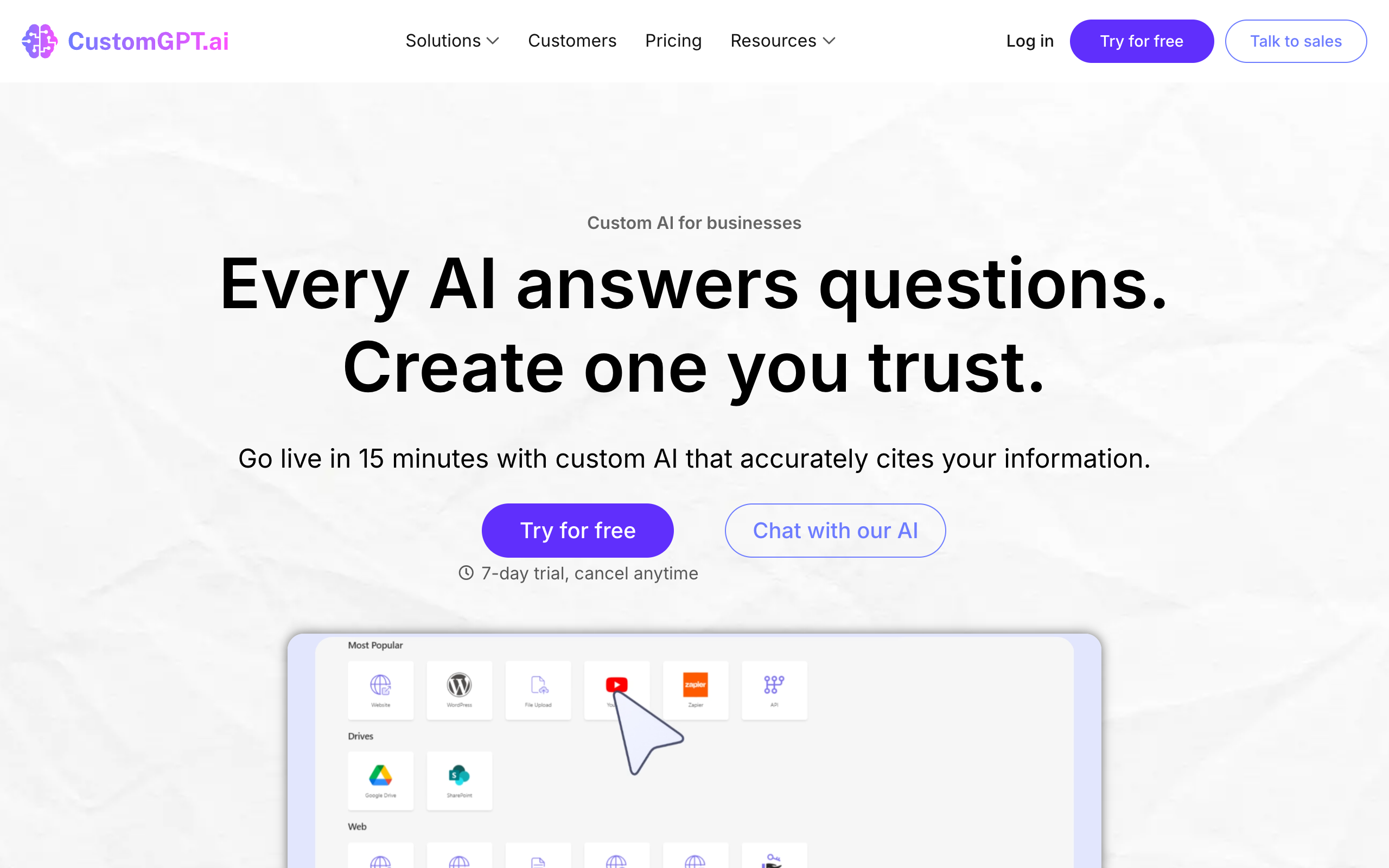
CustomGPT.ai is a no-code RAG platform that builds AI agents from business content. It cites sources on every response and sells hard into enterprise knowledge search. It advertises 1,400 or more supported file types, 92 languages, and SOC 2 Type II with GDPR compliance and AES-256 encryption.
SiteGPT is a RAG answering layer built for customer service. It ingests your content, answers from it, escalates to a person on demand, and plugs into the chat tools a service team already runs.
A feature checklist will not separate them. Both build from your content, cite sources, deploy as a website widget, and run a 7-day trial with no free tier. They differ on three things: how usage is metered, whether a human can take over, and who the vendor sells to.
Disclosure: SiteGPT publishes this page. Every CustomGPT figure below comes from CustomGPT's own pricing, features, or FAQ pages, all linked in the Sources section.
How much does a CustomGPT credit buy?
CustomGPT does not say. Its pricing page lists the credit allowance for each plan but never converts a credit into messages.
| Plan | Monthly | Annual (per mo) | Credits/mo | AI agents | Team | Docs per agent |
|---|---|---|---|---|---|---|
| Standard | $99 | $89 ($1,068/yr) | 500 | 2 | 1 | 5,000 |
| Premium | $499 | $449 ($5,388/yr) | 2,500 | 5 | 3 | 20,000 |
| Enterprise | Custom | Custom | Custom | Custom | Custom | Custom |
CustomGPT quotes Enterprise on its own pricing page as typically $2,000 to $6,000 a month. Annual billing saves 10%.
The plan cards also state an actions-per-message limit: 1 on Standard, 3 on Premium. That suggests one answer can consume a variable share of the allowance depending on what it does. The conversion itself is missing.
CustomGPT documents two consequences of hitting a limit, and the buyer carries both.
Limits stop work rather than degrade it. CustomGPT's FAQ states that indexing stops immediately when you hit your plan limits, with a limited indicator shown in the crawl status page.
Overage is not refundable. CustomGPT's refund policy states that refunds apply only to the current subscription charge on the account, not to overage charges from the prior month.
The published escape hatch is an add-on: 2,500 extra credits for $300 a month. That is the only public price attached to CustomGPT usage. It works out to roughly $0.12 per extra credit, although CustomGPT does not frame it that way and a credit still does not equal a message.
How many messages does a SiteGPT plan include?
Between 400 and 40,000 a month, depending on the plan and the model. SiteGPT meters messages, and a message counts both the customer's question and the AI's reply.
SiteGPT's pricing page says the count depends on which model answers. GPT-4.1-mini costs roughly 10 times less per message than GPT-4.1, and the pricing calculator shows both ends of the range.
| Plan | Annual (per mo) | All GPT-4.1 | All GPT-4.1-mini | Pages | Team |
|---|---|---|---|---|---|
| Starter | $39 ($468/yr) | 400 messages | 4,000 messages | 1,000 | 1 |
| Growth | $79 ($948/yr) | 1,000 messages | 10,000 messages | 10,000 | 4 |
| Scale | $259 ($3,108/yr) | 4,000 messages | 40,000 messages | 50,000 | 10 |
Monthly rates are higher: $59, $129, and $429 respectively.
The headline "up to 10,000 messages" is the top of the range. A buyer who runs everything on GPT-4.1 gets 1,000 messages on Growth. The advantage is that both endpoints are published before you pay. You can compute the range, and you choose the model that moves it.
$600 a year at the entry tier, and a volume range you can compute
CustomGPT Standard on annual billing is $1,068 a year. SiteGPT Starter on annual billing is $468 a year. The gap is $600 a year, or 56% less, for the entry plan of each product. SiteGPT Growth at $948 a year still undercuts CustomGPT Standard by $120 a year while providing 4 team seats against 1. Rates verified on both pricing pages on 27 July 2026.
Is CustomGPT more expensive than SiteGPT?
Yes, at every published tier. The entry plans differ by $600 a year on annual billing.
The second tier is where the two products separate hardest. CustomGPT Premium is $449 a month on annual billing, $5,388 a year. SiteGPT Growth is $79 a month on annual billing, $948 a year. That is 5.7 times the price for the tier most teams land on when one seat stops being enough.
Both platforms answer from your content. Only one lets you forecast the bill before signing.
CustomGPT: credits
- $99 monthly or $89 annual for 500 credits a month on Standard
- $499 monthly or $449 annual for 2,500 credits a month on Premium
- Credits-per-message rate not published on pricing, FAQ, or explainer
- Actions per message capped at 1 on Standard and 3 on Premium
- Indexing stops at plan limits, and overage charges are non-refundable
- Extra credits add-on: 2,500 for $300 a month
SiteGPT: messages
- $59 monthly or $39 annual for 400 to 4,000 messages on Starter
- $129 monthly or $79 annual for 1,000 to 10,000 messages on Growth
- A message is defined as the question plus the reply
- Both ends of the range shown by the on-page calculator
- Extra 5,000 messages add-on: $39 a month
- Model split adjustable from billing settings at any time
At the GPT-4.1 end, SiteGPT Starter's 400 messages is a smaller number than CustomGPT Standard's 500 credits. The two units do not compare directly. You can put a floor of 400 answers a month on SiteGPT Starter. You cannot put any floor on CustomGPT Standard.
Which platform ingests more file types?
CustomGPT, and ingestion is its strongest feature. It advertises 1,400 or more file types and 5,000 documents per agent on Standard (20,000 on Premium). It also connects to Google Drive, Dropbox, SharePoint, OneDrive, YouTube, Confluence, Notion, HubSpot, Zendesk, Freshdesk, Shopify, WordPress, Gitbook, Zapier, and RSS. For an archive of mixed legacy formats, that breadth is difficult to match.
SiteGPT documents 12 or more source types. They include websites and sitemaps, YouTube, GitHub, raw text, and file uploads (CSV, TXT, PDF, DOCX, PPTX, MD). Cloud sources are Google Drive, Notion, Dropbox, OneDrive, SharePoint, and Box, plus help centers such as Zendesk, Freshdesk, Intercom, Confluence, and Gitbook.
Roughly 2,500 cleaned characters count as one page, and files go up to 10 MB. The full connector list is on the SiteGPT integrations page.
Pros
- CustomGPT: 1,400+ file types is a wider net than any documented SiteGPT format list.
- CustomGPT: 20,000 documents per agent on Premium suits large mixed archives.
- CustomGPT: SOC 2 Type II, GDPR, and AES-256 encryption published prominently.
- SiteGPT: auto-refresh on a published schedule, monthly on Growth, weekly plus a daily auto-scan on Scale.
- SiteGPT: 1,000 to 50,000 pages by plan, with 500,000 on Enterprise.
- SiteGPT: 95+ languages against CustomGPT's 92.
If the deployment is HIPAA-covered, connector breadth stops being the deciding factor for either vendor. SiteGPT's HIPAA workspaces switch connected apps off entirely (Notion, Google Drive, Dropbox, OneDrive, Box, GitHub) and confine PHI to end-user conversations, leaving website links, file uploads, and text snippets as the supported paths. Ask any vendor the same question: which of these connectors survive once a BAA is in place?
SiteGPT's edge is freshness. Scheduled auto-refresh and auto-scan re-crawl trained content on a published cadence, so answers track help center edits without a manual reindex. For a customer service bot answering from documentation that changes weekly, that schedule matters more than exotic file support.
Can CustomGPT hand off to a human?
Not on the evidence CustomGPT publishes. For a customer service deployment, this is the largest functional gap between the two.
CustomGPT does not document human handoff. As of 27 July 2026, its features, pricing, and FAQ pages do not mention live agent takeover, escalation to a person, or handoff with conversation context. That is not proof the capability is absent, and a buyer for whom it matters should ask CustomGPT sales directly. It does mean the capability is not something you can verify before a sales call.
SiteGPT documents it and ships it on every tier. When a customer asks to talk to a person, the conversation is handed off and the team is notified with the transcript and captured contact details. Email and dashboard notifications work on every plan, Slack needs Growth or above, and webhooks need Scale or above. Specifics are documented at SiteGPT's human support docs.
Escalations also have somewhere to land. From Growth, SiteGPT's chat-channel integrations cover Slack, Crisp, Messenger, Google Chat, Freshchat, and Zoho SalesIQ. Starter has no chat integrations.
The Zendesk integration needs Scale and Zendesk Suite Professional or above. One SiteGPT customer describes the Zendesk setup:
"We've got the bot dialled in, we're using GPT-4, have an avenue for escalations to Zendesk, and so far I have no complaints."
Brent Burrows II, Vice President of Retail and Sales at CBS Bahamas
For a scored field of platforms compared on handoff specifically, see the AI chatbots with human handoff roundup.
Do SiteGPT and CustomGPT have MCP servers?
Yes, both do. On agent access the two are close to level.
CustomGPT lists an MCP server in its developer resources, alongside a RAG API reference, SDK documentation, OpenAI compatibility, and a developer starter kit. SiteGPT's developer surface is documented too. It publishes an API v2 reference with an OpenAPI document, SDKs for TypeScript, Python, and Go, and a CLI. The API integration guide covers token scopes, webhooks, and CI/CD. SiteGPT's docs list no OpenAI-compatible endpoint, and CustomGPT's do.
SiteGPT publishes a remote MCP server with OAuth and a three-tool interface, so an assistant can operate the chatbot itself. The SiteGPT agents page covers what an assistant can run end to end, and MCP for customer service covers what MCP changes about service work. Claude is the confirmed MCP client. SiteGPT also publishes setup guides for Claude Code, Cursor, and Codex.
If the buyer is a developer who wants an OpenAI-compatible RAG endpoint to build a product on, CustomGPT is the closer fit. If the buyer wants an assistant to run the support bot itself, the SiteGPT MCP server is built for that. For the wider field of AI agents in customer service, see the AI agents hub.
How are SiteGPT and CustomGPT rated?
Both are rated on thin evidence. SiteGPT holds 4.8 out of 5 on G2 from 12 reviews, and CustomGPT holds 4.0 from one.
4.8/5·G2(12) 4/5·G2(1) 3.6/5·Product Hunt(5)CustomGPT's G2 profile carried a single review, rated 4.0 out of 5, when checked in September 2026. Its Product Hunt score is 3.6 out of 5 from 5 reviews, and those reviews are two to three years old, including one detailed criticism of early retrieval quality that predates several product generations. SiteGPT's 4.8 out of 5 comes from 12 G2 reviews.
None of these numbers is strong evidence. Twelve, one, and five reviews are all small samples. Do not treat 4.8 against 4.0 or 3.6 as a verdict.
CustomGPT's stronger proof is not on review sites. Its own testimonials name MIT's Martin Trust Center for Entrepreneurship, Bernalillo County, GEMA, BQE Software, and Dlubal Software. In an enterprise evaluation, references like these carry more weight than a dozen G2 entries.
Cons
- SiteGPT: 12 G2 reviews is a thin evidence base for a buying committee.
- SiteGPT: file-format support is narrower than CustomGPT's 1,400+ types.
- SiteGPT: no OpenAI-compatible API endpoint, which CustomGPT lists for developers.
- SiteGPT: the headline message count assumes a mini-heavy model split.
- CustomGPT: no published credits-per-message rate, so the bill cannot be forecast.
- CustomGPT: 1 team member on the $1,068-a-year Standard plan.
- CustomGPT: no documented human escalation path.
- CustomGPT: one G2 review, and overage charges are non-refundable.
Full side-by-side table
| Feature | SiteGPT | CustomGPT.ai |
|---|---|---|
| Category | RAG answering layer for customer service | RAG platform for agents and knowledge search |
| Metering unit | Message (question plus reply) | Credit (conversion not published) |
| Entry plan, monthly | $59 | $99 |
| Entry plan, annual | $39/mo, $468/yr | $89/mo, $1,068/yr |
| Second tier, annual | $79/mo, $948/yr | $449/mo, $5,388/yr |
| Top published tier | Scale, $259/mo annual | Enterprise, typically $2,000 to $6,000/mo |
| Volume at entry tier | 400 to 4,000 messages, both ends published | 500 credits, no published conversion |
| Volume at second tier | 1,000 to 10,000 messages | 2,500 credits |
| Overage | Extra 5,000 messages for $59/mo billed monthly, or $39/mo billed yearly | Extra 2,500 credits for $300/mo, non-refundable |
| Behavior at limit | Add-on available | Indexing stops immediately |
| Chatbots or agents | 1 / 2 / 3 by plan | 2 / 5 by plan |
| Team seats | 1 / 4 / 10 by plan | 1 / 3 by plan |
| Training volume | 1,000 to 50,000 pages by plan | 5,000 to 20,000 docs per agent |
| File formats | CSV, TXT, PDF, DOCX, PPTX, MD, up to 10 MB | 1,400+ file types |
| Content sources | 12+ including cloud drives, GitHub, YouTube, help centers | Cloud drives, YouTube, Confluence, Notion, HubSpot, help centers, RSS |
| Auto-refresh | Monthly, weekly, or daily by plan | Not published as a schedule |
| Human escalation | All tiers, email and dashboard notifications | Not documented |
| Chat integrations | None on Starter. Slack, Crisp, Messenger, Google Chat, Freshchat, Zoho SalesIQ from Growth. Zendesk from Scale | Deployment to website, WordPress, SharePoint, Shopify, Wix, Squarespace |
| Developer surface | API v2 and SDKs on Growth+, CLI, webhooks on Scale, MCP server | RAG API, SDK docs, OpenAI compatibility, MCP server |
| Languages | 95+ | 92 |
| Remove branding | $59/mo billed monthly, or $39/mo billed yearly | Included on Premium |
| Free trial | 7 days, all self-serve plans, card required | 7 days, Standard and Premium |
| Free tier | None | None |
| Compliance | SOC 2 Type II, GDPR, HIPAA BAA and DPA on Enterprise | SOC 2 Type II, GDPR, AES-256 |
| G2 rating | 4.8/5 (12 reviews) | 4.0/5 (1 review) |
| Product Hunt | Not scored here | 3.6/5 (5 reviews) |
Should you choose SiteGPT or CustomGPT?
Choose SiteGPT for a customer service team and CustomGPT for an enterprise knowledge team.
Pick SiteGPT if the buyer is a customer service team. The entry plan costs $600 a year less, and the volume range is published at both ends. Human escalation is documented on every tier, with routing into Slack or Crisp from Growth and Zendesk from Scale. Growth gives four seats for less than CustomGPT charges for one.
Pick CustomGPT if the buyer is an enterprise knowledge team. It fits a corpus of thousands of mixed legacy documents. It also fits when procurement weighs named institutional references like MIT and Bernalillo County. Ask sales two questions first: how many credits a typical answer consumes, and what happens when a customer asks for a human.
Pick neither yet if you have not counted your volume. Both run a 7-day trial with no free tier. Run the same 100 real customer questions through both, then compare what each one consumed. That is the only way to compare a credit to a message.
Best forCustomer service teams that want a computable bill, on-demand human escalation, and more than one seat without moving to a $5,388-a-year plan.
Can you compute your AI answering bill for next quarter from public pricing?
- If no, the credits-per-message rate is not published→A published message range removes the unknown
- If yes, sales gave you a written conversion→Compare it against 400-4,000 messages at $39/mo billed yearly ($59 monthly)
Does a customer ever need to reach a person mid-conversation?
- If yes, that is core to the service model→SiteGPT documents escalation on all tiers
- If no, this is internal knowledge search→CustomGPT is built for that job
How many people need dashboard access?
- If more than one→CustomGPT Standard is single-seat. The next tier is $5,388/yr
- If just you→Either entry plan works. Compare on price and volume
What does the content look like?
- If a website, help center, and a few docs→Both ingest it; decide on price and escalation
- If thousands of mixed legacy file formats→CustomGPT's 1,400+ types is the wider net
| Scenario | Best pick | Why |
|---|---|---|
| 3-person support team, help center plus website | SiteGPT Growth | $948/yr with 4 seats against $5,388/yr for 3 seats on CustomGPT Premium |
| Solo founder testing a docs bot | SiteGPT Starter | $468/yr against $1,068/yr, both single-seat |
| University or public-sector knowledge base | CustomGPT | Named references at MIT and Bernalillo County, plus SOC 2 Type II |
| Archive of 1990s-era mixed file formats | CustomGPT | 1,400+ file types is the wider ingestion net |
| Finance needs a fixed number for the budget | SiteGPT | Credit-to-message conversion is not published by CustomGPT |
| Customers frequently ask for a human | SiteGPT | On-demand escalation on all tiers with transcript and contact details |
| Escalations must land in Crisp or Slack | SiteGPT Growth | Both are supported chat-channel integrations from Growth |
| Escalations must land in Zendesk | SiteGPT Scale | The Zendesk integration needs Scale and Zendesk Suite Professional or above |
| Building a product on a RAG API | CustomGPT | A RAG API with OpenAI compatibility and a developer starter kit |
| Docs change weekly and must stay current | SiteGPT Scale | Weekly auto-refresh plus a daily auto-scan on a published schedule |
| Buying committee wants deep review evidence | Neither | 12 G2 reviews and one G2 review are both thin. Run the trials |
For the same evaluation against another content-trained platform, see SiteGPT vs Chatbase and the Chatbase alternative breakdown. For CustomGPT assessed on its own terms rather than head to head, see the CustomGPT AI review. Teams weighing a per-seat platform instead will find that math in SiteGPT vs Zendesk and SiteGPT vs Intercom. For another platform that meters credits rather than messages, see the DocsBot alternative guide.
Frequently asked questions
Pricing
What is the price difference between SiteGPT and CustomGPT? On annual billing, CustomGPT Standard is $89 per month, billed as $1,068 a year, and SiteGPT Starter is $39 per month, billed as $468 a year. That is a gap of $50 a month, or $600 a year. On monthly billing the entry plans are $99 for CustomGPT and $59 for SiteGPT, a gap of $40 a month. Figures verified on both pricing pages on 27 July 2026.
Is CustomGPT more expensive than SiteGPT? Yes at every published tier. Entry is $99 against $59 monthly, and $89 against $39 on annual billing. The second tier is $499 against $129 monthly. CustomGPT Enterprise is quoted on its own pricing page as typically $2,000 to $6,000 a month, while SiteGPT Enterprise is custom without a published band. Whether CustomGPT is more expensive per answer cannot be calculated, because the credits-per-message rate is not published.
Does CustomGPT have a free plan? No. CustomGPT offers a 7-day free trial on both the Standard and Premium plans and no permanently free tier. SiteGPT also offers a 7-day free trial on all self-serve plans, with a credit card required, and no free tier. Neither product has a free plan, so the trial is the only way to test either without paying.
What happens when you hit the limits on each plan? CustomGPT's FAQ states that indexing stops immediately when you hit your plan limits. Its refund policy states that refunds apply only to the current subscription charge and not to overage charges from the prior month. SiteGPT sells a fixed add-on instead: an extra 5,000 messages a month for $59 a month billed monthly, or $39 billed yearly, alongside a branding-removal add-on at the same prices.
Metering and volume
What is a CustomGPT credit? CustomGPT meters usage in credits: 500 a month on Standard and 2,500 a month on Premium. As of 27 July 2026, CustomGPT does not publish how many credits a single customer message consumes on its pricing page, its FAQ page, or its own pricing explainer article. The plan cards do state an actions-per-message limit, 1 on Standard and 3 on Premium, which suggests usage varies by what an answer does. Without a published conversion, a credit allowance cannot be converted to a message count.
How many messages does a SiteGPT plan actually include? It depends on the model you choose, and SiteGPT publishes both ends. The pricing calculator shows Growth delivering 10,000 messages if the entire quota runs on GPT-4.1-mini, or 1,000 messages if the entire quota runs on GPT-4.1, because mini costs about 10 times less per message. Starter's range is 400 to 4,000 on the same basis. A message counts both the customer's question and the AI's reply.
How many team members and chatbots does each plan include? CustomGPT Standard includes 1 team member and 2 AI agents, and Premium includes 3 team members and 5 AI agents. SiteGPT Starter includes 1 team member and 1 chatbot. Growth includes 4 team members and 2 chatbots, and Scale includes 10 team members and 3 chatbots. At the closest price point, CustomGPT Standard at $1,068 a year gives 1 seat and SiteGPT Growth at $948 a year gives 4.
Capabilities
Which one has more content sources? They are closer than most comparisons admit, and CustomGPT leads on file formats. CustomGPT advertises 1,400 or more file types and connectors including Google Drive, Dropbox, SharePoint, OneDrive, YouTube, Confluence, Notion, HubSpot, Zendesk, and Freshdesk. SiteGPT documents 12 or more source types covering websites, sitemaps, YouTube, GitHub, cloud drives, and help centers, with scheduled auto-refresh. For raw document variety CustomGPT wins. For scheduled re-crawling of live content SiteGPT publishes a clearer schedule.
Does CustomGPT hand off conversations to a human agent? CustomGPT does not document a human escalation or live agent handoff feature on its features page, pricing page, or FAQ page as of 27 July 2026. SiteGPT escalates when the visitor asks for a person on every plan, then notifies the team with the transcript and captured contact details. Email and dashboard notifications work on every plan, Slack needs Growth or above, and webhooks and Zendesk need Scale or above. If handoff is a requirement, verify it with CustomGPT sales before buying.
Do both platforms offer an MCP server for AI agents? Yes. CustomGPT lists an MCP server among its developer resources alongside a RAG API, SDK documentation, and OpenAI compatibility. SiteGPT publishes a remote MCP server with OAuth and setup guides for Claude, Cursor, Codex, and other clients. Claude is the confirmed MCP client for SiteGPT. The other pages are setup guides SiteGPT publishes.
Choosing
What are the third-party ratings for SiteGPT and CustomGPT? Neither has a deep review base. CustomGPT's G2 profile carried one review, rated 4.0 out of 5, as of September 2026, and it holds 3.6 out of 5 from 5 reviews on Product Hunt. SiteGPT holds 4.8 out of 5 from 12 reviews on G2. Twelve reviews, one review, and five reviews are all thin evidence, so neither number should carry much weight against named customer references.
When is CustomGPT the better choice? When document variety or enterprise procurement drives the decision. CustomGPT advertises 1,400 or more file types, 20,000 documents per agent on Premium, SOC 2 Type II and GDPR compliance with AES-256 encryption, and an enterprise motion that includes a dedicated account team and forward-deployed engineering. Its named references include MIT's Martin Trust Center, Bernalillo County, and GEMA. That is stronger institutional proof than a 12-review G2 profile.
Which should a small customer service team pick? SiteGPT, on the published numbers. A small team buying at the entry tier pays $468 a year against $1,068, gets a message range it can compute in advance, and gets human escalation with email and dashboard notifications on every tier. Routing escalations into Slack or Crisp needs Growth ($79/mo billed yearly, $129 monthly), and Zendesk needs Scale ($259/mo billed yearly, $429 monthly). Starter includes no chat integrations. The case for CustomGPT at that size rests on file-format breadth, which most small service teams do not need.
Sources
- CustomGPT.ai pricing, plan rates, credit allowances, seats, agents, docs per agent, add-on prices, and the Enterprise band, verified 27 July 2026
- CustomGPT.ai FAQ, behavior at plan limits and the refund policy on overage charges, verified 27 July 2026
- CustomGPT.ai pricing explained, the vendor article still describing query-based limits, verified 27 July 2026
- CustomGPT.ai features, file-format count, connectors, languages, and citation behavior, verified 27 July 2026
- CustomGPT on G2, one review at 4.0/5, checked September 2026
- CustomGPT on Product Hunt, 3.6/5 from 5 reviews, verified 27 July 2026
- SiteGPT pricing, plan rates, message ranges from the model-split calculator, page and seat limits, and add-ons, verified 27 July 2026
- SiteGPT human support documentation for escalation and notification specifics
- SiteGPT on G2, 4.8/5 from 12 reviews, verified 27 July 2026
- SiteGPT HIPAA program page, standard BAA, and HIPAA workspace docs for BAA plan gating and which connectors a covered workspace disables
- Gartner, Four Emerging Challenges to Delivering Value from AI, the 500-1,000% GenAI cost-calculation error estimate and the CIO cost survey