


The best WhatsApp AI chatbot depends on what you need it to do. respond.io suits a team that runs WhatsApp as a full sales and service channel. SiteGPT suits a business that wants inbound questions answered from its own content at a flat price. Tidio is the lowest-cost way to start.
No platform here is best at everything. Each one below is labelled by the job it does best.
iShort answer
Pick respond.io if you need a shared inbox, AI agents, and broadcasts in one place, and can spend $159 a month or more. Pick SiteGPT if your answers already live in your website and documents and you want a bill you can predict, from $78 a month billed yearly with the WhatsApp add-on. Pick Tidio if you want to start free.
Check Meta's message fees before you compare prices. Since 1 October 2026 Meta charges for replies beyond the first 1,000 a month on each number, and most platforms pass that on.
Ask each vendor these before you compare monthly prices.
Does it answer from your content?
Some platforms train on your website and files. Others only run flows you script by hand.
Who pays Meta?
Meta charges per message. Vendors pass it through, mark it up, or include it.
How does a person take over?
A shared inbox, a dashboard, or the WhatsApp Business app, and on which plan.
Do you keep your number?
Coexistence keeps the Business app working. Without it the number leaves the app.
Do you need broadcasts?
Outbound campaigns need templates and a tool built for them. Not every chatbot has one.
What should you look for in a WhatsApp AI chatbot?
Five things decide whether a platform fits. Monthly price is the least reliable of them, because Meta's fees and metered AI usage sit on top.
| Criterion | The question to ask |
|---|---|
| Training | Does the AI answer from my website, files, and help center on WhatsApp, or only from flows I build? |
| Message fees | Are Meta's per-message fees passed through, marked up, or included? |
| Handoff | Where does a person take over, and which plan includes it? |
| Number | Can the WhatsApp Business app stay on the same number? |
| Broadcasts | Can it send template campaigns, and do I need that? |
Meta's fees changed on 1 October 2026. Its pricing documentation now gives each business number "1,000 free service messages per month" and charges from the 1,001st. A reply to a US number then costs $0.0034, and a reply to a UK number costs $0.0220. The full rate card is in WhatsApp Business API pricing.
How were these platforms ranked?
The ranking assumes a US or UK business that already receives customer questions on WhatsApp and wants AI to answer them. Platforms that cover the whole channel well come first. Narrower tools follow, each labelled with the job it does best.
Prices and features were read on each vendor's own pages on 13 October 2026. Where a vendor page did not confirm a point, the entry says so.
What are the best WhatsApp AI chatbots?
1. respond.io: best for teams running WhatsApp as a full channel
respond.io is a messaging platform built around a shared inbox. Its AI Agents answer from approved knowledge sources, escalate when confidence is low, and let a person take over any chat. It also sends broadcasts and supports coexistence, so the WhatsApp Business app stays on the number.
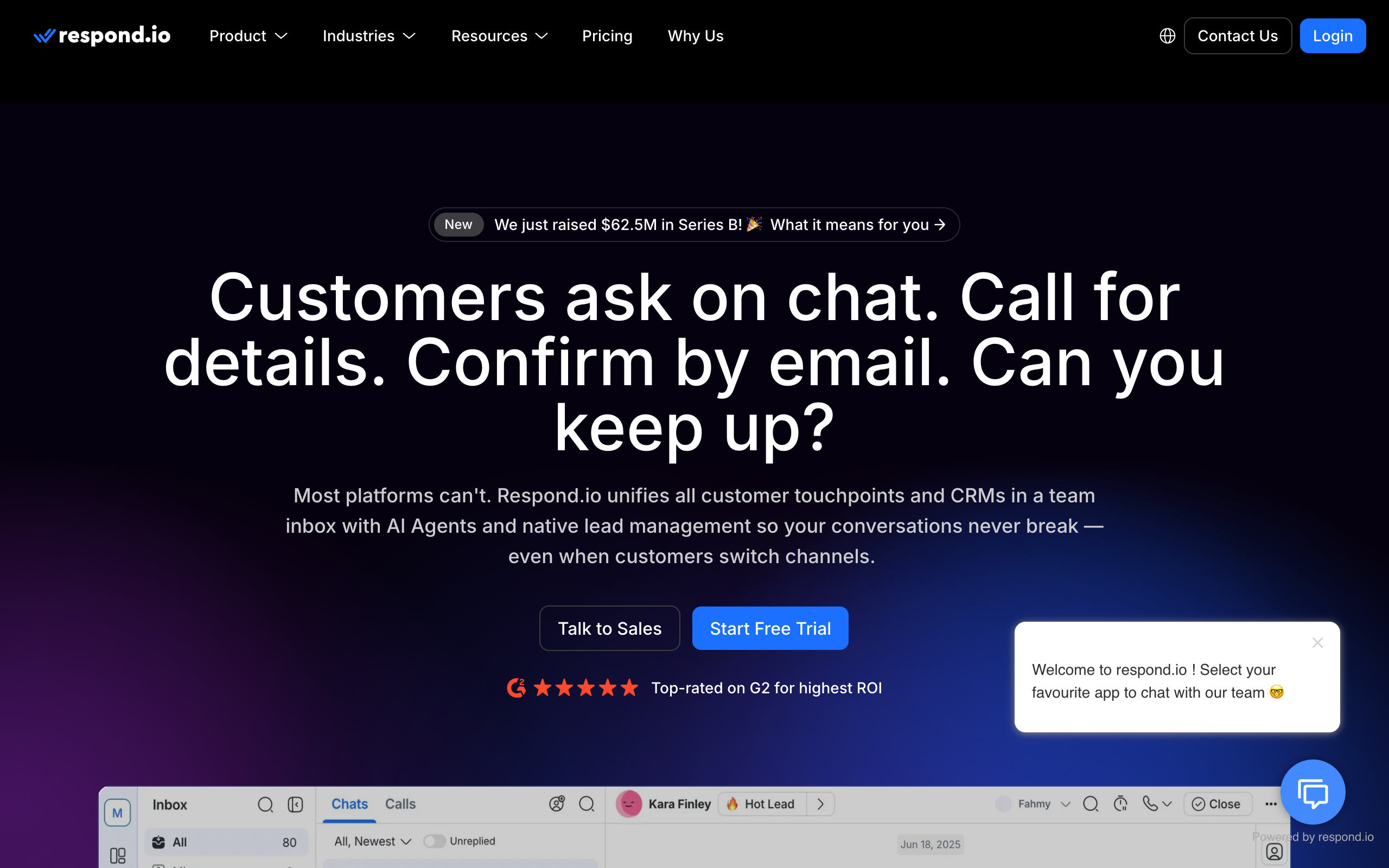
The price reflects that scope. Per its pricing page, AI Agents and broadcasts start on Growth at $159 a month billed yearly, or $199 billed monthly, with 10 users. The $79 Starter plan lists neither.
Pros
- States that it does not mark up WhatsApp's official rates
- AI Agents, shared inbox, and broadcasts in one product
- Coexistence supported, so the Business app stays on the number
- 10 users included on Growth
Cons
- AI Agents and broadcasts start at $159 a month billed yearly
- Starter plan lists neither AI Agents nor broadcasts
- AI credits and monthly active contacts are metered, with paid overages
Best forSales and service teams of five or more that treat WhatsApp as a primary channel and need inbox, AI, and broadcasts together.
2. SiteGPT: best for answering inbound questions from your own content
SiteGPT trains one chatbot on your website, files, and help center, then answers on your website and on WhatsApp. It draws on 12+ source types: websites, files, Google Drive, Notion, YouTube, help centers, and more. Auto-sync keeps them current.
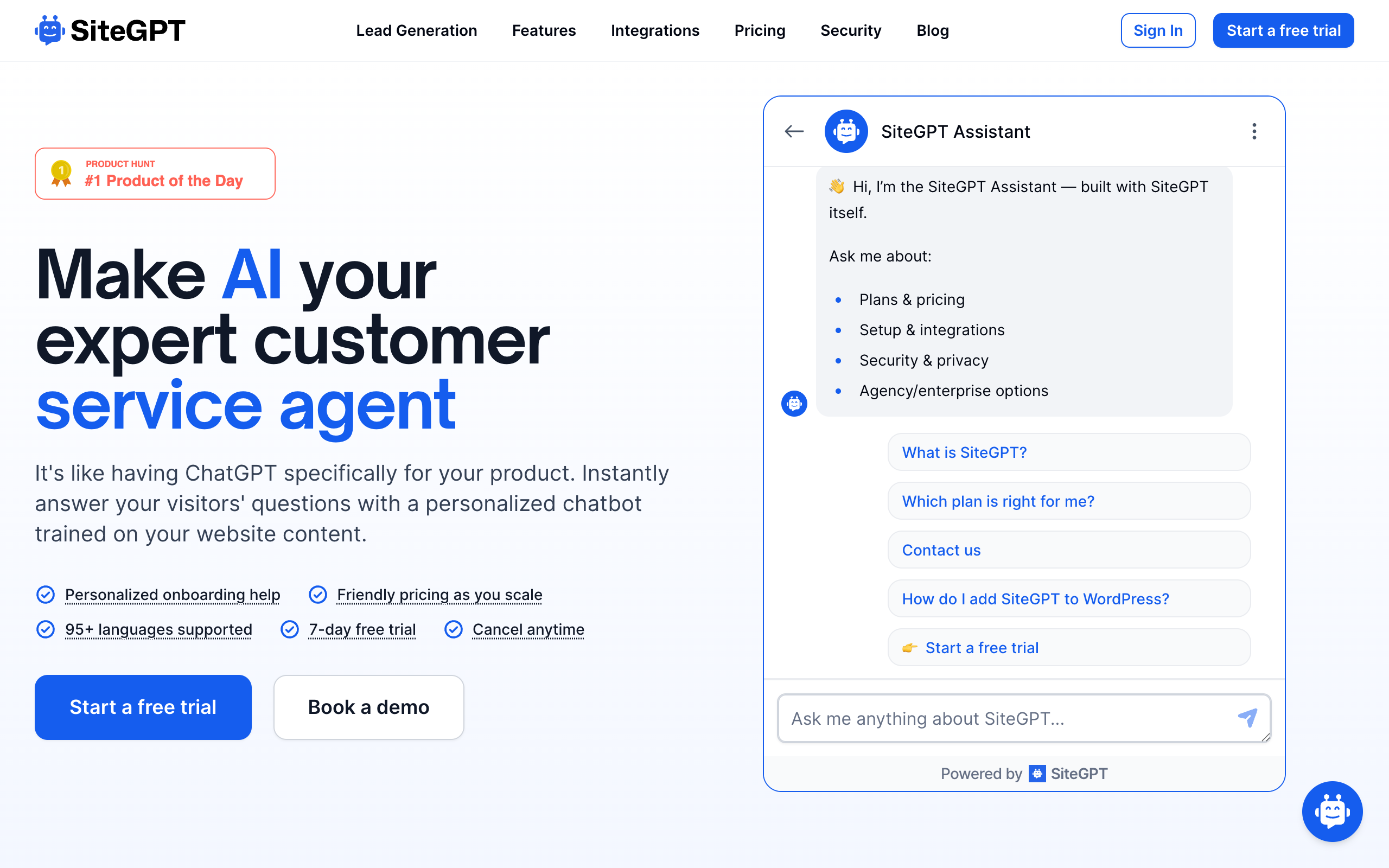
WhatsApp is an add-on at $59 a month billed monthly, or $39 a month billed yearly, on top of any plan. Starter is $59 monthly or $39 a month billed yearly, so the lowest total is $78 a month billed yearly. The SiteGPT docs say Meta does not bill you for conversations, because the add-on covers them.
You can keep your WhatsApp Business app number, connect a dedicated number, or take a free US number. A person takes over from the dashboard, or from the Business app when you keep your app number.
Pros
- Flat price: the add-on covers Meta's conversation fees
- Trains on 12+ source types with auto-sync, and answers in 95+ languages
- Keeps your WhatsApp Business app number, with replies from the app pausing the AI
- In-chat lead form and booking link, with human takeover on every plan
Cons
- Reads text only: voice notes and uncaptioned media get a request to type
- No broadcasts or template campaigns in the documentation
- No shared multi-channel inbox, and Starter has one team member
- Free number option is a US (+1) number
Best forSmall and mid-size businesses whose answers already live in their website and documents, and who want a predictable bill.
3. Tidio: best for the lowest-cost start
Tidio pairs live chat and ticketing with its Lyro AI agent. Its WhatsApp help article says the integration is available on every plan, including Free, and that Tidio adds no markup to Meta's fees.
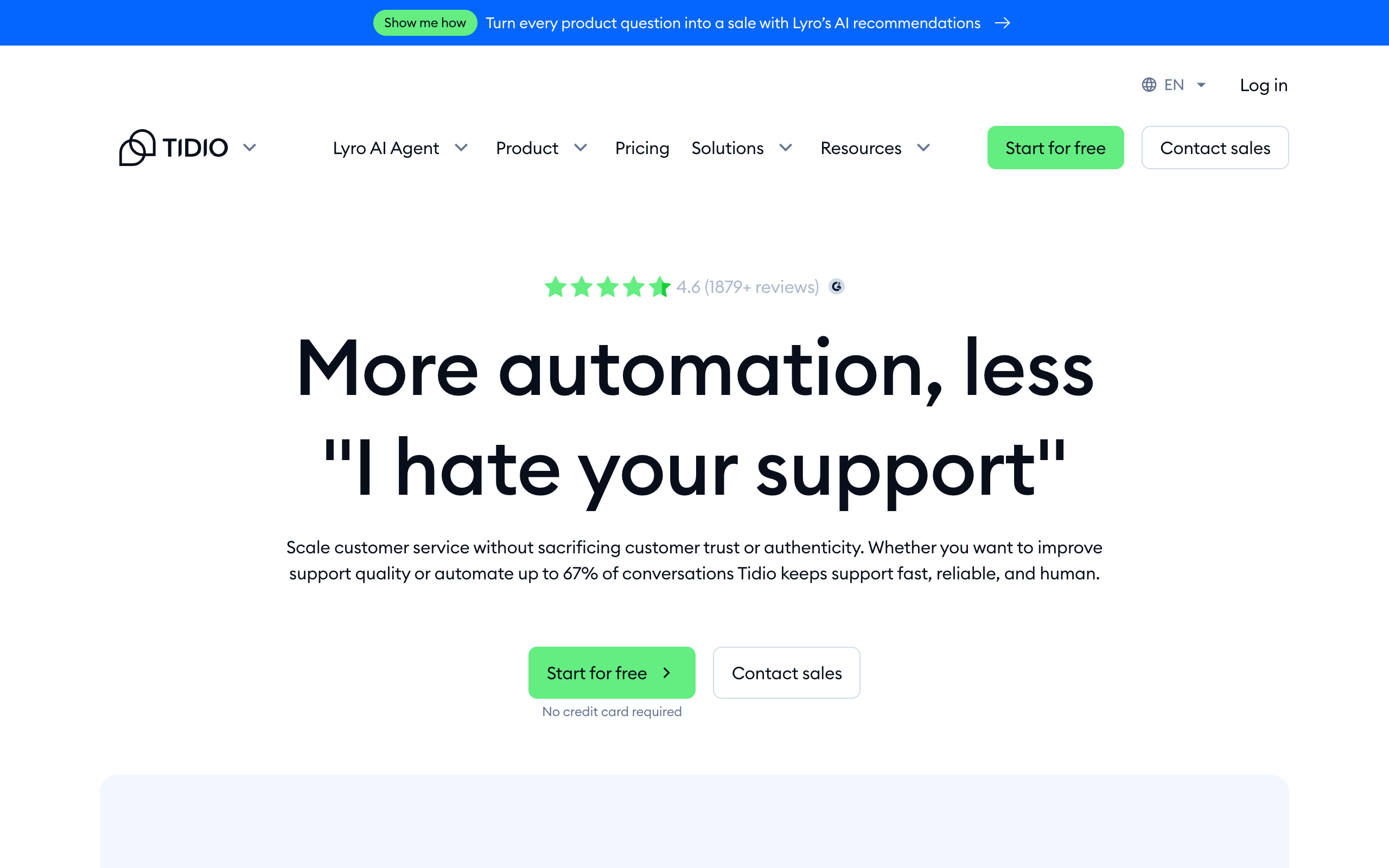
Lyro learns from website content, FAQs, CSV and PDF files, and Zendesk articles. Paid plans start at $24.17 a month billed yearly, and Lyro is a separate add-on from $32.50 a month for 50 conversations. The Free plan includes 50 lifetime Lyro conversations.
The limits are firm. Tidio answers inbound conversations only, so there are no templates or broadcasts. The number must also be removed from the WhatsApp Business app before you connect it.
Pros
- WhatsApp on every plan, including Free
- No markup on Meta's fees, with a spend cap on the free plan
- Shared inbox across live chat, email, Messenger, Instagram, and WhatsApp
Cons
- Inbound only: no templates or broadcasts
- The number must leave the WhatsApp Business app
- Lyro is priced separately from the plan
Best forSmall stores and service businesses that want to test WhatsApp with AI before spending anything.
How Tidio compares feature by feature is in SiteGPT vs Tidio.
4. Chatbase: best for AI that reads attachments and sends campaigns
Chatbase is a content-trained AI agent builder. Its WhatsApp documentation says the agent reads attachments on WhatsApp, and you pay Meta directly for messages, so there is no vendor markup.
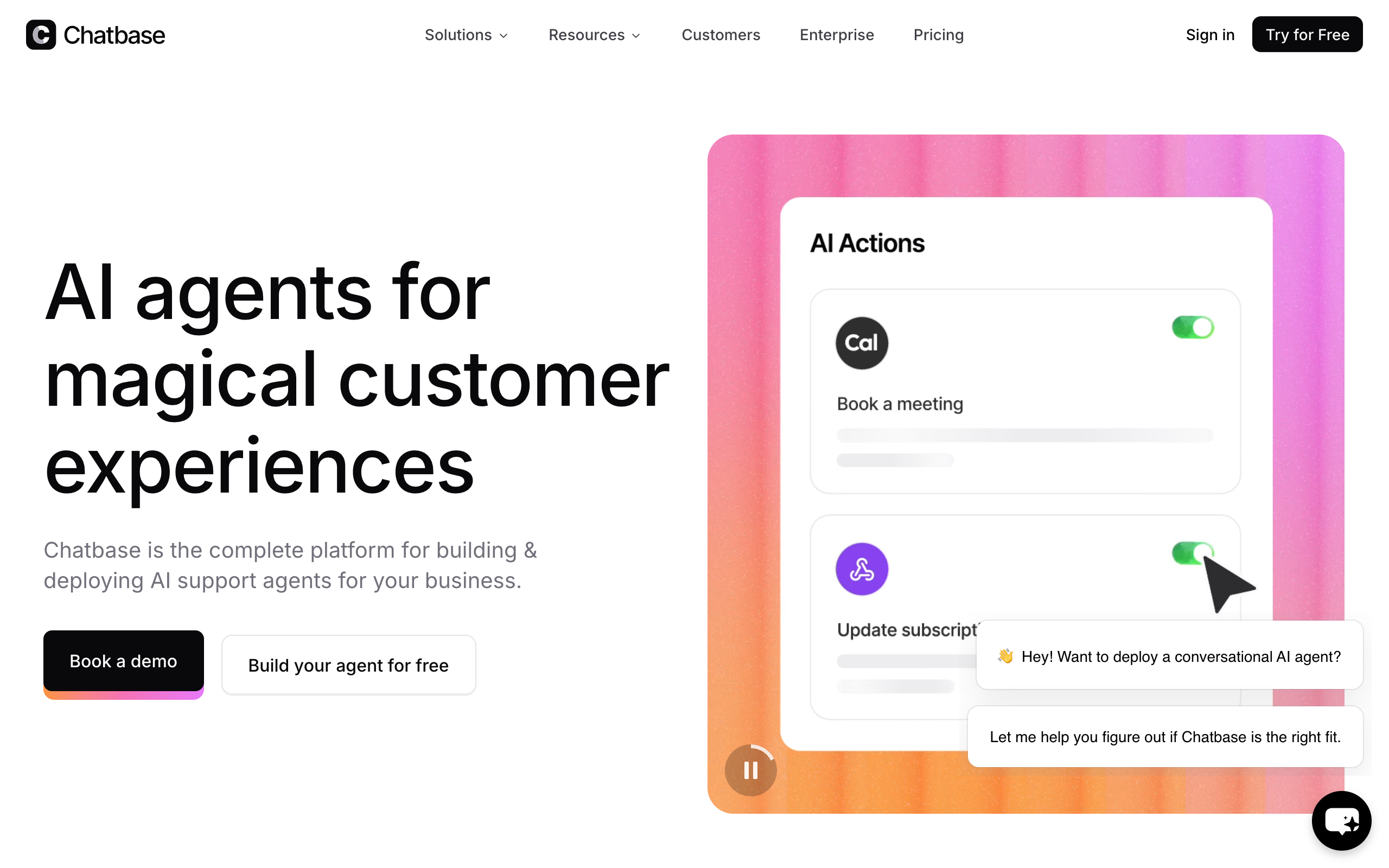
Per its pricing page, Hobby is $40 a month and Standard is $150 a month. Native Helpdesk takeover and outbound campaigns are listed on Standard. The docs say the number "can only be used by the AI agent", so the WhatsApp Business app does not stay on it.
Pros
- Reads attachments on WhatsApp
- Meta fees paid directly to Meta
- Outbound campaigns with approved templates
Cons
- Takeover and campaigns sit on the $150 a month Standard plan
- No coexistence: the number leaves the Business app
- Message credits are metered, at $40 per extra 1,000
Best forTeams whose customers send photos and documents, and who want campaigns from the same tool.
The two products are compared in full in SiteGPT vs Chatbase.
5. Wati: best for WhatsApp-first teams that broadcast
Wati is built for WhatsApp alone. Its pricing page puts a team inbox, AI agents, and 15,000 broadcasts a month on the entry Growth plan, with 3 users.
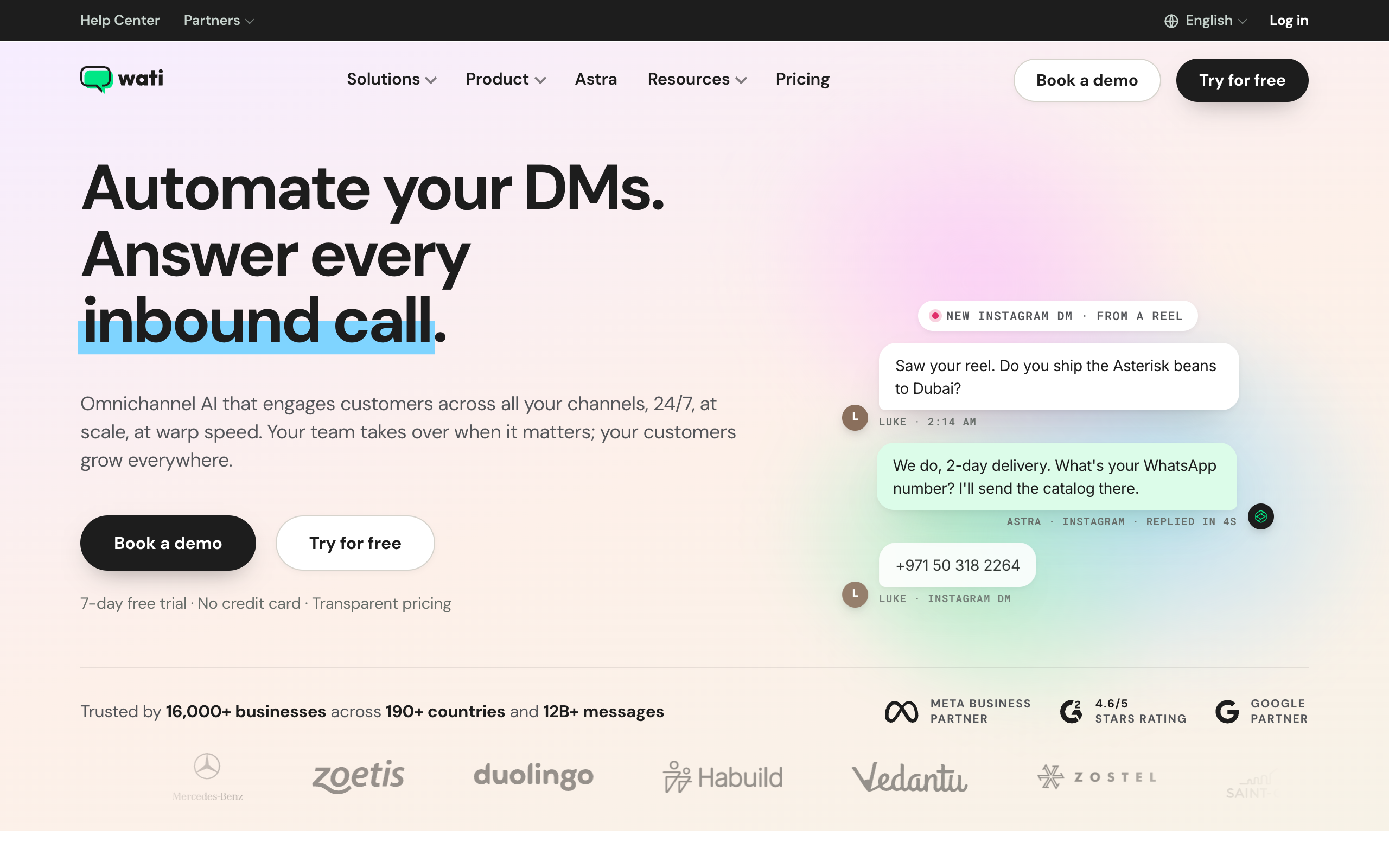
Wati's pricing page shows prices in local currency, so check the figure it displays in your region. Template messages are charged per message from a Wati wallet on top of the plan, and the rate card is only visible inside the app. Coexistence is supported and is enabled by contacting Wati.
Pros
- Team inbox, AI agents, and broadcasts on the entry plan
- Coexistence supported on request
- Built only for WhatsApp, so every feature targets the channel
Cons
- Per-message rates are not published outside the app
- AI credits and chatbot sessions are metered separately
- Prices are localised, which makes comparison harder
Best forTeams whose main WhatsApp job is outbound: order updates, reminders, and promotions, with an inbox for the replies.
6. Manychat: best for low-cost broadcasts and flows
Manychat is a flow builder for Instagram, Messenger, and WhatsApp. Its Pro plan article lists $39 a month billed monthly, or $29 a month billed yearly, for 2,500 active contacts, 3 users, and WhatsApp broadcasts.
Manychat's content-trained feature, AI Knowledge, is documented as available only for the Instagram channel. On WhatsApp you build flows by hand and add AI steps inside them.
Pros
- Lowest paid entry price here for WhatsApp broadcasts
- Publishes its WhatsApp per-message rates by region
- Strong flow builder shared across Instagram and Messenger
Cons
- Knowledge-trained AI does not run on WhatsApp
- Flows must be scripted step by step
- Advanced inbox routing needs the Business plan
Best forCreators and small shops that already run Manychat on Instagram and want scripted WhatsApp flows and broadcasts.
7. Fin (formerly Intercom): best for teams already on the Intercom helpdesk
Fin is the AI agent from the company formerly called Intercom. WhatsApp is available on every helpdesk plan as a pay-as-you-go channel, and Fin deploys on it.
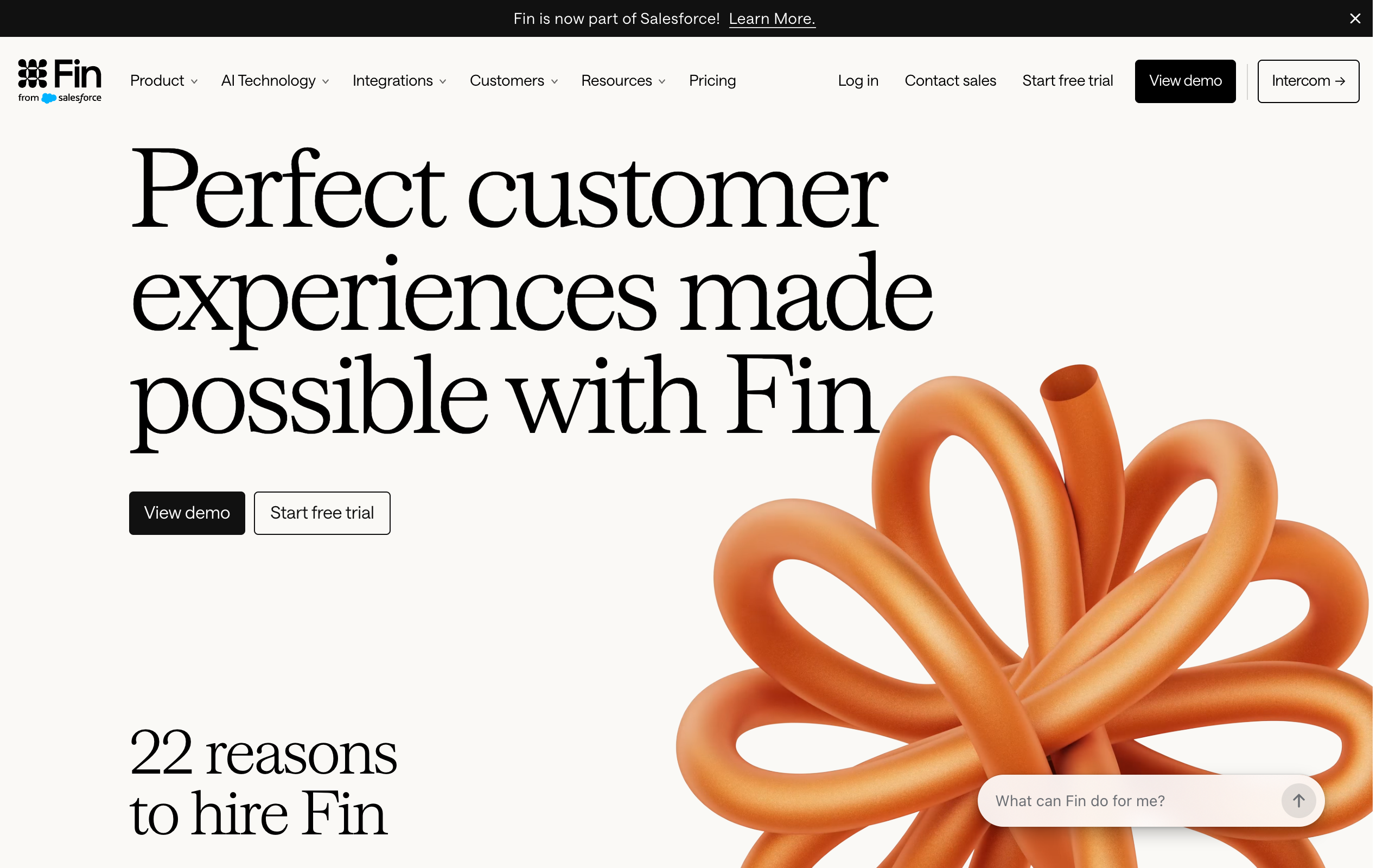
Three charges apply together. Seats start at $29 a month billed yearly, or $39 billed monthly, on Essential. Fin starts at $0.99 per outcome on top.
The usage-based channels article prices bulk outbound WhatsApp from $0.10 a message. The plans article applies the $0.99 rate to chat and email and sends other channels to Sales, so Fin's WhatsApp price is not public.
Pros
- Full helpdesk: inbox, ticketing, routing, and reporting
- WhatsApp available on every plan
- Bulk and event-triggered template sends
Cons
- Seat, outcome, and bulk-message charges stack
- Fin's per-outcome price on WhatsApp is not published
- Coexistence is not documented
Best forTeams that already run service in Intercom and want WhatsApp in the same inbox.
The trade-offs against a flat-priced tool are in SiteGPT vs Intercom.
8. Botpress: best for developers who want full control
Botpress is an agent builder with knowledge bases, LLM agents, and custom code. Its WhatsApp guide has you pay Meta through your own WhatsApp account, and lets you send template messages from a flow.
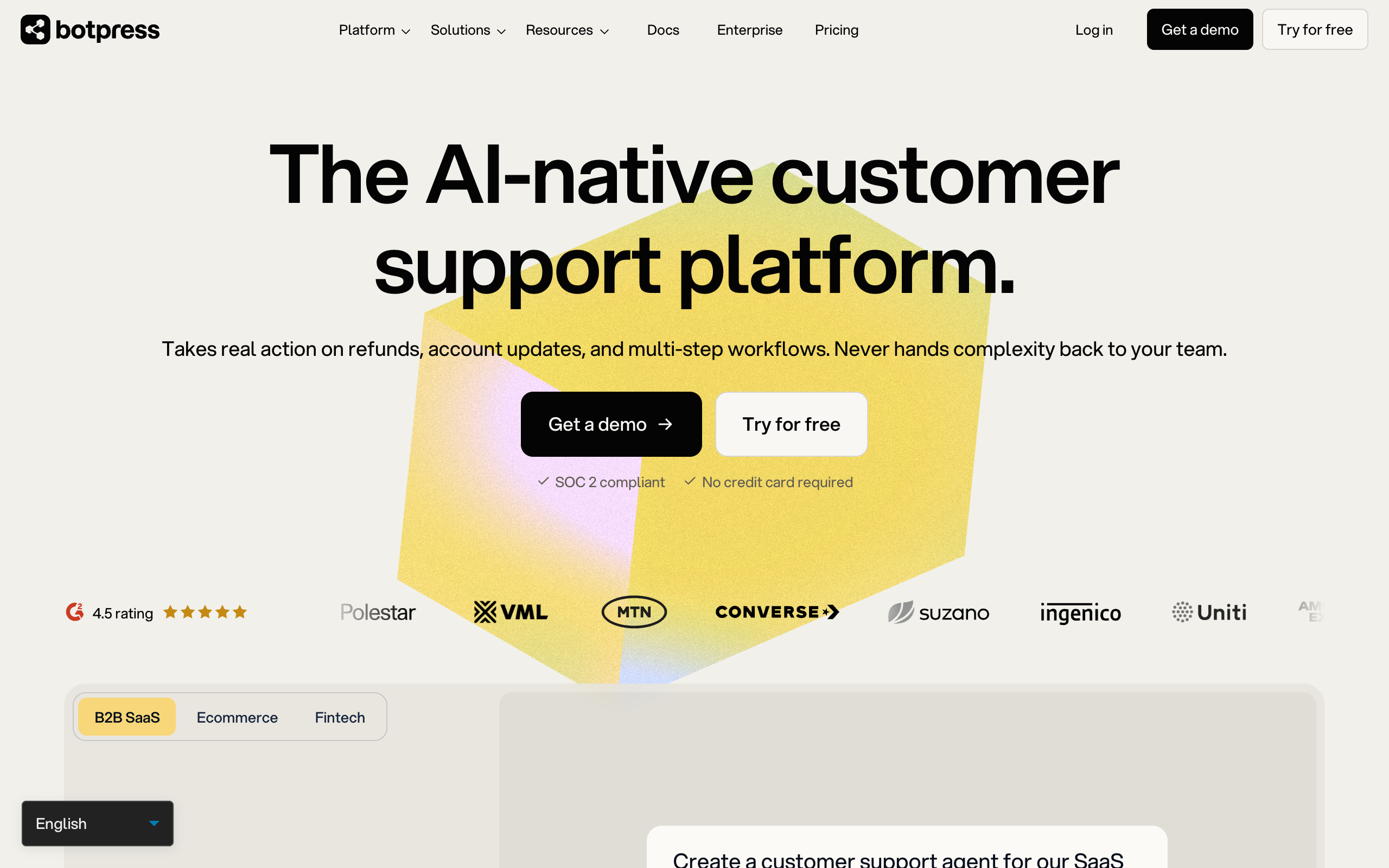
Per its pricing page, the Free plan covers 100 conversations a month. Plus is $150 a month billed annually with 250 conversations and 3 seats, and the human-in-the-loop integration requires Plus or higher. There is no campaign tool.
Pros
- Most flexible builder on this list
- Meta fees paid directly through your own account
- Free plan for prototyping
Cons
- Leans toward developers
- Human handoff starts on the $150 a month Plus plan
- No built-in broadcast tool
Best forTeams with an engineer who will own the agent and wants to shape its logic in code.
9. Landbot: best for visual, scripted flows
Landbot is a visual no-code builder. It offers a Human Takeover block, a team inbox, and scheduled WhatsApp campaigns.
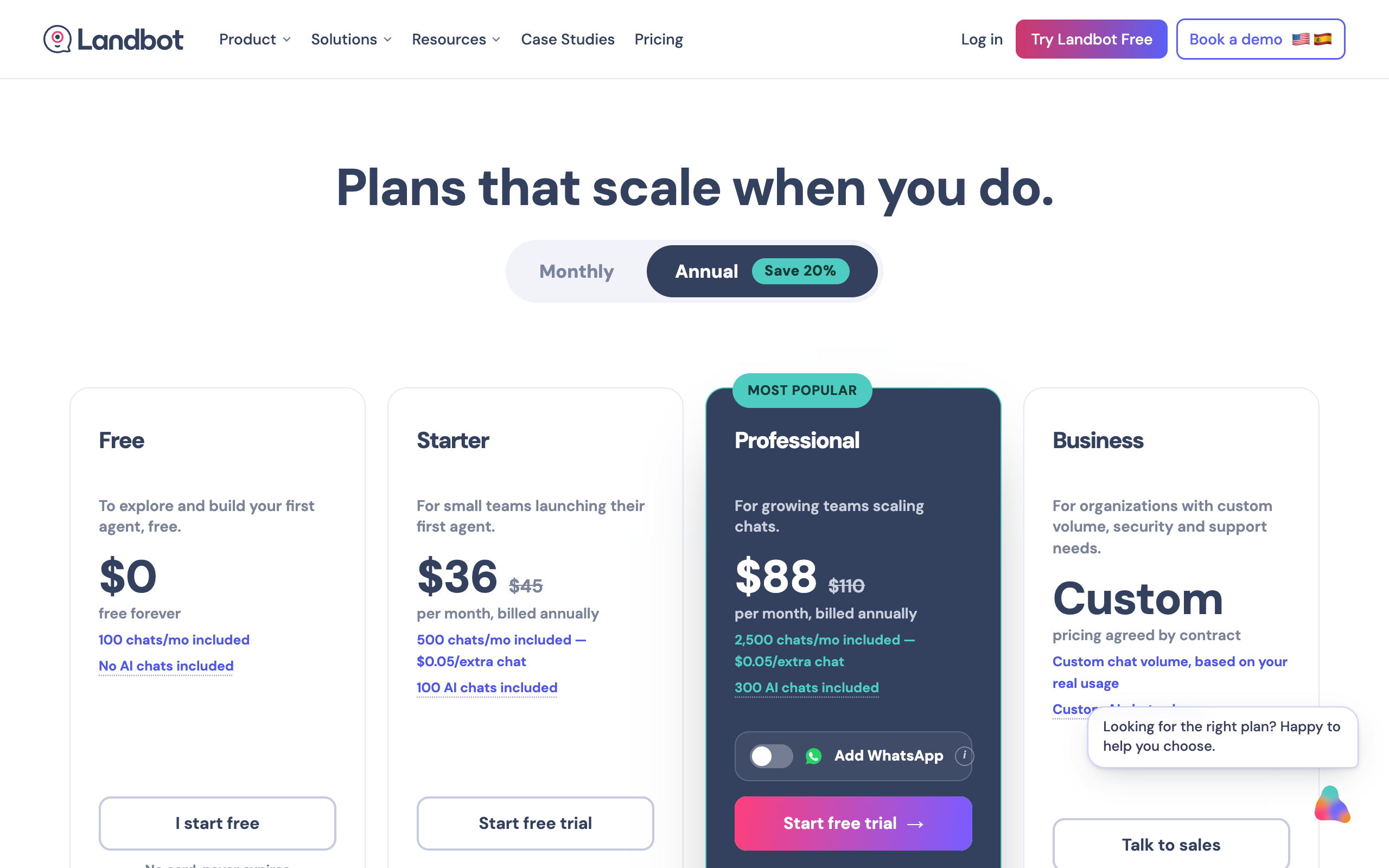
Its pricing page is in euros. The Professional WA plan is listed at €160 a month with 2,500 chats, 500 AI chats, and 3 seats. Landbot adds €0.05 to every template message on top of Meta's cost, and charges €0.10 for each extra AI chat.
Pros
- Clear visual builder for scripted flows
- Takeover block, team inbox, and campaigns
- Service messages free up to 1,000 a month
Cons
- €0.05 markup on every template message
- AI chats metered on top of the plan
- Priced in euros only
Best forMarketing teams that want to design a guided flow, such as lead qualification, screen by screen.
How do the nine platforms compare side by side?
| Platform | Entry price with WhatsApp and AI | Meta fees | Trained on your content | Keeps Business app number | Broadcasts |
|---|---|---|---|---|---|
| respond.io | $159/mo billed yearly (Growth) | Passed through, no markup | Yes | Yes | Yes |
| SiteGPT | $78/mo billed yearly (Starter + add-on) | Covered by the add-on | Yes, 12+ sources | Yes | No |
| Tidio | Free, then $24.17/mo billed yearly + Lyro | Passed through, no markup | Yes | No | No |
| Chatbase | $40/mo (Hobby), $150 for takeover | Paid directly to Meta | Yes | No | Yes (Standard) |
| Wati | Localised, check in your region | Charged from a wallet | AI agents on all plans | On request | Yes |
| Manychat | $29/mo billed yearly (Pro) | Charged from a wallet | Not on WhatsApp | Not confirmed | Yes |
| Fin | $29/seat billed yearly + $0.99/outcome | Inbox replies listed as free | Yes | Not documented | Yes |
| Botpress | $150/mo billed annually (Plus) | Paid directly to Meta | Yes | Not documented | Templates only |
| Landbot | €160/mo (Professional WA) | Meta cost + €0.05 per template | AI agents on paid plans | Not documented | Yes |
"Not documented" means the vendor's public pages did not state it on 13 October 2026. Ask the vendor before you rely on it.
How does the stack fit together?
Many teams need two tools on WhatsApp, because answering and broadcasting are different jobs.
A team that does both often runs a broadcast tool and an answer layer side by side.
Outbound: the broadcast tool
- Order updates and reminders
- Promotions to opted-in contacts
- Approved message templates
- Wati, Manychat, or respond.io
Inbound: the answer layer
- Questions customers send you
- Answers drawn from your content
- Lead capture and handoff to a person
- SiteGPT, Tidio, or Chatbase
A WhatsApp number connects to one platform at a time, so the two jobs usually run on separate numbers. One number sends the campaigns. The other is the number on your website and receipts that customers message with questions.
If you only answer inbound questions, you do not need the broadcast tool at all. US businesses should also know that Meta does not currently deliver marketing templates to US phone numbers.
Which WhatsApp chatbot should you pick?
| Scenario | Best pick | Why |
|---|---|---|
| WhatsApp is a primary sales and service channel | respond.io | Inbox, AI Agents, and broadcasts together, with no markup on Meta's rates. |
| Answers already live in your website and documents | SiteGPT | Trains on 12+ sources and keeps the bill flat, with Meta's conversation fees covered. |
| You want to start without paying | Tidio | WhatsApp on the Free plan, with 50 lifetime Lyro conversations. |
| Customers send photos and documents | Chatbase | Its docs say the agent reads attachments on WhatsApp. |
| Most of your WhatsApp volume is outbound | Wati or Manychat | Both are built around broadcasts and templates. |
| You already run Intercom | Fin | WhatsApp arrives in the inbox your team already uses. |
| An engineer will own the bot | Botpress | The most control over logic, with Meta billed directly. |
Do you need to send broadcasts?
- If Yes, and you also want AI and an inbox in one tool→respond.io or Wati
- If Yes, with scripted flows on a small budget→Manychat
- If No, you answer people who message you→SiteGPT or Tidio
Must the WhatsApp Business app stay on your number?
- If Yes→SiteGPT, respond.io, or Wati
- If No, a dedicated number is fine→Any platform on this list
Once you have picked a platform, the setup steps are in how to create a WhatsApp chatbot. What SiteGPT does on the channel, with its limits, is at WhatsApp AI chatbot.
FAQ
What is the best WhatsApp AI chatbot?
It depends on the job. respond.io is the strongest pick for a team that runs WhatsApp as a full sales and service channel.
SiteGPT is the pick for a business that wants inbound questions answered from its own content at a flat price. Tidio is the lowest-cost way to start.
What is the best no-code WhatsApp chatbot builder?
All nine platforms connect to WhatsApp without code. SiteGPT, Tidio, and Chatbase build the chatbot by training it on your content, so there is no flow to design.
Landbot and Manychat use a visual flow builder where you script each step. Botpress is the most flexible and leans toward developers.
How much does a WhatsApp AI chatbot cost?
Entry prices range from free on Tidio to $159 a month billed yearly on respond.io's Growth plan. SiteGPT is $78 a month billed yearly for Starter plus the WhatsApp add-on.
Meta's per-message fees are extra on most platforms. Since 1 October 2026 Meta charges for replies beyond the first 1,000 a month on each number.
Which WhatsApp chatbots have human handoff?
All nine pass a chat to a person in some form. respond.io, Wati, Tidio, and Fin include a shared inbox.
SiteGPT hands off to its dashboard, or to the WhatsApp Business app when you keep your app number. Chatbase puts native takeover on Standard, and Botpress requires Plus. The handoff itself is compared in best AI chatbots with human handoff.
Which platforms let me keep my WhatsApp Business app number?
SiteGPT, respond.io, and Wati document support for coexistence. Wati enables it on request.
Tidio and Chatbase both say the number must be removed from the app first.
Which WhatsApp chatbots can send broadcasts?
respond.io, Wati, Manychat, Chatbase, Fin, and Landbot send template broadcasts or campaigns. Botpress sends template messages from a flow and has no campaign tool.
Tidio and SiteGPT answer inbound conversations and do not send broadcasts.
Do WhatsApp chatbot platforms mark up Meta's fees?
Some do. respond.io and Tidio state that they add no markup, and Chatbase and Botpress have you pay Meta directly.
Landbot adds €0.05 to each template message. Wati does not publish its rates outside the app. SiteGPT's add-on covers Meta's conversation fees.
Can a WhatsApp chatbot be used for patient conversations?
No platform changes this. Meta's terms state that the WhatsApp Business Platform is not HIPAA compliant and that Meta is not a business associate.
A US healthcare practice should keep protected health information off WhatsApp, whichever chatbot it uses. The reasoning and the HHS sources are in is WhatsApp HIPAA compliant.
How was this ranking built?
Every price, plan, and feature claim comes from each vendor's own pricing page, help center, or documentation, read on 13 October 2026. G2 ratings were read on each G2 page in a browser the same day.
SiteGPT publishes this page and is ranked second for the job stated in its entry.
Sources
- respond.io pricing and WhatsApp cost FAQ. Plans, AI Agents, and the no-markup statement.
- Connect WhatsApp, SiteGPT documentation, and SiteGPT pricing.
- Integration with WhatsApp, Tidio Help Center, and Tidio pricing.
- WhatsApp integration, Chatbase documentation, and Chatbase pricing.
- Wati pricing and WhatsApp coexistence, Wati Help Center.
- Pro plan and AI Knowledge, Manychat Help Center.
- Fin pricing and usage-based channels, Intercom Help Center.
- Botpress pricing and WhatsApp integration guide.
- Landbot pricing and Landbot for WhatsApp.
- Pricing on the WhatsApp Business Platform, Meta for Developers. The 1 October 2026 rate card.