


For content-heavy teams, the strongest Chatbase alternative is SiteGPT. It swaps model-weighted credits for plain message counting, includes more team seats and more chatbots at a lower price, and ingests 12 or more content sources instead of files, links, and Q&A pairs. For the deepest live-agent handoff from one vendor, Fin (formerly Intercom, now owned by Salesforce) ranks first, at a higher cost.
Stay on Chatbase for voice, telephony, and action-heavy agents. Switch to SiteGPT when the job is answering questions from a large, changing body of content.
iShort answer
Chatbase is a good product with three weak spots for content-heavy teams. Every plan includes one AI agent, message credits are spent per model request instead of per customer answer, and removing the Chatbase badge costs $1,188 per year.
A team running 4,000 answers a month pays $1,440 a year on Chatbase Standard. The same team pays $948 a year on SiteGPT Growth (billed yearly) and gets 10,000 messages, 2 chatbots, and 4 seats instead of 3. Switching means retraining SiteGPT on the same sources, which usually takes an afternoon.
If you are switching because a healthcare or education contract now demands a signed BAA, that is an Enterprise conversation on both platforms. SiteGPT publishes its standard BAA and documents what a covered workspace turns off. Read both before you commit. Whether your chatbot needs a BAA at all is covered in do you need a BAA for your website chatbot.
Key takeaways
| Question | Answer |
|---|---|
| Best for deepest handoff | Fin (formerly Intercom), at a higher per-seat plus per-outcome cost |
| Best for content-heavy teams | SiteGPT, for content-trained answering with plain message counting |
| Biggest switching trigger | Credits vary by model and multiply with actions, so monthly cost is hard to forecast |
| Second trigger | Every Chatbase plan includes 1 AI agent; extra agents are $25/mo each |
| Cost at 4,000 answers/mo | Chatbase Standard $1,440/yr vs SiteGPT Growth $948/yr (both billed yearly), a 34% saving |
| White-label cost | Chatbase $1,188/yr add-on vs SiteGPT $468/yr billed yearly ($708/yr on monthly billing) |
| Keep Chatbase if | You need voice, telephony, payment or calendar actions, or a permanent free tier |
80%
of common customer service issues will be resolved autonomously by agentic AI by 2029, cutting operational costs by 30%, according to a Gartner prediction. The platform picked today shapes deflection for years.
Source: Gartner, March 2025Each one is verifiable on the Chatbase pricing page and in its own documentation (pricing checked September 2026).
Credits are not answers
A credit is consumed per request to the AI model, and heavier models consume more. An agent that runs an action makes two requests, so one answer can cost twice the credits.
One agent per plan
Free, Hobby, Standard, and Pro all include exactly 1 AI agent. A second agent is a $25 per month add-on, or $300 per year.
Branding is a premium line item
Removing 'Powered By Chatbase' costs $99 per month, which is $1,188 per year. Full white-labeling is Enterprise-only.
Training size is capped in MB
Extracted training text is limited to 10 MB on Hobby, 20 MB on Standard, and 40 MB on Pro. Large documentation sets hit that ceiling.
What does Chatbase do well?
Chatbase is a capable AI agent platform. It holds 4.8 out of 5 on G2 and 4.3 out of 5 from 73 reviews on Capterra, and reviewers consistently praise setup speed and integration breadth.
The WordPress plugin is the exception. The Chatbase plugin on WordPress.org has not been updated since March 2025, is not tested against any WordPress 7.x release, and holds a 68% rating. That is the weakest of any established plugin in the category. If WordPress is where the widget has to run, the directory data on every option is in best chatbot for WordPress website.
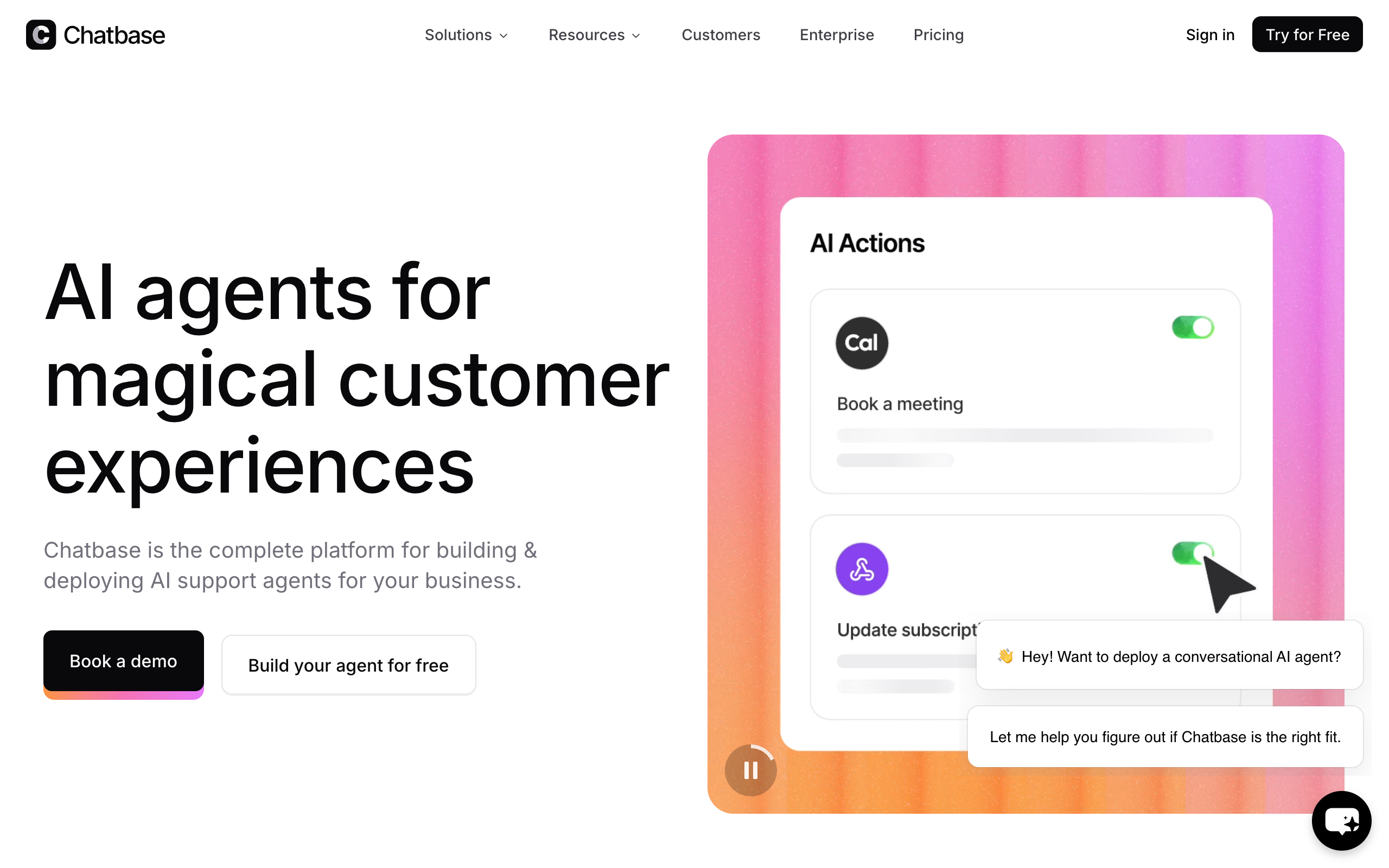
Chatbase does three things better than most standalone AI chatbot tools.
- Actions. Chatbase agents can run documented actions: booking through Cal.com or Calendly, Stripe payments, Salesforce and Shopify lookups, web search, and custom actions.
- Voice and telephony. Standard and above include voice agents with concurrent call limits (10 on Standard, 20 on Pro). Most content-trained chatbot platforms, SiteGPT included, do not offer this.
- A permanent free tier. 50 message credits per month at $0 is enough for a proof of concept. Agents on that plan are deleted after 14 days of inactivity.
If those three capabilities describe the job you need done, keep Chatbase. The rest of this guide is for teams with a different job.
Why do teams switch away from Chatbase?
Teams switch because of how Chatbase meters and prices usage. Answer quality rarely comes up.
1. Message credits are not customer answers
Chatbase bills message credits per request to the AI model. Its own pricing FAQ says "each request made to the AI model costs a certain number of message credits depending on your chosen model." If an agent runs an action, it makes a second model request, which the FAQ describes as "2 requests and 2x the number of credits."
So 4,000 credits does not mean 4,000 conversations, or even 4,000 answers. A verified G2 reviewer described the forecasting problem:
The credit system can be a bit tricky to wrap your head around at first. Since different AI models burn through credits at varying speeds, it's tough to nail down exactly how many you'll need each month.
Running out mid-month triggers auto-recharge at $40 per 1,000 credits, which is $0.04 per credit on top of the plan you already bought.
2. Every plan includes exactly one AI agent
The Chatbase plan comparison table lists Agents: 1 for Free, Hobby, Standard, and Pro alike. A separate bot for a second brand, a second language, or an internal knowledge base is an add-on at $25 per AI agent per month ($300 per year).
3. Removing the badge costs more than most entry plans
The "Remove 'Powered By Chatbase'" add-on is $99 per month, or $1,188 per year, and true white-labeling appears only on the custom-priced Enterprise plan. For an agency or a brand-sensitive site, that add-on alone can exceed the cost of an entire competing platform.
4. Training content is capped in megabytes
Chatbase caps extracted training text at 10 MB on Hobby, 20 MB on Standard, and 40 MB on Pro. Documentation-heavy companies, help centers with thousands of articles, and multi-product catalogs run into that ceiling well before they run into the message ceiling.
5. Sources are narrower than the marketing suggests
Chatbase documents files (PDF, DOC, DOCX, TXT), plain text, website links and sitemaps, Q&A pairs, Notion, and support tickets as sources. That covers the common cases. It does not cover the cloud drives, repositories, and video libraries where a lot of institutional knowledge actually lives.
What should you look for in a Chatbase alternative?
Five checks separate platforms that look similar on a feature grid.
- Predictable metering. Ask whether the unit you are billed for is the unit your customer experiences. Messages are forecastable. Model-weighted credits that multiply with actions are not.
- Source breadth. Count the source types, then check whether they include the systems your content actually lives in: cloud storage, repositories, help centers, video.
- Content freshness. Trained content goes stale as your docs change. Look for automatic re-crawling on a schedule, so nobody has to remember to retrain.
- Included seats. Support is a team activity. Check how many people can log in before the price changes.
- Branding removal cost. Branding removal and white-labeling are priced very differently across vendors, and the difference is often larger than the base plan gap.
What are the best Chatbase alternatives?
The ranking weighs how completely each tool replaces Chatbase for a customer service team. It looks at answer quality, depth of human handoff, and total cost.
- Fin (formerly Intercom, now owned by Salesforce) ranks first on handoff depth. The AI agent and the live-agent inbox come from one vendor, with the strongest native handoff of the group. Seats start at $29 per month billed annually, plus $0.99 per outcome, so the total runs materially higher than a standalone agent.
- SiteGPT ranks second and is the pick for content-heavy teams. It counts plain messages, includes more seats and chatbots per plan, and trains on 12+ source types. The next section covers it in detail.
- ChatBot.com fits teams already running LiveChat or HelpDesk from Text. It has a mature no-code workflow builder, and it bills per user with AI resolutions metered separately.
Crisp and Tidio fit SMB and e-commerce teams that want affordable flat-rate omnichannel messaging with AI attached. They put the inbox first and the content-trained agent second.
Is SiteGPT a good Chatbase alternative?
Yes, for content-heavy teams. SiteGPT trains on your existing business content using retrieval-augmented generation, answers customer questions, and escalates to a person when someone asks for one. It targets the same job as Chatbase, and it makes different tradeoffs on metering, sources, and seats.
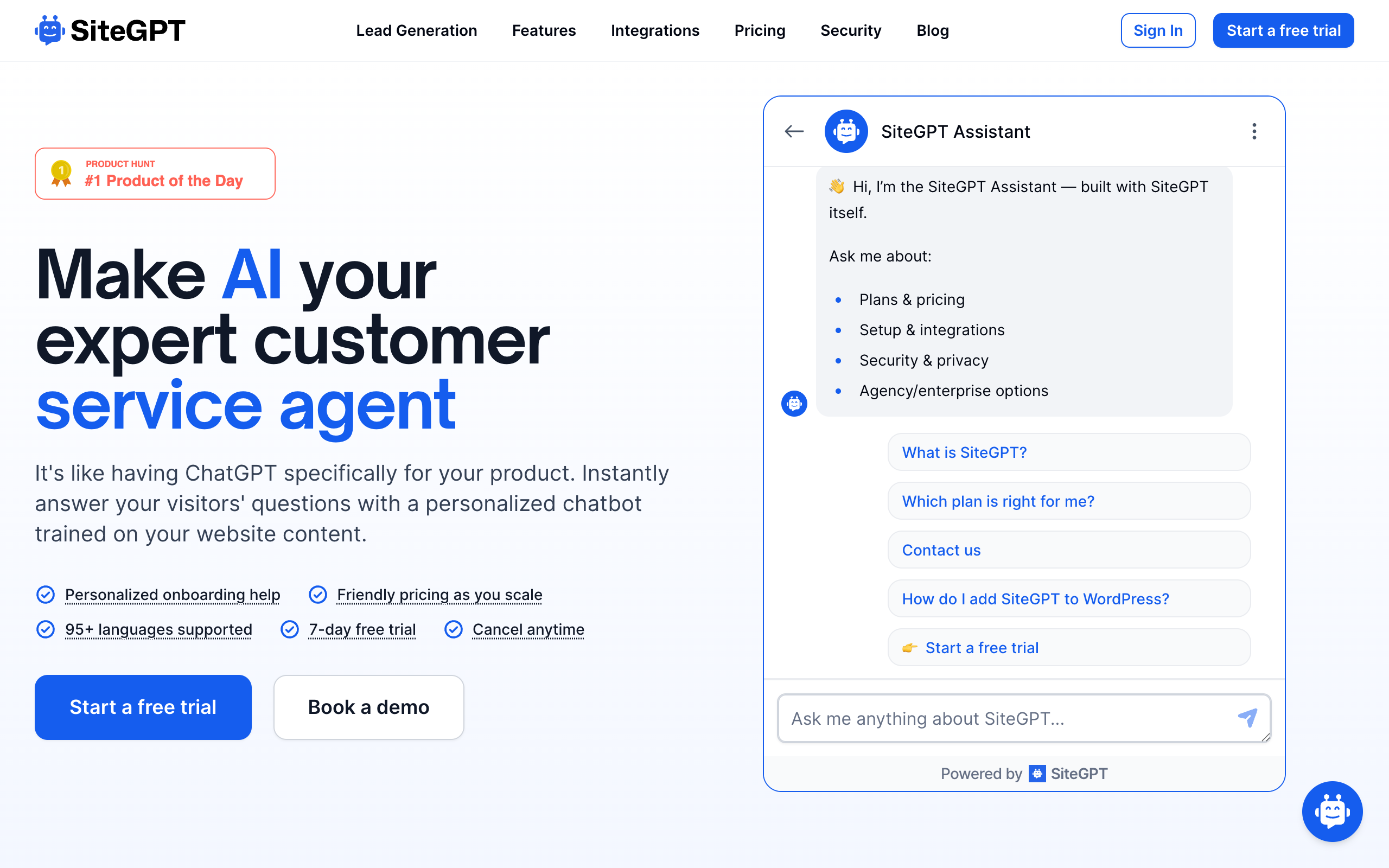
Key features
- 12+ content sources: websites, sitemaps, YouTube videos and channels, GitHub, raw text, file uploads (CSV, TXT, PDF, DOCX, PPTX, MD), Google Drive, Notion, Dropbox, OneDrive, SharePoint, Box, plus help centers including Zendesk, Freshdesk, Intercom, Confluence, and Gitbook.
- Auto-refresh and auto-scan: monthly on Growth, weekly refresh plus daily scan on Scale, daily on Enterprise, so answers track your content instead of drifting from it.
- Plain message counting: 4,000 messages on Starter, 10,000 on Growth, 40,000 on Scale, independent of which model produced the answer.
- Human escalation on all tiers: when a customer asks for a person, the team is notified by email and in the dashboard, plus Slack on Growth and above and webhooks on Scale and above.
- Chat-tool integrations: Slack, Crisp, Messenger, Google Chat, Freshdesk Messaging, and Zoho SalesIQ from Growth. Zendesk is Scale and above only and needs Zendesk Suite Professional or higher. Starter has no chat integrations.
- 95+ languages and full control of appearance, logo, tone, and personality.
Pros
- Message counting is plain and forecastable: a message is a reply, not a model request
- 12+ content sources, including cloud drives, GitHub, YouTube, and help centers
- 4 team seats on Growth at $79/mo billed yearly ($129 monthly), versus 3 seats at $120 billed annually on Chatbase Standard
- 2 chatbots on Growth and 3 on Scale at no extra cost
- Branding removal is $39/mo billed yearly ($59 monthly), $720 per year less than the Chatbase equivalent on annual billing
- Automatic re-crawling keeps trained content current without manual retraining
Cons
- No permanent free plan, only a 7-day free trial
- No voice or telephony agent
- No built-in payment, calendar, or CRM write actions
- WhatsApp is a paid add-on, and Intercom and HubSpot integrations are not live
- No chat integrations on Starter, and Zendesk needs the Scale plan
- Smaller third-party review base than Chatbase on G2 (12 reviews)
Pricing (annual rates, shown per month and billed yearly):
| Plan | Price | Includes |
|---|---|---|
| Starter | $39/mo ($468/yr) | 1 chatbot, 4,000 messages, 1,000 pages, 1 seat |
| Growth | $79/mo ($948/yr) | 2 chatbots, 10,000 messages, 10,000 pages, 4 seats, monthly auto-refresh, API |
| Scale | $259/mo ($3,108/yr) | 3 chatbots, 40,000 messages, 50,000 pages, 10 seats, weekly refresh + daily scan, webhooks |
| Enterprise | Custom | Up to 10,000 chatbots, 500,000 pages, daily refresh, HIPAA BAA available |
Monthly billing is higher at $59, $129, and $429 for Starter, Growth, and Scale. Add-ons: remove SiteGPT branding at $59/mo billed monthly or $39/mo billed yearly, and extra 5,000 messages at the same rates. Source: SiteGPT pricing.
4.8/5·G2(12)SiteGPT makes it easy & intuitive to get your chatbot setup & working in no time at all - anyone can do it.
Verified user on G2
Best forTeams whose chatbot's main job is answering questions from a large, frequently changing body of content, with a clean handoff to a human when the answer is not there.
Is SiteGPT cheaper than Chatbase?
Both platforms discount annual billing, so the fair comparison is annual against annual. Every figure below uses annual billing, including SiteGPT add-ons at their $39/mo yearly rate. Chatbase advertises 20% off yearly plans, and SiteGPT advertises up to 40% off.
| What you need | Chatbase | SiteGPT | Difference |
|---|---|---|---|
| 4,000 answers per month | Standard, $120/mo ($1,440/yr), 3 seats | Growth, $79/mo ($948/yr), 4 seats, 10,000 messages | $492/yr less on SiteGPT |
| Entry paid plan | Hobby, $32/mo ($384/yr), 700 credits | Starter, $39/mo ($468/yr), 4,000 messages | $84/yr more on SiteGPT, roughly 6x the message allowance |
| Two chatbots | Standard + 1 extra agent, $145/mo ($1,740/yr) | Growth, $79/mo ($948/yr) | $792/yr less on SiteGPT |
| Unbranded widget | Standard + branding removal, $219/mo ($2,628/yr) | Growth + branding removal, $118/mo ($1,416/yr) | $1,212/yr less on SiteGPT |
| High volume | Pro, $400/mo ($4,800/yr), 15,000 credits, 5 seats | Scale, $259/mo ($3,108/yr), 40,000 messages, 10 seats | $1,692/yr less on SiteGPT |
$1,212 saved per year, a 46% reduction
Chatbase Standard ($1,440/yr) plus branding removal ($1,188/yr) totals $2,628/yr for 4,000 credits and 3 seats. SiteGPT Growth ($948/yr) plus branding removal ($468/yr) totals $1,416/yr for 10,000 messages, 2 chatbots, and 4 seats.
Branding removal alone costs $1,188 per year on Chatbase and $468 per year on SiteGPT (billed yearly), a $720 annual gap before either platform has answered a single question.
Chatbase has changed its plan allowances more than once during 2026, so confirm the tier before budgeting. The full Chatbase pricing breakdown, tier by tier and add-on by add-on, sits in the Chatbase review.
What other Chatbase alternatives are worth knowing?
For a broader field with verified handoff details on each tool, see the roundup of AI chatbots with human handoff. For a feature-by-feature head-to-head, see SiteGPT vs Chatbase. For the review-intent question of whether Chatbase itself is any good, see the Chatbase review. Teams running the same switching math against a credit-metered documentation tool will find it in the DocsBot alternative guide.
Is there a free Chatbase alternative?
No content-trained platform in this guide offers a permanent free tier that is production-ready. Chatbase's own Free plan (50 message credits per month, agents deleted after 14 days of inactivity) is the closest thing to a free option in this category, and it is built for proofs of concept rather than live support.
- SiteGPT offers a 7-day free trial on every plan instead of a free tier (credit card required), so you test the full product rather than a capped one.
- Tidio has a permanent free plan with 50 conversations per month, but its Lyro AI is a paid add-on.
- A free plan that caps you at 50 answers a month covers roughly 2 conversations a day, which no support team can run on.
Is there an open-source Chatbase alternative?
Yes, if you self-host a retrieval-augmented generation stack and build the same behavior yourself. You then own hosting, model API costs, retraining pipelines, widget development, and escalation logic as engineering work instead of paying a subscription.
- Self-hosting makes sense when data residency rules prohibit any third-party processor, or when a chatbot is core product rather than a support tool.
- For everyone else, the build cost usually exceeds years of a $39-79/mo subscription (SiteGPT Starter or Growth, billed yearly) before the first answer ships.
- Teams choosing open source for data-control reasons should first check whether a vendor's compliance posture (SOC 2 Type II, GDPR, a signed BAA) already satisfies the requirement.
Which Chatbase alternative is GDPR compliant?
Both SiteGPT and Chatbase state GDPR compliance, so GDPR alone does not separate them. SiteGPT is also SOC 2 Type II certified, and for teams whose contracts require HIPAA, it publishes its standard BAA for legal review before any sales call.
- On both platforms, HIPAA support is Enterprise-only. No Starter, Growth, Scale, Hobby, Standard, or Pro plan on either side includes a BAA.
- SiteGPT documents what a covered workspace turns off. EU and US procurement reviews ask for that level of detail.
- The current program status lives at sitegpt.ai/hipaa.
A GDPR claim on a vendor page does not settle your own obligations as the controller. What those are for a website chatbot is covered in GDPR and your website chatbot, and the clauses to check in the vendor's contract are in what to look for in a chatbot DPA.
How do you migrate from Chatbase to SiteGPT?
Moving between content-trained platforms means retraining on the same sources. You do not export data. Neither platform locks your knowledge inside a proprietary model file, because both learn from source content you already own.
- List your live sources. Open the Chatbase agent and note every source it trains on: the website or sitemap, uploaded files, Q&A pairs, Notion pages, and any ticket sources.
- Point SiteGPT at the same material. Add the site or sitemap, connect the help center, and connect the drives (Google Drive, Notion, Dropbox, OneDrive, SharePoint, Box) that hold content you were previously uploading by hand. Training starts immediately.
- Rebuild instructions and persona. Copy your Chatbase system instructions across, then set tone, language, and appearance. Keep the escalation rule explicit: when a customer asks for a person, escalate.
- Test the top 20 questions in parallel. Run your most common real questions against both agents during the 7-day trial and compare answers side by side. Do not skip this step.
- Swap the widget and turn off auto-recharge. Replace the script tag and confirm escalation notifications reach the right inbox or Slack channel. Then disable Chatbase auto-recharge credits before you cancel, so no top-up bills after the switch.
When is Chatbase still the right choice?
Switching would be a mistake in three cases.
- You need voice or telephony. Chatbase includes voice agents on Standard and above, with 10 concurrent calls on Standard and 20 on Pro. SiteGPT does not offer voice. At enterprise scale, Decagon and Sierra also run voice agents, on custom contracts.
- Your agent needs to take actions. Booking through Cal.com or Calendly, taking a Stripe payment, writing to Salesforce, or pulling live Shopify order data are documented Chatbase actions. SiteGPT focuses on answering from content and escalating to a person.
- You need a permanent free tier. SiteGPT's trial is 7 days. Chatbase's Free plan runs indefinitely at 50 credits per month, subject to the 14-day inactivity deletion rule.
How do you choose a Chatbase alternative?
What is the chatbot's main job?
- If answering questions from documentation, help center, or site content→SiteGPT
- If running the AI agent and a full live-agent desk from one vendor→Fin (formerly Intercom)
- If adding AI to LiveChat or HelpDesk you already run→ChatBot.com
- If live chat plus AI for a small e-commerce store→Tidio or Crisp
- If taking actions: booking, payments, CRM writes→Chatbase
- If handling phone calls as well as chat→Chatbase
How predictable does the monthly bill need to be?
- If finance needs a fixed number→SiteGPT, which counts messages
- If variable usage is acceptable→Chatbase, or Fin at $0.99 per outcome
How many bots and seats do you need?
- If 2 or more bots, or 4 or more people logging in→SiteGPT Growth at $79/mo billed yearly ($129 monthly)
- If one bot, one or two people→Chatbase Hobby at $32/mo billed annually is the cheapest entry
Does the widget need to be unbranded?
- If yes, and budget matters→SiteGPT, at $468/yr billed yearly versus $1,188/yr
- If yes, with full white-label and SSO→Chatbase Enterprise or SiteGPT Enterprise
Which tool fits your use case?
| Scenario | Best pick | Why |
|---|---|---|
| SaaS company with 2,000+ documentation pages | SiteGPT | 10,000 pages on Growth, and MB caps do not apply |
| Agency running client chatbots unbranded | SiteGPT | Branding removal at $468/yr billed yearly instead of $1,188/yr |
| Support team of 4 sharing one dashboard | SiteGPT Growth | 4 seats included at $79/mo versus 3 seats at $120/mo (both billed yearly) |
| Large support org that wants AI and the live-agent inbox in one platform | Fin | Shared inbox and the deepest native handoff, at $29+/seat plus $0.99 per outcome |
| Team already running LiveChat or HelpDesk | ChatBot.com | Same Text ecosystem, with a mature no-code workflow builder |
| Small online store that wants live chat plus AI | Tidio | Free plan to start. Starter plus Lyro AI is about $57/mo billed annually |
| Team that needs a bot to book demos automatically | Chatbase | Documented Cal.com and Calendly booking actions |
| Business handling inbound phone support | Chatbase | Voice and telephony on Standard and above |
| Knowledge spread across Google Drive and Notion | SiteGPT | Native cloud storage and Notion ingestion |
| Docs that change weekly | SiteGPT Scale | Weekly auto-refresh plus daily auto-scan |
| Multilingual customer base | SiteGPT | 95+ documented languages with per-bot language control |
| Escalations must land in Slack or Crisp | SiteGPT Growth | Native Slack and Crisp integrations from Growth |
| Escalations must land in Zendesk | SiteGPT Scale or Chatbase | SiteGPT's Zendesk integration needs Scale+ and Zendesk Suite Professional+. Chatbase also escalates into Zendesk |
| Proof of concept with no budget | Chatbase Free | 50 credits per month at $0, with 14-day inactivity deletion |
| Regulated business needing a signed BAA | SiteGPT Enterprise | Standard BAA published for review. Enterprise only, as on Chatbase |
| Two brands, one support team | SiteGPT Growth | 2 chatbots included instead of $25/mo per extra agent |
Two of those rows collide if PHI is involved, so read them together. On a SiteGPT HIPAA workspace, the Zendesk, Slack, and Crisp chat integrations are switched off. Connected apps such as Google Drive and Notion cannot be linked, because conversations and content have to stay inside the covered chain.
Website links, file uploads, and text snippets remain available, and PHI is confined to end-user conversations while training content stays PHI-free. Conversation text is redacted 7 days after last activity by default, configurable on the order form.
SiteGPT's HIPAA page is the authoritative source for what is available today, and the BAA itself is published for legal review.
Frequently asked questions
Basics
What is the best Chatbase alternative? It depends on the job. For teams whose chatbot answers questions from a large body of content, SiteGPT is the strongest pick. It ingests 12 or more source types including Google Drive, Notion, Dropbox, OneDrive, SharePoint, Box, GitHub, YouTube, and help centers, counts plain messages instead of model-weighted credits, and includes 4 team seats on Growth ($79/mo billed yearly, $129 monthly). Fin (formerly Intercom, now owned by Salesforce) is the stronger pick when you want the AI agent and a full live-agent desk from one vendor. Chatbase remains the better pick for voice, telephony, and action-heavy agents.
Why do teams switch away from Chatbase? The three most common reasons are the credit model, the one-agent limit, and branding costs. Chatbase bills message credits per request to the AI model, and its own documentation confirms that different models consume different credit amounts and that enabled actions can double the credits used for a single answer. Every Chatbase plan includes one AI agent, with extra agents at $25 per month each, and removing Chatbase branding costs $99 per month or $1,188 per year.
When is Chatbase still the better choice? Chatbase is the better choice for voice and telephony agents, which SiteGPT does not offer, for agents that need to take actions such as booking meetings through Cal.com or Calendly, processing Stripe payments, or writing to Salesforce, and for anyone who needs a permanently free tier to experiment with.
Pricing
How much does Chatbase cost in 2026? Chatbase pricing, verified on its pricing page in September 2026, is $0 for Free with 50 message credits per month, $32 per month billed annually ($384 per year) for Hobby with 700 credits, $120 per month billed annually ($1,440 per year) for Standard with 4,000 credits, and $400 per month billed annually ($4,800 per year) for Pro with 15,000 credits. Enterprise pricing is custom and is the only tier that includes white-labeling and SSO.
Is SiteGPT cheaper than Chatbase? At comparable message volume, yes. Chatbase Standard costs $120 per month billed annually for 4,000 message credits and 3 seats. SiteGPT Growth costs $79 per month billed yearly ($129 billed monthly) for 10,000 messages, 2 chatbots, and 4 team members. On annual billing that is $492 less per year, a 34% saving, with 2.5 times the message allowance.
How much does it cost to remove Chatbase branding? Removing the "Powered By Chatbase" badge is an add-on priced at $99 per month or $1,188 per year, and full white-labeling is listed only on the custom-priced Enterprise plan. SiteGPT sells branding removal as an add-on at $39/mo billed yearly ($468 per year), which is $720 per year less than the Chatbase add-on. On monthly billing the SiteGPT add-on is $59/mo, still $480 per year less.
Does SiteGPT have a free plan? No. SiteGPT offers a 7-day free trial on all plans (credit card required) rather than a permanent free tier. Chatbase has a Free plan with 50 message credits per month, though its own pricing page notes that agents are deleted after 14 days of inactivity on that plan.
Limits and metering
What is the difference between message credits and messages? A Chatbase message credit is consumed per request to the AI model, and the number of credits per request depends on the model selected. If an agent runs an action, such as checking a calendar, it makes an extra model request and consumes extra credits, so one customer answer can cost more than one credit. SiteGPT counts messages, so 4,000 messages on the Starter plan means 4,000 replies regardless of which model produced them.
How many AI agents does each Chatbase plan include? Every Chatbase plan, from Free through Pro, includes 1 AI agent. Additional agents are an add-on at $25 per AI agent per month, or $300 per AI agent per year. SiteGPT includes 1 chatbot on Starter, 2 on Growth, and 3 on Scale at no extra cost.
Which platform trains on more content? SiteGPT trains on more content at every paid tier above entry level. Chatbase caps extracted training text at 10 MB on Hobby, 20 MB on Standard, and 40 MB on Pro. SiteGPT allows 1,000 pages on Starter, 10,000 on Growth, and 50,000 on Scale, where one page is roughly 2,500 cleaned characters, so the Growth plan alone covers roughly 25 million characters.
Do both platforms support multiple languages? Both support multilingual conversations. SiteGPT documents support for 95 or more languages. Chatbase does not publish a specific language count on its pricing page, and its language coverage follows the underlying model selected.
Switching
Can you migrate a Chatbase agent to SiteGPT? There is no one-click importer between the two platforms, and there does not need to be. Both are trained on source content rather than on a proprietary model file, so you point SiteGPT at the same website, sitemap, help center, and documents Chatbase was trained on, then swap the widget script. Most teams complete the retrain in an afternoon, and the 7-day free trial covers the overlap.
Does SiteGPT support human handoff like Chatbase? Yes. SiteGPT escalates a chat to a human agent when a customer asks to talk to a person, and notifies the team by email and in the dashboard, plus Slack on Growth and above and webhooks on Scale and above. Escalation is available on all tiers, with seat counts scaling by plan. Chatbase escalates through its own Help Desk or a connected desk such as Zendesk, Freshdesk, or Fin.
How do the two platforms compare on third-party ratings? Chatbase holds 4.8 out of 5 on G2 and 4.3 out of 5 from 73 reviews on Capterra. SiteGPT holds 4.8 out of 5 from 12 reviews on G2. The two score identically on G2, and Chatbase has the larger review base.
Sources
- Chatbase pricing, including plan comparison table and add-ons, verified 2 September 2026
- Chatbase documentation for sources, actions, integrations, and escalation
- Chatbase plugin on WordPress.org, for the 68% rating and March 2025 last update
- Chatbase reviews on G2, 4.8/5
- Chatbase reviews on Capterra, 4.3/5 from 73 reviews
- SiteGPT pricing and SiteGPT reviews on G2, 4.8/5 from 12 reviews
- SiteGPT HIPAA program page, standard BAA, and HIPAA workspace docs for BAA availability and covered-workspace behavior
- Gartner, "Agentic AI Will Autonomously Resolve 80% of Common Customer Service Issues by 2029" (March 2025)