


Decagon is an enterprise AI agent platform for customer service. It fits large companies with high chat, email, and voice volume and engineers who can manage the agent. Smaller teams usually cannot evaluate it, because Decagon publishes no prices and offers no trial.
iShort answer
This review scores Decagon 4.2 out of 5. Its agents follow written procedures and take actions through APIs and MCP. They work across chat, email, and voice, with built-in testing and QA.
The buying process is the weak point. Decagon has no public price and no trial. Healthcare buyers also need a written BAA commitment, because no public Decagon page confirms one.
Key takeaways
| Aspect | Verdict |
|---|---|
| Best for | Enterprises with high volume across chat, email, and voice |
| Pricing | Not published. Per-conversation or per-resolution contracts through sales |
| Biggest strength | Agent Operating Procedures plus simulation testing and QA |
| Biggest limitation | No price, no trial, and a demo before anything else |
| Compliance | SOC 2 Type II, ISO 27001, PCI DSS, and HIPAA listed on its trust center |
| Better fit for small teams | SiteGPT, from $39 a month billed yearly |
The four things to know before you book the demo.
What it is
An AI agent platform that resolves chat, email, and voice conversations and takes actions in the systems you connect.
Who buys it
Enterprises such as Chime, Duolingo, and Rippling. Decagon added more than 100 enterprise customers in its last fiscal year.
How you buy it
A demo, then a custom contract priced per conversation or per resolution. No rates are published.
What to confirm
A signed BAA if you handle patient data. The trust center lists HIPAA, but no public page confirms a BAA.
What is Decagon?
Decagon is a conversational AI platform that builds and runs AI agents for customer service. It calls its product "the AI concierge for every customer." The agents handle conversations end to end and take actions in the tools a company already uses.
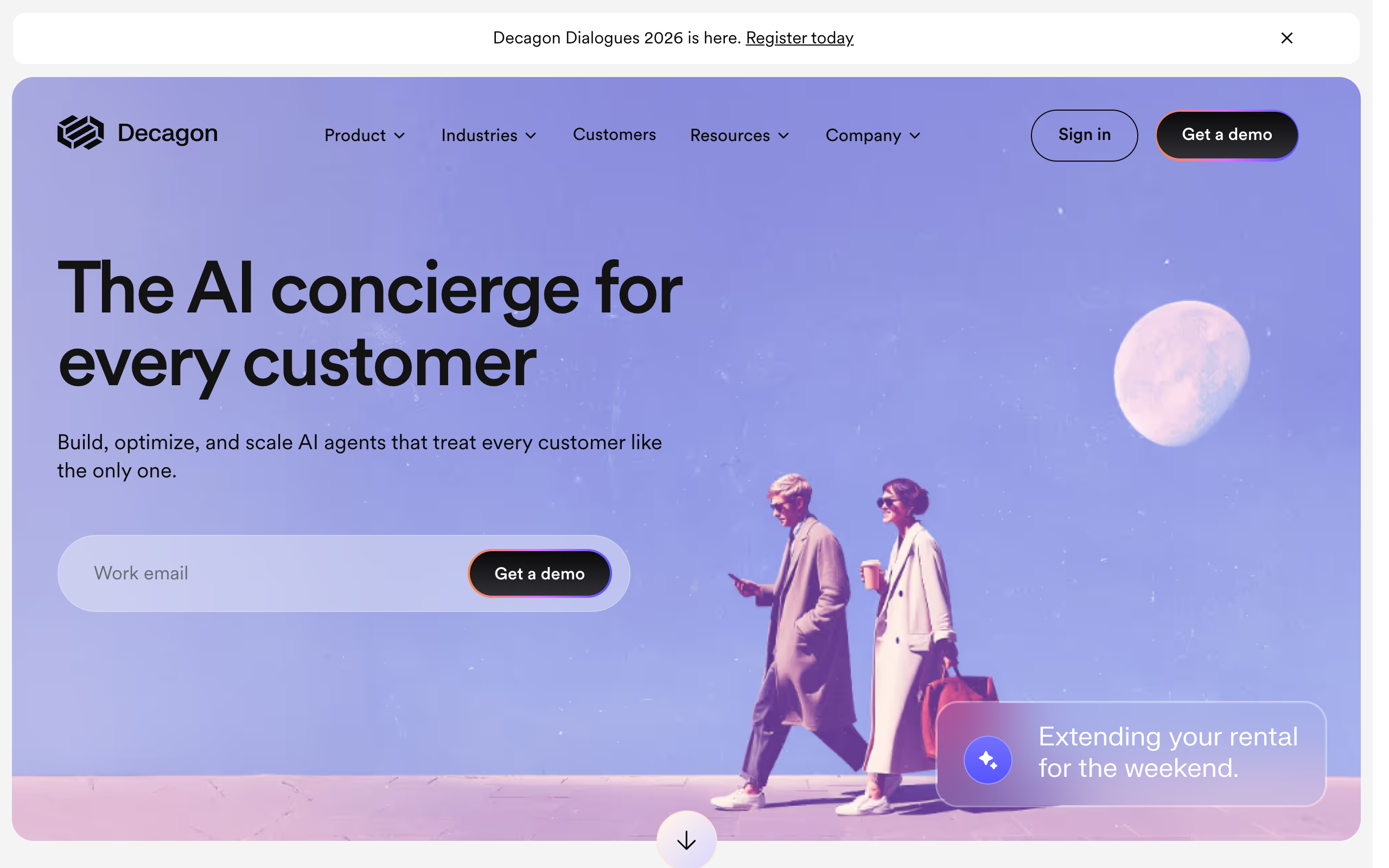
The company raised a $250 million Series D at a $4.5 billion valuation on 27 January 2026, led by Coatue and Index Ventures. SiliconANGLE put total funding at about $481 million. Decagon says it added more than 100 enterprise customers in its last fiscal year, including Avis Budget Group, Block, and Deutsche Telekom. Its customer page also shows Block's Cash App.
Decagon sits at the far end of the range this category covers. A content-trained tool answers questions from your docs. Decagon's agents also check accounts, change orders, and call customers back. The difference between those two levels is explained in AI agent vs chatbot.
What can Decagon do?
Agent Operating Procedures
Agent Operating Procedures (AOPs) are how you tell a Decagon agent what to do. You write them in plain language, the way you would write a procedure for a new hire. Engineers can version them in Git. Decagon says each run shows why the agent took the steps it took.
Duet, Decagon's AI partner, drafts AOPs from past transcripts and suggests changes. Duet Autopilot, released on 9 June 2026, turns signals from live conversations into proposed agent updates. Every change it proposes needs human approval before it goes live.
Channels
- Chat covers web live chat, SMS, and WhatsApp, with live translation.
- Email agents handle long customer threads.
- Voice agents take and place calls in more than 70 languages. They switch language mid-call and hand off to a person with a summary.
Actions and integrations
Decagon's integrations page lists Salesforce, Intercom (now Fin), and Zendesk for CRM and ticketing. It also lists Confluence, Contentful, and Kustomer as knowledge sources, and Amazon Connect and RingCentral for calls.
For everything else, Decagon offers APIs, custom tools, and SIP trunking for voice. Its agents can also call tools from MCP servers. What MCP changes for service teams is covered in MCP for customer support.
That MCP support runs one way. Decagon's agents call other servers, but no first-party Decagon MCP server that outside assistants can connect to was found. If you want Claude or another assistant to operate your support bot, SiteGPT publishes a remote MCP server for that, and its agents page lists what an assistant can run end to end.
Testing, QA, and reporting
Decagon ships four tools for testing and reviewing the agent.
- Simulations test the agent against scripted conversations. They run on a schedule or inside a CI/CD pipeline and can alert PagerDuty.
- Watchtower reviews every live conversation against criteria you write in plain language.
- Insights reports CSAT and deflection for each procedure, and you can ask it questions in plain language.
- Experiments runs live A/B tests on agent behavior.
Proactive agents and outbound campaigns
The March 2026 launch added user memory, so agents remember a customer across channels. It also added outbound voice, so agents can call at the right moment, for example to confirm an appointment.
Campaign Composer followed on 2 September 2026. It runs multi-step outbound campaigns over voice, SMS, and email, with opt-out handling and PII and PHI redaction.
Decagon Assist
Decagon Assist, released on 19 August 2026, is a copilot for human reps. It summarizes past conversations, suggests replies, and offers one-click actions. It works inside Salesforce, Zendesk, and Front.
How much does Decagon cost?
Decagon does not publish prices. Its pricing page returns a 404, Capterra lists pricing as "contact vendor", and there is no free trial or free plan.
Decagon's own blog describes two contract models:
| Model | How it bills | Notes |
|---|---|---|
| Per conversation | A fixed rate for every incoming conversation | Volume discounts available. Decagon says most customers choose this |
| Per resolution | A higher fixed rate for each resolved conversation | Escalations to a person are not charged |
Source: Decagon, Pricing the AI agent economy.
Decagon publishes no dollar figures. Two competitors publish estimates instead. Fin (formerly Intercom, now owned by Salesforce) and eesel AI both report a platform fee of about $50,000 a year, plus about $0.99 per conversation or $0.50 per resolution.
Neither cites a primary source, and both sell competing products. Use those numbers as a rough starting point for a budget conversation.
What results does Decagon report?
Decagon publishes case studies with specific numbers. They measure different things, so do not compare them directly. A resolution rate, a deflection rate, and a cost reduction are three separate metrics.
70%
Chat and voice resolution at Chime, with 60% lower service costs
80%
Chat deflection at Duolingo, up from about 30% with its previous vendor
95%
Cost reduction at ClassPass
38% to 50%+
Chat deflection at Rippling across 12+ product lines
50%+
Voice deflection at Valon, with CSAT held near 90%
$1M
Revenue from fully AI-handled conversations at Hunter Douglas
Duolingo was live on chat within one month. Chime's voice agent handles more than 1 million calls a month. Both figures come from Decagon's case studies.
What are Decagon's pros and cons?
Pros
- Agent behavior is written in plain language and can be versioned in Git
- Simulations, live QA review, and A/B tests are built in
- Chat, SMS, WhatsApp, email, and voice from one platform
- Outbound voice and multi-step campaigns, which most service agents lack
- Trust center lists SOC 2 Type II, ISO 27001, PCI DSS 4.0.1, and HIPAA
- Published customer results with specific numbers at large brands
Cons
- No public pricing, and competitor estimates start around $50,000 a year
- No free trial and no self-serve sign-up
- G2 reviewers report an average implementation time of 2 months
- No public page confirms that Decagon signs a BAA
- A small review base: 30 G2 reviews and none on Capterra
What do users say about Decagon?
4.8/5·G2(30)Decagon holds 4.8 out of 5 on G2 from 30 reviews, read on 14 September 2026. Twenty-seven are five stars and three are four stars. That is a small base next to Fin's 3,911 G2 reviews. Decagon's Capterra listing had none.
G2's summary of those reviews names features and ease of implementation as the most common praise. The most common complaints are missing features and limited customization. Reviewers put the average time to implement at 2 months.
Competitors publish harsher reports, so weigh them with that in mind. eesel AI writes that real deployments need engineering time, even for integrations sold as low-code. eesel and Quiq both report complaints that it can be hard to see why the agent made a decision. Decagon's AOP page says each run shows why the agent acted.
Ask for a reference customer at your size and volume. A pilot on your own conversations will tell you more than any review page.
How does Decagon handle security and HIPAA?
Decagon's trust center lists these frameworks:
| Framework | Listed |
|---|---|
| SOC 2 Type II | Yes, report dated October 2025, available on request |
| ISO 27001:2022 | Yes |
| PCI DSS 4.0.1 | Yes |
| HIPAA | Yes |
| GDPR and CCPA | Yes |
| EU AI Act | Transparency statement published |
Decagon's security page says it uses zero-day retention with LLM providers such as OpenAI and Anthropic. It also says it redacts PII with Google's DLP service and supports SSO through Okta and Microsoft Entra. Subprocessors named on the trust center are Google Cloud, AWS, Azure, and OpenAI.
A HIPAA listing is not the same as a signed business associate agreement (BAA). No public Decagon page reviewed for this article says Decagon signs one. If patient data will pass through the agent, get that commitment in writing before you sign. When a chatbot deployment needs a BAA at all is covered in do you need a BAA for your website chatbot.
Training content needs separate care. If your agent learns from help articles or past tickets, keeping PHI out of your chatbot's training data covers how to scrub that content first. The checks to run on any vendor are listed in HIPAA chatbot vendor questions.
Should you choose Decagon or SiteGPT?
Decagon and SiteGPT serve different buyers. Decagon is for companies that want an agent to take actions across every channel and can fund a sales-led rollout. SiteGPT is for teams that want an agent answering from their own content this week, at a price they can see before they sign up.
| Decagon | SiteGPT | |
|---|---|---|
| Buying | Demo and custom contract | Self-serve, 7-day trial (card required) |
| Price | Not published | $39, $79, or $259 a month billed yearly. $59, $129, or $429 billed monthly |
| Channels | Chat, SMS, WhatsApp, email, voice | Website chat on every plan. Slack, Messenger, Google Chat, Crisp, Freshdesk Messaging, and Zoho SalesIQ from Growth. Zendesk from Scale |
| Actions | Takes actions in connected systems through APIs and MCP | Captures leads and sends messages, leads, and escalations to webhooks. Does not issue refunds or change accounts |
| Knowledge | Help centers and knowledge bases such as Confluence and Contentful | 12+ source types, including websites, PDFs, Google Drive, Notion, GitHub, YouTube, and help centers, with auto-sync |
| Human handoff | To a person with a summary, including on voice | On every plan, with email alerts and agent takeover in chat history |
| HIPAA | Listed on trust center. BAA not confirmed publicly | BAA published and available on Enterprise only |
On HIPAA, SiteGPT's BAA is limited to the Enterprise plan. A covered workspace also narrows what the agent can reach. Patient data stays inside end-user conversations, training content must be free of it, and connected apps and chat integrations are off by default. How that works is documented on the SiteGPT HIPAA page.
Both products put an AI agent in front of customers. They differ on what the agent is allowed to do and on how you buy it.
Choose Decagon when
- The agent must change orders, bookings, or accounts
- Voice calls are a large share of your volume
- You have engineers to own procedures and tests
- A platform fee near $50,000 a year, per competitor estimates, fits the budget
Choose SiteGPT when
- Most questions are answered in your docs and help center
- You need a known monthly price before you start
- You want to test on your own content in a trial
- People on your team handle the few cases the agent cannot
Who should buy Decagon?
| Scenario | Best pick | Why |
|---|---|---|
| Enterprise with over a million voice calls a year | Decagon | Voice in 70+ languages, outbound calling, and published results at Chime's scale. |
| Regulated fintech that needs PCI DSS and SOC 2 | Decagon | Both are listed on its trust center, and Chime and Cash App appear on its customer page. |
| Healthcare provider handling patient data | Confirm the BAA first | HIPAA is listed, but no public page confirms a signed BAA. |
| SaaS team under 5,000 conversations a month | SiteGPT or Fin | Both publish prices and let you test before you talk to sales. |
| Existing Intercom (now Fin) helpdesk customer | Fin | Fin runs inside the inbox you already pay for, at $0.99 per outcome. |
The closest enterprise alternative is Sierra, reviewed in Sierra review. The full field, from Fin and Ada to Zendesk and Gorgias, is ranked in the best AI customer support agents. Every agent review and guide on this site is grouped on the AI agents hub.
FAQ
What is Decagon?
Decagon is an enterprise AI agent platform for customer service. Its agents answer and resolve conversations across chat, email, and voice, and they take actions in connected systems such as Salesforce and Zendesk. Teams write the agent's behavior as Agent Operating Procedures in plain language. Customers include Chime, Duolingo, and Rippling.
How much does Decagon cost?
Decagon does not publish prices. Its pricing page returns a 404 and its only sign-up path is a sales demo. Decagon's own blog describes two contract models: a fixed rate per conversation, or a higher fixed rate per resolved conversation with no charge for escalations.
Decagon says most customers pick per-conversation pricing. Estimates of about $50,000 a year as a platform fee come from competitors, not from Decagon.
Does Decagon have a free trial?
No. Decagon has no free trial, no free plan, and no self-serve sign-up as of September 2026. Capterra lists the free trial as not available. Every route in starts with a demo request.
Is Decagon worth it?
Decagon is worth evaluating for enterprises with high conversation volume across chat, email, and voice, and with engineers who can own the agent's procedures and tests. Its published results include 70% resolution at Chime and 80% chat deflection at Duolingo.
It is a poor fit for small teams that need a price before a sales call or want to test on their own content first.
Is Decagon HIPAA compliant?
Decagon's trust center lists HIPAA alongside SOC 2 Type II, ISO 27001, and PCI DSS. No public Decagon page reviewed in September 2026 states that Decagon signs a business associate agreement (BAA). Healthcare buyers should get that commitment in writing during the sales process.
What channels does Decagon support?
Decagon supports chat, email, and voice. Its chat product covers web live chat, SMS, and WhatsApp. Its voice agents work in more than 70 languages and can place outbound calls.
Does Decagon support MCP?
Yes. Decagon agents can call tools from MCP servers to read data and take actions in other systems. Decagon lists MCP next to its APIs and custom tool integrations. A first-party Decagon MCP server that other assistants can connect to was not found.
What is the difference between Decagon and SiteGPT?
Decagon is an enterprise agent platform that takes actions across chat, email, and voice, bought through a sales contract with no public price. SiteGPT is a self-serve AI agent trained on your own content, with flat monthly plans from $39 a month billed yearly and a 7-day trial.
SiteGPT answers and hands off to people. It does not issue refunds or change accounts by itself, and it has no voice channel.
What are the best Decagon alternatives?
Sierra is the closest match for enterprise buyers who want voice and custom agents. Fin (formerly Intercom, now owned by Salesforce) publishes a price of $0.99 per outcome and runs on existing helpdesks. Ada suits enterprises already on Zendesk or Salesforce. SiteGPT suits smaller teams that want a flat price and a same-week launch.
Sources
- Decagon: homepage, integrations, Agent Operating Procedures, voice, chat, testing and QA, security, trust center
- Decagon blog: pricing models, Series D, Duet Autopilot, Proactive Agents, Campaign Composer, Decagon Assist, MCP
- Decagon case studies: Chime, Duolingo, ClassPass, Rippling, Valon, Hunter Douglas
- Third parties: SiliconANGLE, TechCrunch, Capterra, fin.ai pricing estimate, eesel AI review
- SiteGPT: pricing, human support docs, webhooks docs, HIPAA
- Ratings: G2