


OpenAI and Anthropic both sign Business Associate Agreements. Each one covers named products and settings only, and neither covers the chatbot vendor sitting between you and the model.
A few terms first, because the rest of this depends on them. HIPAA is the Health Insurance Portability and Accountability Act, the US law on how patient information is handled. PHI, or protected health information, is any health detail that can be traced back to a person.
A business associate, or BA, is an outside vendor that handles PHI for a healthcare organization. A BAA, or Business Associate Agreement, is the contract that permits it. HHS, the US Department of Health and Human Services, writes and enforces the HIPAA rules.
iShort answer
Yes, both sign. OpenAI offers a BAA for its API and specific ChatGPT products, but not for ChatGPT Business. Anthropic offers one for the Claude API, Claude in Microsoft Foundry, and Enterprise plans, but not for Team or individual plans.
A BAA binds the one organization that accepted it. If you use a chatbot vendor, you need a BAA with the vendor and written proof that the vendor holds its own with the provider.
Three situations, three different contracts.
You call the model API directly
You sign with OpenAI or Anthropic, in the organization that sends the data, and you use eligible features only.
Your staff use ChatGPT or Claude
You need an eligible product. ChatGPT Business, Claude Team, and individual plans do not qualify.
A chatbot vendor runs the model
You sign with the vendor. The vendor signs with the model provider. Your own provider BAA adds nothing here.
Everything around the model
Transcripts, search indexes, logs, and helpdesk handoffs need their own coverage.
Key takeaways
| Question | OpenAI | Anthropic |
|---|---|---|
| Signs a BAA? | Yes | Yes |
| API route | Self-serve in the API Platform for eligible organizations. No enterprise agreement needed | Self-serve in the Claude Console for eligible organizations. Sales for a negotiated BAA |
| Chat product route | ChatGPT for Healthcare, Enterprise with Regulated Workspace, FedRAMP, and Clinicians | Enterprise plans, enabled by the Primary Owner |
| Plans excluded | ChatGPT Business | Team, Free, Pro, Max, and Ultra |
| Retention model | Public 2024 addendum ties API PHI to zero retention endpoints. The current list says Modified Retention | HIPAA readiness does not need zero data retention, and it blocks ineligible features |
| Reversible? | Cannot be disabled in API Platform settings | Permanent once enabled |
Does OpenAI sign a BAA?
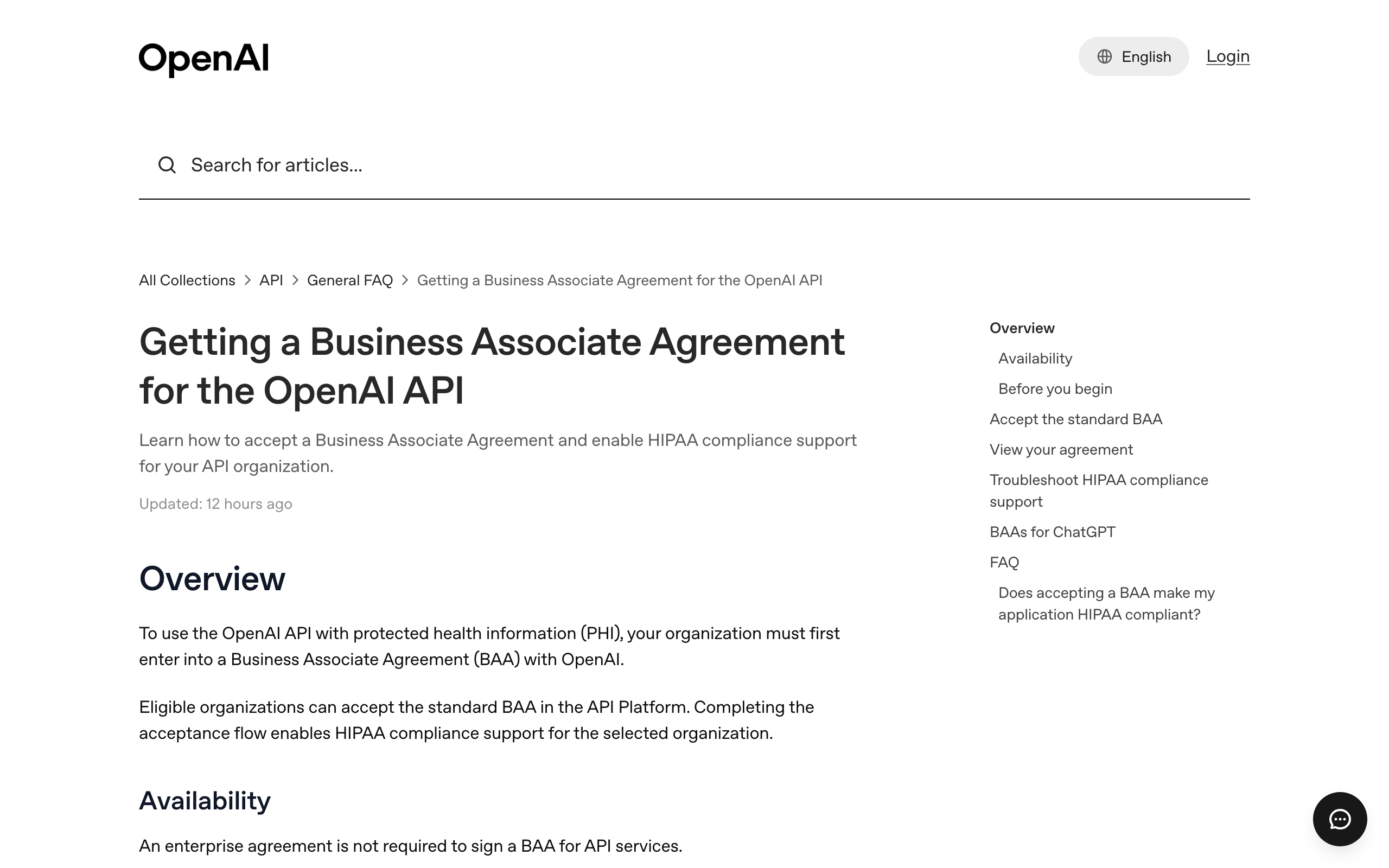
Yes, OpenAI signs a BAA for named products. Its BAA help article says an organization must enter a BAA before using the API with PHI.
The API route is self-serve for some organizations. An admin opens organization settings and accepts the standard BAA under HIPAA compliance support. OpenAI says an enterprise agreement is not required. Self-serve enrollment does need an established history of API usage, and an organization that is not ready sees "Not eligible yet".
Enabling it is one-way in settings. OpenAI says HIPAA compliance support cannot then be disabled in the API Platform settings.
ChatGPT has its own rules. Sales-managed ChatGPT Enterprise and Edu accounts go through sales. OpenAI states that it does not offer a BAA for ChatGPT Business. Eligible individual clinicians have a separate in-product flow for ChatGPT for Clinicians.
OpenAI's HIPAA eligible products list names six products:
- ChatGPT for Healthcare
- ChatGPT for Enterprise with Regulated Workspace
- ChatGPT FedRAMP
- ChatGPT for Clinicians
- API with Modified Retention
- API FedRAMP with Modified Retention
The list has limits. Improved memory is not covered, and OpenAI warns that a feature being available does not mean it is covered.
The public Healthcare Addendum, version 111124, adds detail. PHI may go only through Eligible Services. API use outside an approved zero retention organization, or to an endpoint not eligible for zero retention, is excluded. That PDF dates from November 2024, so read the version you accept in settings.
Does Anthropic sign a BAA?
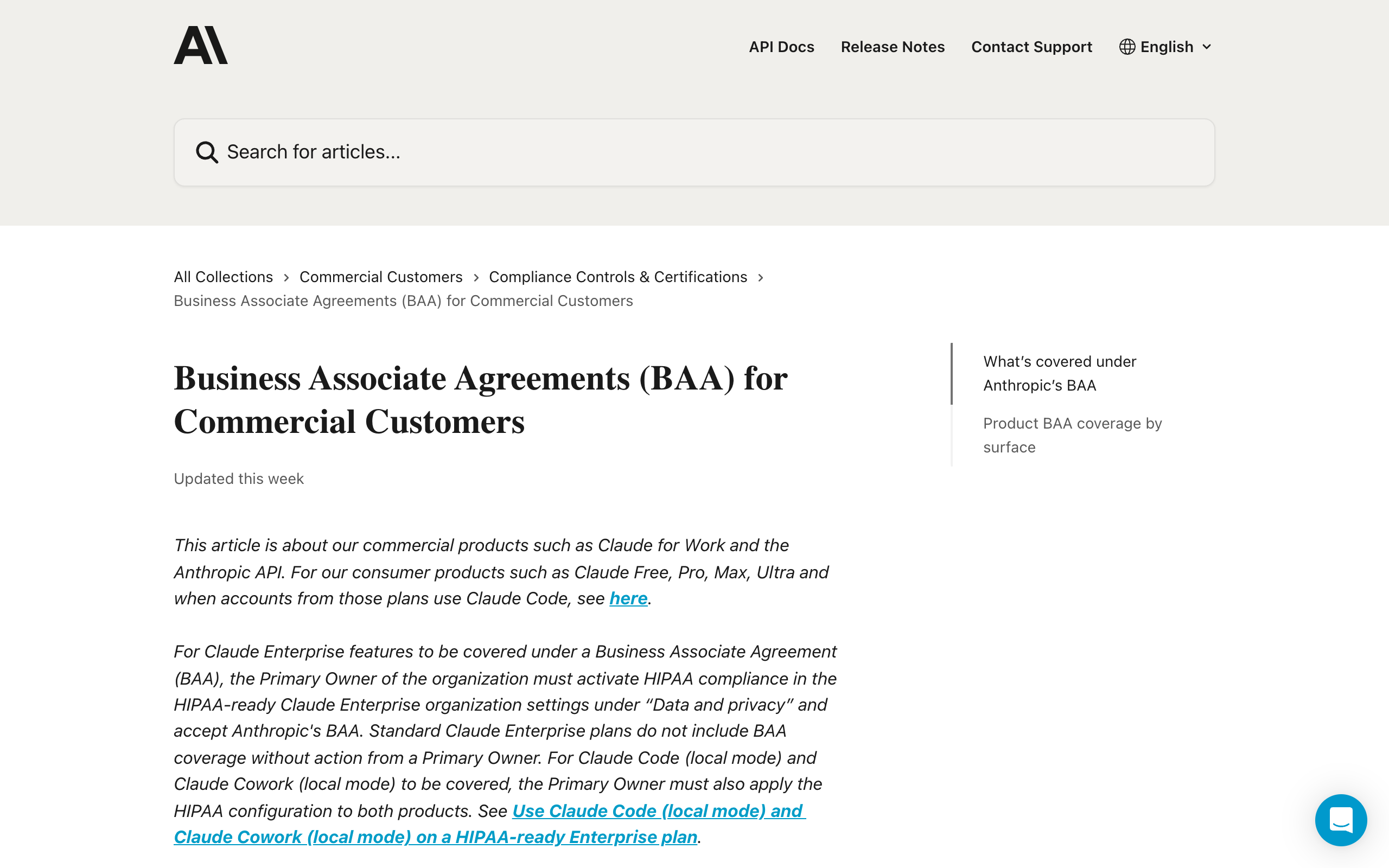
Yes, Anthropic signs a BAA for its HIPAA-ready services. Its BAA article for commercial customers names the first-party API, Claude in Microsoft Foundry, and Enterprise plans.
The API route has two paths. The API data retention docs say most organizations can accept the standard BAA in the Claude Console. Organizations that need a negotiated BAA work with sales. Anthropic says the configuration is permanent once enabled, and that your signed BAA is the official source of truth on covered features.
The Enterprise route is narrow. Only the Primary Owner can accept the BAA and enable HIPAA. The HIPAA-ready Enterprise article states that Team plans and individual plans cannot enable it. A BAA signed for API use before 2 December 2025 does not extend to an Enterprise plan.
Anthropic's terms also list what is excluded:
| Surface | Status under Anthropic's published terms |
|---|---|
| Messages API, with listed features | Covered in a HIPAA-enabled organization |
| Batch API, Files API, Code Execution, Web Fetch | Not covered. Anthropic's API returns a 400 error when a request uses an ineligible feature |
| Claude Console | Not covered for processing PHI |
| Amazon Bedrock and Google Cloud's Agent Platform | Outside Anthropic's readiness program. Use that platform's own compliance terms |
| Claude Platform on AWS | HIPAA readiness not available |
| External tools connected to your application | Not covered |
How do the two BAAs differ?
The largest difference is retention. OpenAI's public 2024 addendum ties API PHI to its Zero Retention API. OpenAI's current product list uses the term Modified Retention, so confirm the exact setting in the agreement you accept.
Anthropic takes another route. Its docs say HIPAA readiness applies safeguards across the data lifecycle, and that you do not also need zero data retention. Its Covered Models article adds that some models require 30-day retention and cannot run in zero data retention organizations. Anthropic says the two cannot coexist in one API organization.
With OpenAI, ask which retention setting your organization runs. With Anthropic, ask which features and models your organization can call.
OpenAI's 2024 BAA text requires breach reports "promptly" after discovery, with no day count. Neither provider's BAA makes your deployment compliant. OpenAI's article states this directly.
Does your provider BAA cover your chatbot vendor?
No. A provider BAA covers the organization that accepted it. Anthropic's terms state this. OpenAI's flow enables support for the organization you select.
A chatbot vendor calls the model from its own account. Your OpenAI or Anthropic BAA has no effect on that account, even if the vendor uses the same provider.
HHS guidance on business associates lists a third-party chatbot on a patient portal as a business associate example. It also says a business associate must hold a BAA with any subcontractor before disclosing PHI to it. OpenAI's BAA reflects the same chain: the customer may be a business associate of an "Upstream Customer", with OpenAI as its subcontractor.
Only the right-hand chain covers a vendor-run chatbot.
Common assumption
- Your hospital signs a BAA with OpenAI
- The chatbot vendor uses OpenAI
- So the chatbot must be covered
- No vendor BAA reviewed
What HIPAA expects
- Your hospital signs a BAA with the chatbot vendor
- The vendor signs a BAA with the model provider
- The vendor signs a BAA with each other PHI supplier
- You get written confirmation of the chain
If you still need to settle whether a chatbot requires a contract at all, when a website chatbot needs a BAA covers the trigger and the conduit exception.
What does a model provider BAA not cover?
A model provider BAA covers what that provider processes under its eligible services. A chatbot has several other places where PHI can rest or pass through.
| Part of the chatbot | Who holds it | Covered by the model provider BAA? |
|---|---|---|
| The model call | Model provider | Yes, on eligible services |
| Chat transcripts | Chatbot vendor or its database supplier | No |
| Search indexes | Vector database supplier | No |
| Logs and observability tools | Chatbot vendor or its supplier | No |
| Lead form records | Chatbot vendor | No |
| Email and push notifications | Email supplier | No |
| Handoff to a helpdesk | Helpdesk vendor | No |
| A visitor's widget session on your site | Chatbot vendor | No |
Some duties also flow upward to you. OpenAI's 2024 addendum bars representing that a human produced the output, and it requires a written agreement with upstream customers. Expect similar terms in your vendor contract.
How does the chain work at SiteGPT?
SiteGPT is one worked example. The subprocessor list names three vendors in the PHI path: Convex for the database, Pinecone for vector search, and OpenAI for AI responses and embeddings.
Each operates under its own BAA with SiteGPT, and AI processing routes only to OpenAI on zero-data-retention endpoints. Anthropic is not listed as a SiteGPT subprocessor, so a HIPAA workspace does not offer a choice of model provider.
The BAA is Enterprise-only. SiteGPT signs it on the Enterprise plan at custom pricing, never on Starter, Growth, or Scale. The HIPAA program page states the status, and the standard BAA is published for your lawyer to read.
A covered workspace narrows the product, and the HIPAA workspace docs list the changes:
Pros
- Three named vendors in the PHI path, each under its own BAA with SiteGPT
- OpenAI runs on zero-data-retention endpoints only
- Breach reporting within five business days of discovery
- Conversation content redacted seven days after last activity, and the order form can set another window
- PHI never used to train AI models
Cons
- The BAA needs the Enterprise plan. Starter, Growth, and Scale do not include it
- Chat integrations, including Zendesk and Slack, are not available in a HIPAA workspace
- Cloud connectors such as Notion and Google Drive are not supported there
- Your SiteGPT contract confines PHI to conversations and keeps training content free of it. That is a contract term, and you must review content yourself
- SiteGPT answers from your content and takes no actions on live systems such as an EHR
Best forHealthcare teams that want a published BAA, a named PHI vendor chain, and a website chatbot trained on PHI-free content.
What should you ask a chatbot vendor?
Ask for names and documents. A vendor that says "we use OpenAI, and OpenAI is HIPAA compliant" has given you neither.
- Which model providers receive PHI, and do you hold a signed BAA with each?
- Which retention setting does your model account use?
- Who else in the chain can receive PHI? Please name the database, search, logging, and email suppliers.
- Which features switch off in a covered workspace?
- How many days do you take to report a breach, given that your provider's clock runs first?
The full version, with SiteGPT's own answers, is in the 12 questions to ask a chatbot vendor before you sign a BAA. The HIPAA chatbot requirements guide explains the safeguards behind each question.
Frequently asked questions
Does OpenAI sign a BAA? Yes. OpenAI signs a Business Associate Agreement for named products. API organizations that meet the self-serve requirements can accept the standard BAA in the API Platform, and OpenAI says an enterprise agreement is not required. ChatGPT Enterprise and Edu accounts that are sales-managed go through sales. OpenAI states that it does not offer a BAA for ChatGPT Business.
Does Anthropic sign a BAA? Yes. Anthropic offers a BAA for its HIPAA-ready services: the first-party Claude API, Claude in Microsoft Foundry, and Enterprise plans. Eligible API organizations can accept the standard BAA in the Claude Console, and organizations that need a negotiated BAA work with sales. Team plans and individual plans (Free, Pro, Max, and Ultra) cannot enable HIPAA.
If you have a BAA with OpenAI, does it cover your chatbot vendor? No. A provider BAA applies to the organization that accepted it. Your chatbot vendor calls the model from its own account, so the vendor needs its own BAA with the provider, and you need a BAA with the vendor. Your agreement with the provider does nothing for that second chain.
Which AI provider does SiteGPT use for HIPAA deployments? OpenAI, through zero-data-retention endpoints only, under OpenAI's own BAA with SiteGPT. SiteGPT's subprocessor list names Convex, OpenAI, and Pinecone as the only vendors in the PHI path. SiteGPT's own BAA is available on the Enterprise plan only, not on Starter, Growth, or Scale.
Sources
All pages below were read on 2 November 2026.
- OpenAI: Getting a BAA for the OpenAI API
- OpenAI: HIPAA eligible products and functionality
- OpenAI Healthcare Addendum and BAA, version 111124
- Anthropic: BAAs for commercial customers
- Anthropic: HIPAA-ready Enterprise plans
- Anthropic: API and data retention
- Anthropic: Covered Models under a BAA
- HHS: Business associates guidance
- SiteGPT HIPAA program page, standard BAA, subprocessor list, and HIPAA workspace docs