


The best AI agent for customer service in 2026 is Fin (formerly Intercom, now owned by Salesforce) for most teams. It publishes a price of $0.99 per outcome, runs on the helpdesk you already have, and holds 4.5 out of 5 on G2 from 3,911 reviews.
SiteGPT is the best value for small and mid-size teams that want a flat monthly price. Decagon and Sierra lead for enterprises that need agents to take actions and answer the phone. Ada, Zendesk, Gorgias, and Tidio each win a narrower job.
iShort answer
Pick Fin if you want the safest default with a public price. Pick SiteGPT if your answers live in your docs and you want a bill you can predict, from $39 a month billed yearly. Pick Decagon or Sierra if the agent must change orders or accounts across chat, email, and voice, and you can fund a sales-led rollout.
On HIPAA, SiteGPT publishes its BAA and offers it on Enterprise only. Fin and Zendesk both offer BAAs on eligible plans. Decagon, Sierra, and Ada list HIPAA but publish no BAA terms, so get them in writing.
80%
of common customer service issues will be resolved by agentic AI without human intervention by 2029, according to a Gartner prediction. Gartner also expects a 30% cut in operational costs.
Source: Gartner, March 2025Key takeaways
| Agent | Best for | Pricing | G2 |
|---|---|---|---|
| Fin (formerly Intercom) | Most teams | $0.99 per outcome | 4.5 (3,911) |
| SiteGPT | Small and mid-size teams on a budget | From $39/mo billed yearly | 4.8 (12) |
| Decagon | Enterprises that need actions and voice | Not published | 4.8 (30) |
| Sierra | Enterprise voice, outcome contracts | Not published | 4.5 (128) |
| Ada | Enterprises on Zendesk or Salesforce | Not published | 4.6 (173) |
| Zendesk AI agents | Existing Zendesk customers | Suite from $55/agent/mo billed yearly | 4.3 (7,073) |
| Gorgias AI Agent | Shopify stores | Per resolution | 4.6 (582) |
| Tidio Lyro | Smallest budgets | From $24.17/mo billed yearly | 4.6 (1,962) |
Four questions narrow eight vendors to one or two.
Can you see a price?
Fin, SiteGPT, Zendesk, and Tidio publish prices. Decagon, Sierra, and Ada require a sales call.
Must the agent act?
Refunds and account changes point to Fin, Decagon, Sierra, Ada, or Zendesk. Answers plus handoff fit SiteGPT or Tidio.
Do you need voice?
Sierra, Decagon, Ada, and Zendesk handle calls. Fin Voice is custom-priced. SiteGPT and Tidio Lyro have no voice agent.
Do you handle patient data?
SiteGPT publishes its BAA on Enterprise. Fin and Zendesk offer BAAs on eligible plans. Tidio says it is not a business associate.
What should you look for in an AI agent for customer service?
Seven checks decide most purchases in this category. Start with the first two, because they rule out half the market.
| Check | What to ask the vendor |
|---|---|
| Pricing model | Do you charge per resolution, per conversation, per seat, or a flat plan? What counts as a resolution? |
| Buying process | Can I sign up and test on my own content, or do I need a demo first? |
| Actions | Can the agent look up orders, issue refunds, or change accounts, and through which systems? |
| Channels | Which of chat, email, voice, SMS, and WhatsApp are included on my plan? |
| Human handoff | Who triggers it, where does the conversation land, and does my team see the full transcript? |
| Knowledge sources | Can it learn from PDFs, cloud drives, Notion, and past tickets, and how often does it re-sync? |
| Compliance | Which plan includes a signed BAA? Where is the DPA and the subprocessor list? |
Per-resolution pricing and flat pricing move risk in opposite directions. Under per-resolution pricing, a failed answer costs nothing, but the bill grows as the agent improves. A flat plan keeps the bill fixed, but unresolved conversations still use your allowance. The math at real volume is worked through in SiteGPT vs Intercom.
The actions check matters more each year. Gartner predicts that agentic AI will resolve 80% of common customer service issues without human intervention by 2029. The difference between an agent that answers and one that acts is explained in AI agent vs chatbot, and the AI agents hub collects the full reviews behind this ranking.
How were these AI agents ranked?
Every price, plan limit, channel, and compliance claim comes from the vendor's own pricing page, documentation, or trust center, read on 14 September 2026. G2 ratings were read on each product's G2 review page in a browser the same day, with review counts shown. Where a vendor publishes no price, the figure shown is a third-party estimate, labeled with its source.
The order reflects fit for a stated job rather than one blended score. A 20-person SaaS team and an airline should not buy the same agent. Each entry names who it suits and who should skip it. SiteGPT publishes this page and is ranked second, with its pros and cons listed in the same format as every other entry.
What are the best AI agents for customer service?
1. Fin (formerly Intercom): best overall for most teams
Fin is the AI agent from the company formerly called Intercom, which renamed itself Fin in 2026. Salesforce completed its acquisition of Fin on 10 September 2026. Prices on intercom.com and fin.ai had not changed as of 14 September 2026.
Fin answers chat, email, and messaging channels. It takes actions such as refunds and cancellations through Procedures and data connectors, then hands off to your team in whichever inbox you use. It runs inside Fin's own helpdesk (formerly the Intercom helpdesk) or on another helpdesk with no seats required. Supported helpdesks include Salesforce, HubSpot, and Freshworks.
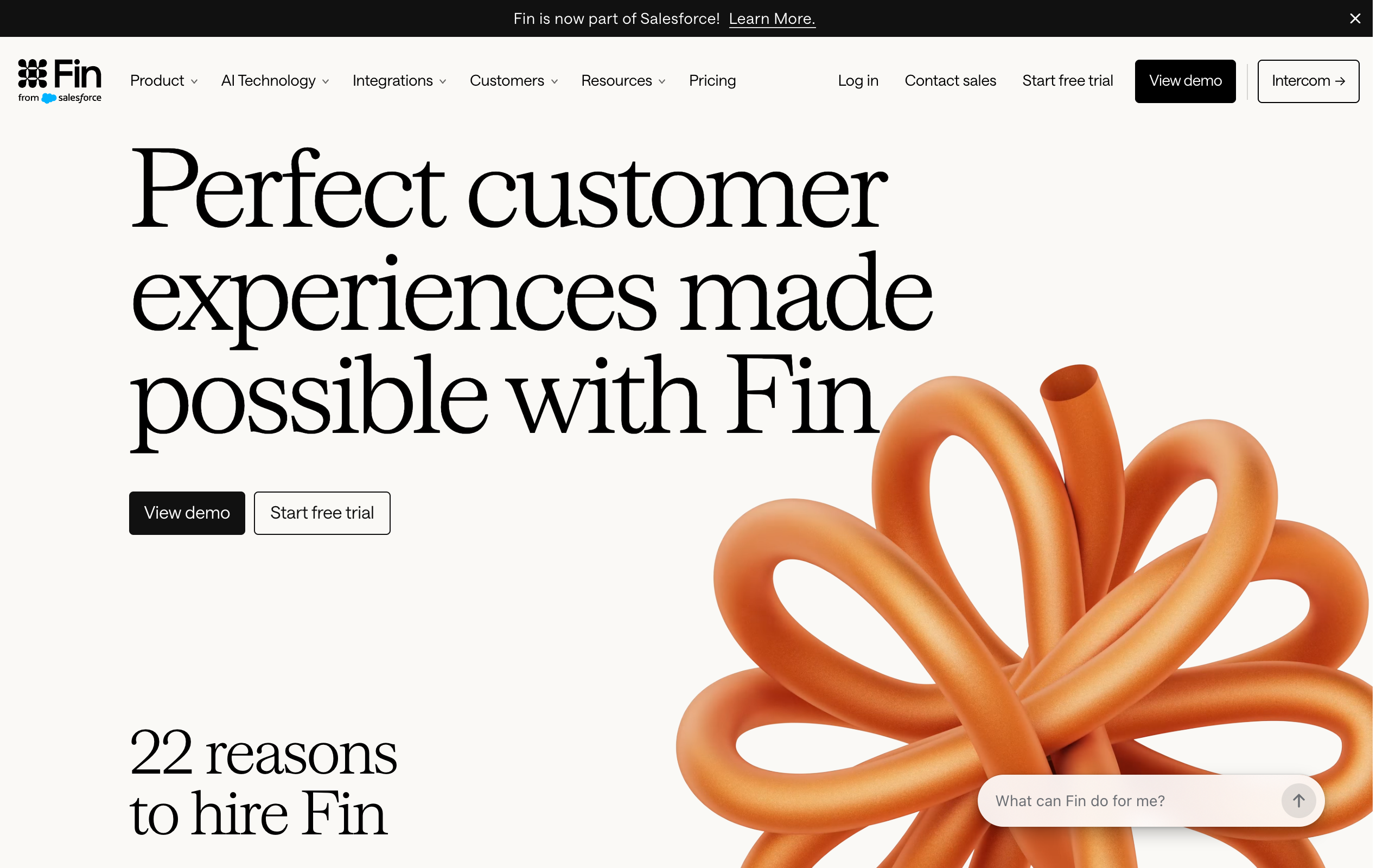
Fin is the default choice because it removes the two biggest barriers in this category. You can see the price, and a 14-day free trial needs no credit card. Fin says it sets up in under an hour on an existing helpdesk.
Pros
- $0.99 per outcome on every plan, so a failed answer is not billed
- Runs on an existing helpdesk, including Salesforce, with no seats
- Takes actions such as refunds and cancellations through Procedures
- 14-day free trial with no credit card, and 93% off for early-stage startups
- 4.5 out of 5 on G2 from 3,911 reviews, the largest review base here
Cons
- On Fin's own helpdesk you pay for seats and outcomes, so the monthly bill is an estimate
- Standalone Fin on another helpdesk has a 50-outcome monthly minimum
- An assumed resolution bills when a customer leaves without asking for more help
- Fin Voice is custom-priced and offered to select customers
| Plan | Price, billed yearly | Notes |
|---|---|---|
| Fin on your helpdesk | $0.99 per outcome | No seats, 50-outcome monthly minimum |
| Essential | $29 per seat/mo plus $0.99 per outcome | Messenger, shared inbox, public help center |
| Advanced | $85 per seat/mo plus $0.99 per outcome | Workflows, multiple inboxes, 20 free Lite seats |
| Expert | $132 per seat/mo plus $0.99 per outcome | SSO, HIPAA support, SLAs, 50 free Lite seats |
Billed monthly, seats are $39, $99, and $139. Sources: Fin pricing, Fin outcomes.
4.5/5·G2(3,911)Best forMost teams, from startups to mid-market, especially those that want a public price and a trial before committing.
The seat and outcome math against a flat plan is in SiteGPT vs Intercom.
2. SiteGPT: best value for small and mid-size teams
SiteGPT trains an AI agent on your own content and puts it on your website, in Slack (Growth and above), or inside Zendesk (Scale and above). It answers from what you give it, captures leads, and hands the chat to a person when the visitor asks.
It does less than Fin, Decagon, or Sierra. It does not issue refunds or change orders by itself, and it has no voice channel. In return you get a flat monthly price, a self-serve setup, and the widest set of content sources in this ranking.
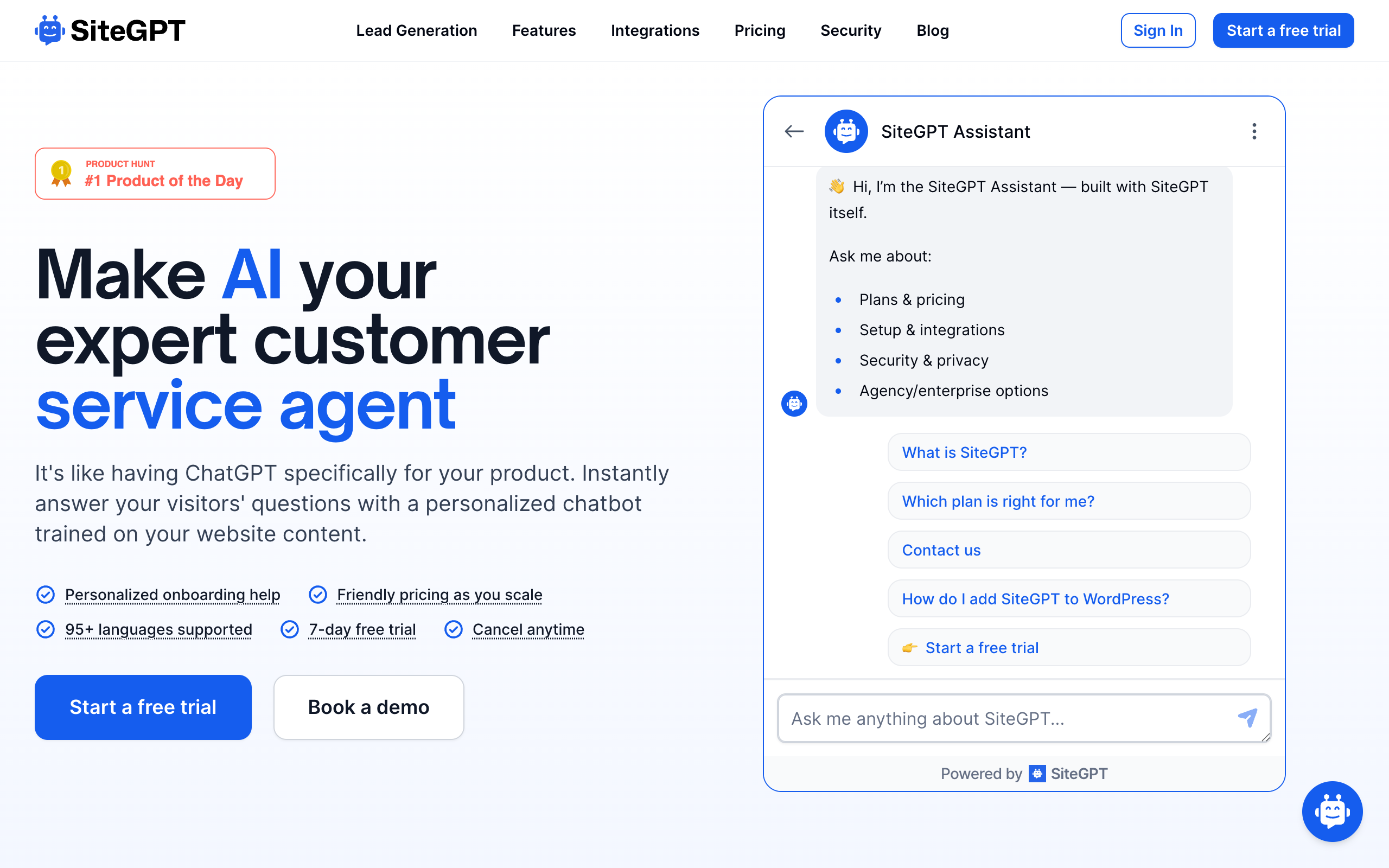
SiteGPT learns from 12+ source types: websites and sitemaps, PDFs and Office files, Google Drive, Notion, Dropbox, OneDrive, SharePoint, Box, GitHub, YouTube, and help centers such as Zendesk, Freshdesk, Intercom, Confluence, and Gitbook. Auto-sync re-crawls them monthly on Growth, weekly with a daily scan on Scale, and daily on Enterprise.
Human handoff is on every plan. The visitor clicks an escalation button, your team gets an email, and an agent can take over the chat while the AI stays silent.
Slack and the other chat integrations start on Growth. On Scale and above, SiteGPT can run as the default AI agent inside Zendesk Messaging, handing off through Zendesk's own switchboard. On Scale and above, webhooks send messages, leads, and escalations to your own systems.
SiteGPT can also be run from an AI assistant. Its remote MCP server lets Claude create a chatbot, train it, and query it without opening the dashboard. MCP for customer service covers what that changes for a service team, and the SiteGPT agents page lists everything an assistant can run end to end.
Pros
- Flat monthly price, so the bill does not rise when the agent resolves more chats
- Self-serve setup with a 7-day trial
- The broadest content ingestion in this ranking, with scheduled auto-sync
- Human takeover on every plan
- HIPAA BAA published for legal review and available on Enterprise
- 95+ languages
Cons
- Does not take autonomous actions such as refunds, cancellations, or account changes
- No voice, SMS, or WhatsApp channel
- Escalation centers on the visitor asking for a person, with fewer trigger options than the enterprise agents
- The trial asks for a credit card
- The BAA is Enterprise only, and a covered workspace turns off connected apps and chat integrations by default
| Plan | Billed monthly | Billed yearly | Notes |
|---|---|---|---|
| Starter | $59/mo | $39/mo ($468/yr) | 1 chatbot, 400 to 4,000 messages depending on model |
| Growth | $129/mo | $79/mo ($948/yr) | 2 chatbots, integrations, monthly auto-sync |
| Scale | $429/mo | $259/mo ($3,108/yr) | 3 chatbots, Zendesk AI agent, weekly auto-sync |
| Enterprise | Custom | Custom | HIPAA BAA, signed DPA, daily auto-sync |
Source: SiteGPT pricing.
4.8/5·G2(12)Best forSmall and mid-size teams whose answers already live in docs, files, and a help center, and who want a price they can budget.
3. Decagon: best for enterprises that need agents to act
Decagon builds AI agents for large companies with heavy chat, email, and voice volume. Chime, Duolingo, and Rippling run it. Teams write the agent's behavior as Agent Operating Procedures in plain language, and the agent takes actions in systems such as Salesforce and Zendesk.
Decagon's testing tools are a main reason to pick it. Simulations run scripted conversations inside a CI/CD pipeline, and Watchtower reviews every live conversation against rules you write. Voice agents work in more than 70 languages and can place outbound calls.
Pros
- Agent behavior written in plain language and versioned in Git
- Chat, SMS, WhatsApp, email, and voice from one platform
- Built-in simulations, live QA review, and A/B tests
- Published results: 70% resolution at Chime and 80% chat deflection at Duolingo
- 4.8 out of 5 on G2 from 30 reviews
Cons
- Decagon publishes no price, and competitors estimate a platform fee near $50,000 a year
- No trial and no self-serve sign-up
- G2 reviewers report an average of 2 months to implement
- HIPAA is listed on its trust center, but no public page confirms a BAA
| Pricing model | Published price | Notes |
|---|---|---|
| Per conversation, or per resolution | None | Decagon says most customers choose per conversation |
Source: Decagon on pricing models.
4.8/5·G2(30)Best forEnterprises with engineers to own the agent, where it must change orders or accounts and voice matters.
The full breakdown is in the Decagon review.
4. Sierra: best for enterprise voice and outcome-based contracts
Sierra, founded by former Salesforce co-CEO Bret Taylor and Clay Bavor, builds agents for large consumer brands. TechCrunch reported in May 2026 that over 40% of the Fortune 50 are customers. SoFi, Rocket Mortgage, and Airtable publish results with it.
Sierra charges per outcome, such as a resolved conversation or a saved cancellation. Transfers to a person are typically free. Voice agents speak more than 55 languages, and Ghostwriter builds an agent from your SOPs, call transcripts, and recordings.
Pros
- Outcome pricing, with handoffs to a person typically not charged
- Voice in 55+ languages, plus SMS, WhatsApp, Apple Business Chat, and email
- Trust center lists FedRAMP High, PCI DSS 4.0.1, and HIPAA
- Published results: 80% resolution at Airtable and +33 NPS at SoFi
- 4.5 out of 5 on G2 from 128 reviews
Cons
- Sierra publishes no price, and third parties estimate about $150,000 a year
- No trial and no sign-up page
- Sierra's own engineers tune agents, so some changes wait on Sierra
- BAA terms are not published
| Pricing model | Published price | Notes |
|---|---|---|
| Per outcome | None | Outcomes are defined in the contract |
Source: Sierra on outcome-based pricing.
4.5/5·G2(128)Best forLarge consumer brands with heavy call volume that want to pay for results under a negotiated contract.
The full breakdown is in the Sierra review.
5. Ada: best for enterprises on Zendesk or Salesforce
Ada runs AI agents for large service teams across messaging, email, and voice. It says it has helped more than 350 businesses, including Deezer, Dott, and IPSY. A unified Reasoning Engine, rolled out in February 2026, powers all three channels from one layer.
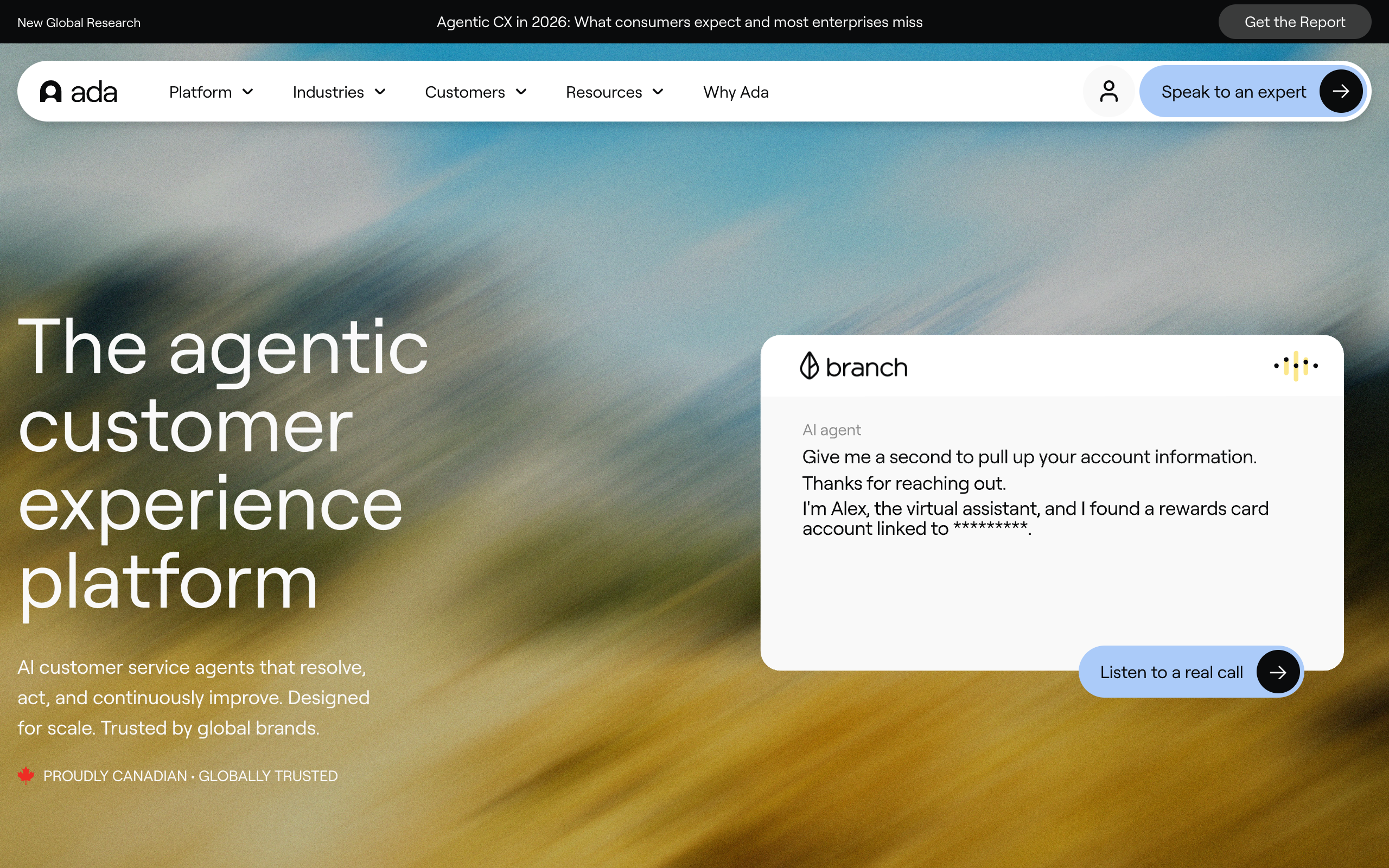
Ada generates answers natively in 60 languages on messaging and email, and supports 42 languages on voice. Its handoff coverage is broad, with listed integrations for Zendesk, Salesforce, Genesys, NICE CXone, Twilio Flex, and Amazon Connect. Ada added a Handoffs API in June 2026.
Pros
- One reasoning engine across messaging, email, and voice
- 60 languages on messaging and email without a translation layer
- Handoff integrations for most major contact center platforms
- Trust page lists SOC 2 Type II, HIPAA, GDPR, PCI DSS, and AIUC-1
- 4.6 out of 5 on G2 from 173 reviews
Cons
- Ada publishes no price, and Vendr reports a median contract of $72,000 a year
- No trial on the live site
- Voice supports 42 languages, fewer than messaging and email
- End users on Trustpilot describe bots that loop on some deployments
| Pricing model | Published price | Notes |
|---|---|---|
| Not stated by Ada | None | Ada's blog argues for per-conversation over per-resolution pricing |
Sources: Ada on pricing models, Vendr.
4.6/5·G2(173)Best forEnterprises already running Zendesk, Salesforce, or a major contact center platform that need one agent across many languages.
The full breakdown is in the Ada review.
6. Zendesk AI agents: best if you already run Zendesk
Zendesk includes AI agents in every Suite plan and bills them on automated resolutions. The Suite Team plan also includes a knowledge base, an action builder, messaging and live chat, and telephony. For a team already working tickets in Zendesk, the AI sits in the same system as the humans.
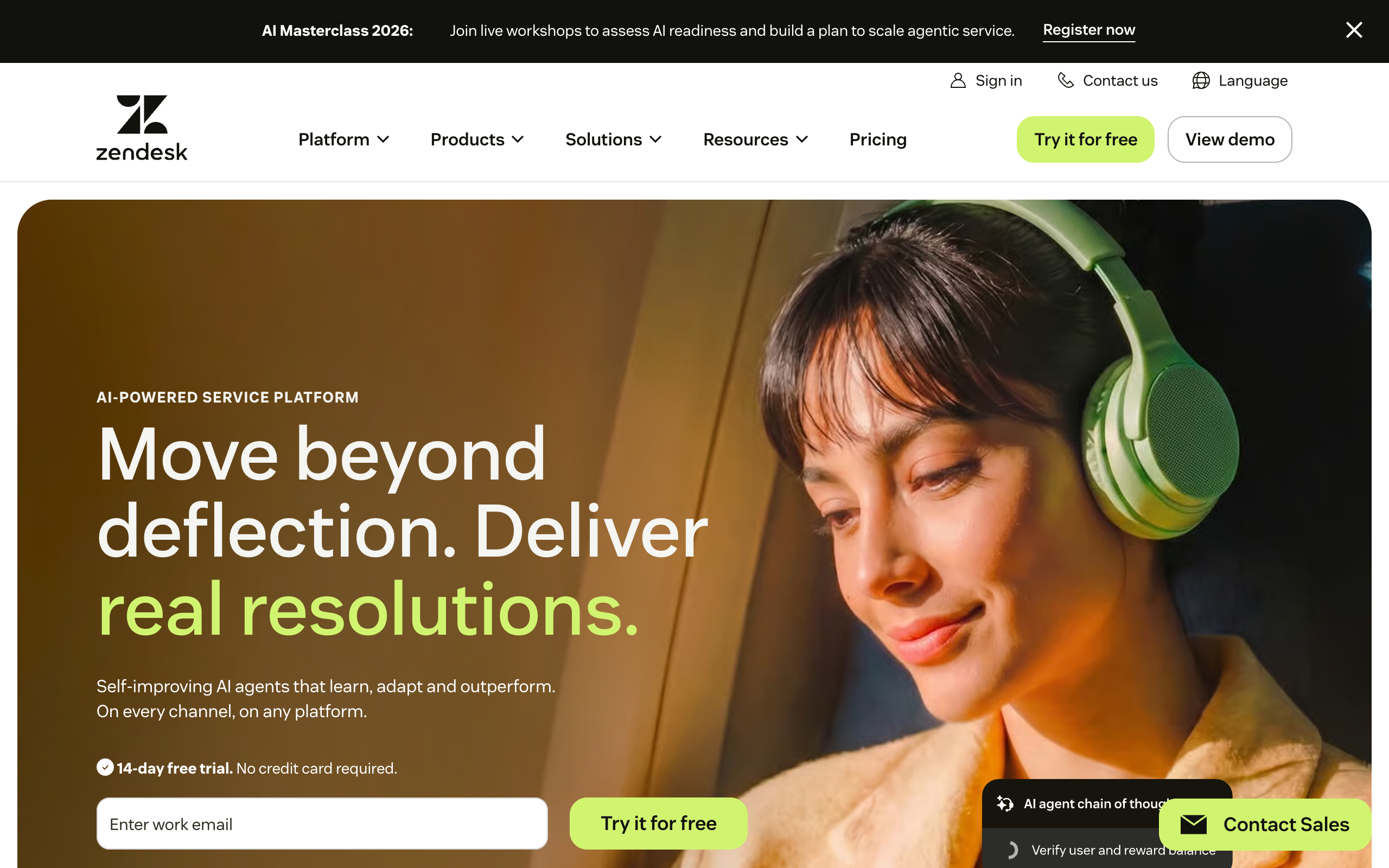
Zendesk credits each account with a resolution allowance and draws verified resolutions from it. Escalations to a person and conversations that fail its LLM check do not count. Zendesk does not publish the dollar price of a single resolution, and you can pre-purchase more allowance.
Pros
- AI agents included in every Suite plan
- AI and human agents share one ticketing system and routing engine
- Action builder on Suite Team and above
- Only verified resolutions draw down the allowance
- 14-day free trial with no credit card
Cons
- Seat-based pricing, from $55 per agent a month billed yearly on Suite Team
- No published price per resolution beyond the included allowance
- Worth it mainly for teams that use Zendesk for ticketing as well
- G2's 4.3 rating covers the whole Zendesk service product, not only its AI agents
| Plan | Price, billed yearly | Notes |
|---|---|---|
| Support Team | $19 per agent/mo | Email and ticketing |
| Suite Team | $55 per agent/mo | AI agents, knowledge base, action builder, messaging, telephony |
| Suite Professional | $115 per agent/mo | Admin copilot, skills-based routing, IVR |
| Suite Enterprise | Contact sales | Intelligent triage, generative AI for voice |
Source: Zendesk pricing.
4.3/5·G2(7,073)Best forTeams that already run ticketing, phone, and routing in Zendesk and want the AI inside the same system.
Adding a content-trained agent in front of Zendesk instead is covered in SiteGPT vs Zendesk.
7. Gorgias AI Agent: best for Shopify stores
Gorgias is a helpdesk and AI agent built for ecommerce. Its AI Agent answers shoppers before a purchase and handles support after one, such as editing orders and managing subscriptions. Gorgias says it powers customer conversations for 40% of Shopify brands.
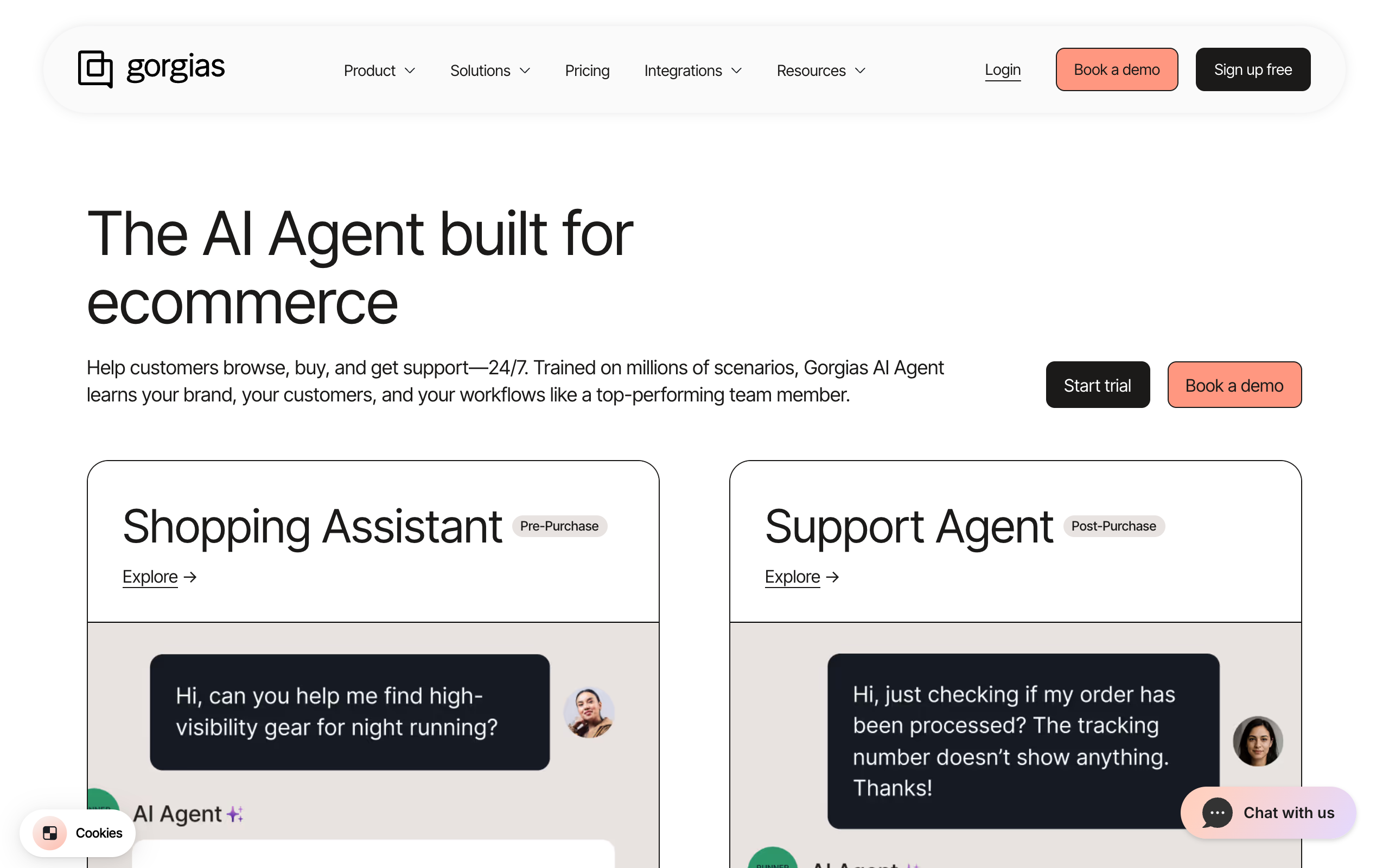
The AI Agent is on every Gorgias plan. It bills per automated interaction, from $0.85 to $1.00 within your plan and $1.50 past the limit. The helpdesk is priced by ticket volume, from 50 to 5,000 tickets a month, rather than per agent.
A ticket the AI resolves pays both the ticket fee and the automation fee. Actions such as cancellations and address changes start on the Basic plan.
Pros
- Built for ecommerce, with order edits and subscription changes
- AI Agent on every plan, billed only when it resolves without a handover
- Helpdesk priced by ticket volume, not per agent
- 30-day free trial with no credit card
- 4.6 out of 5 on G2 from 582 reviews
Cons
- Built mainly for Shopify, and a Capterra reviewer says full AI Agent functionality works only there
- A resolved ticket pays a ticket fee plus an automation fee, so costs climb in busy seasons
- Actions are not included on the Starter plan
- No BAA terms appear on its public pages
| Plan | Billed monthly | Billed yearly | Included |
|---|---|---|---|
| Starter | $40/mo | Monthly only | 50 tickets, 30 automated interactions |
| Basic | $90/mo | $77/mo | 300 tickets, 30 automated interactions |
| Pro | $550/mo | $471/mo | 2,000 tickets, 190 automated interactions |
| Advanced | $1,430/mo | $1,227/mo | 5,000 tickets, 530 automated interactions |
Sources: Gorgias pricing, how Gorgias bills.
4.6/5·G2(582)Best forShopify brands that want one inbox for pre-sale questions, order changes, and support.
Other chatbots for online stores are compared in ecommerce chatbot examples.
8. Tidio Lyro: best for the smallest budgets
Tidio combines live chat, ticketing, and its Lyro AI agent in one inbox. Lyro answers from your help content and hands off to your team when it is unsure. Tidio says Lyro can solve up to 67% of customer problems.
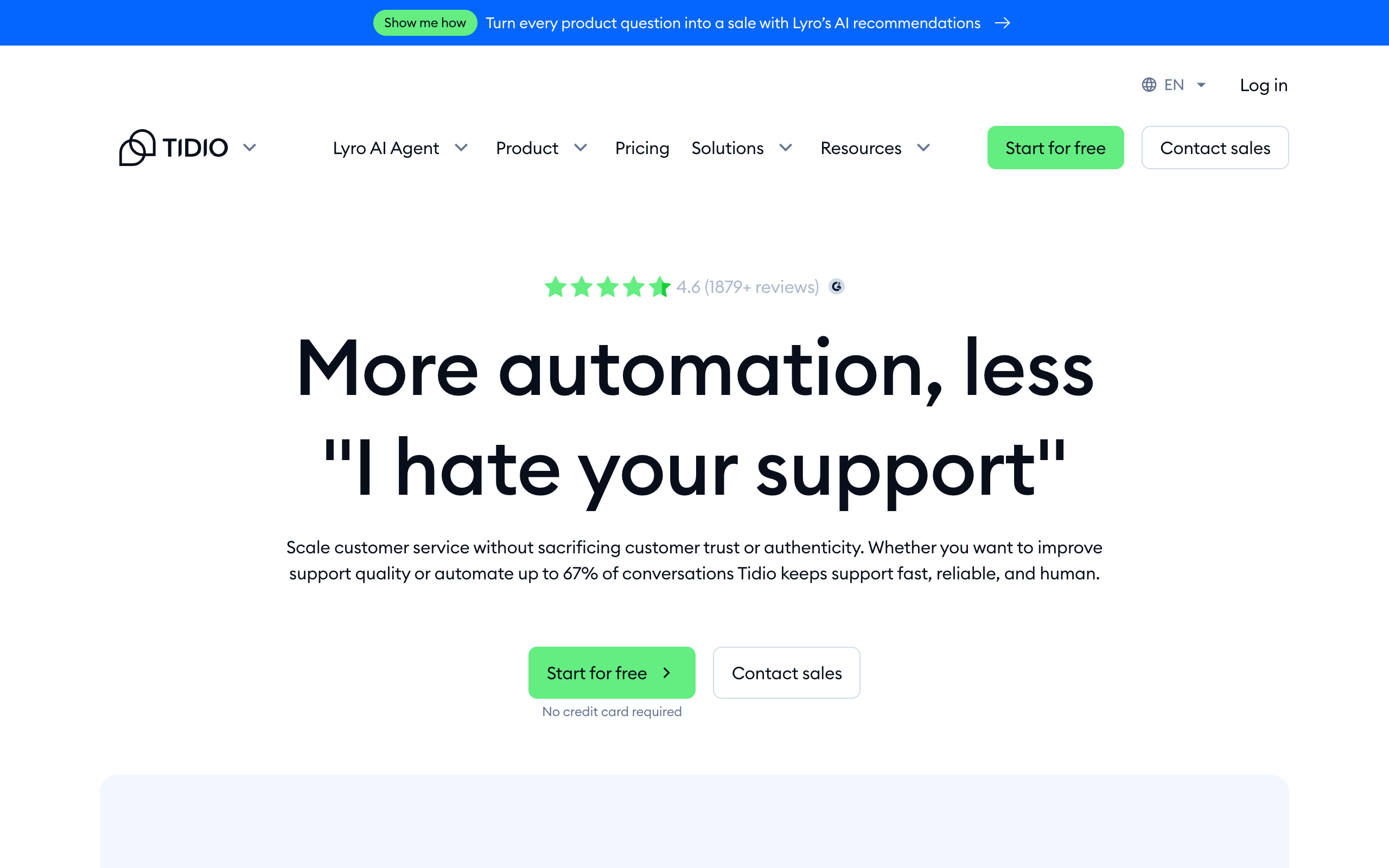
Tidio has a free plan and the lowest paid entry price in this ranking. Lyro is sold as an add-on to the chat plans, and the Premium plan guarantees a 50% Lyro resolution rate with pay-per-resolution billing.
Pros
- A free plan, and the lowest paid entry price in this ranking
- Live chat, ticketing, and AI in a single inbox
- 7-day free trial with no credit card on paid plans
- 4.6 out of 5 on G2 from 1,962 reviews
Cons
- Lyro conversations are metered separately from live chat
- Lighter on actions and integrations than the enterprise agents
- The guaranteed 50% resolution rate is on Premium only, at custom pricing
- Tidio's terms say it is not a HIPAA business associate
| Plan | Billed monthly | Billed yearly | Notes |
|---|---|---|---|
| Free | $0 | $0 | 50 billable conversations, 50 Lyro conversations one-time |
| Starter | $29/mo | $24.17/mo | 100 billable conversations, 50 Lyro conversations one-off |
| Growth | From $59/mo | From $49.17/mo | From 250 billable conversations |
| Plus | From $300/mo plus usage | From $300/mo plus usage | Discounted usage, departments, custom branding |
| Premium | Custom | Custom | Guaranteed 50% Lyro resolution, pay per resolution |
| Lyro AI Agent add-on | $39/mo | From $32.50/mo | From 50 Lyro conversations |
Source: Tidio pricing.
4.6/5·G2(1,962)Best forSmall stores and service businesses that want live chat plus an AI agent for under $100 a month.
A head-to-head on content limits and Lyro pricing is in SiteGPT vs Tidio.
Which AI customer service agents are HIPAA compliant?
A few terms first, because the rest of this section depends on them. HIPAA is the Health Insurance Portability and Accountability Act, the US law covering how patient information is handled. PHI, or protected health information, is any health detail that can be traced back to a person. HHS, the Department of Health and Human Services, writes and enforces the HIPAA rules.
HHS defines a business associate as a person or organization that performs certain HIPAA-regulated functions on behalf of a covered entity, such as a healthcare provider or health plan. For a chatbot, that means a vendor that handles PHI for one. A BAA, or Business Associate Agreement, is the contract that lets that vendor do so lawfully.
If patient data will reach the agent, the plan that includes a signed BAA matters more than any feature. A "HIPAA" badge on a trust page does not tell you whether the vendor signs a BAA or on which plan. Whether your deployment needs a BAA at all depends on what the agent will see, covered in do you need a BAA for your website chatbot.
| Agent | HIPAA position on public pages, 14 September 2026 |
|---|---|
| SiteGPT | Standard BAA published. Enterprise plan only |
| Fin | Pricing lists HIPAA support on the Expert plan. Fin's help center says all Fin workspaces are eligible for a BAA. Confirm which applies to your plan |
| Decagon | HIPAA listed on its trust center. No public page confirms a BAA |
| Sierra | HIPAA listed, with a 2026 HIPAA audit report on request. BAA terms not public |
| Ada | HIPAA listed on its trust page. No public page confirms a BAA |
| Zendesk | BAA available through Advanced Compliance on Suite Professional and above. AI Agents Advanced is a covered add-on |
| Gorgias | Says it is HIPAA compliant and offers a report on request. No BAA terms found |
| Tidio | Its terms state Tidio is not a HIPAA business associate |
Health plans and insurers need a narrower shortlist. HIPAA compliant chatbots for health insurance ranks five platforms for member service and names the plan each BAA requires.
SiteGPT's covered workspace also narrows what the agent can reach. Patient data stays in end-user conversations, training content must be free of it, and connected apps and chat integrations start switched off.
The details are on the SiteGPT HIPAA page. The questions to put to any vendor are in HIPAA chatbot vendor questions. What HIPAA requires of the chatbot beyond the contract is covered in what makes a chatbot HIPAA compliant.
How do the eight AI agents compare side by side?
| Pricing | Trial | Voice | Takes actions | Human handoff | G2 | |
|---|---|---|---|---|---|---|
| Fin | $0.99 per outcome, seats optional | 14 days, no card | Custom-priced Fin Voice | Yes | Into your preferred inbox | 4.5 (3,911) |
| SiteGPT | From $39/mo billed yearly, $59 monthly | 7 days, card required | No | Leads and webhooks only | Every plan, agent takeover | 4.8 (12) |
| Decagon | Not published | No | Yes, 70+ languages | Yes | Yes, with summary | 4.8 (30) |
| Sierra | Not published, per outcome | No | Yes, 55+ languages | Yes | Contact center handoff | 4.5 (128) |
| Ada | Not published | No | Yes, 42 languages | Yes | 14+ integrations, Handoffs API | 4.6 (173) |
| Zendesk AI agents | Seats from $55/agent/mo billed yearly | 14 days, no card | Yes | Yes, action builder | Same ticketing system | 4.3 (7,073) |
| Gorgias AI Agent | From $40/mo, $0.85-$1.00 per AI resolution | 30 days, no card | Phone add-on for human agents | Yes, from Basic | Same helpdesk | 4.6 (582) |
| Tidio Lyro | Free plan, paid from $24.17/mo billed yearly | 7 days, no card | No | Lyro Actions via API | To your team in Tidio | 4.6 (1,962) |
Which agent should you pick?
| Scenario | Best pick | Why |
|---|---|---|
| You want a safe default with a public price | Fin | $0.99 per outcome, a free trial, and the largest G2 review base here. |
| Your answers live in docs, PDFs, and a help center | SiteGPT | 12+ sources with auto-sync, human takeover on every plan, flat pricing from $39 a month billed yearly. |
| The agent must change orders or accounts across voice and chat | Decagon or Sierra | Both take actions in connected systems and run voice at enterprise scale. |
| You run a contact center on Genesys, NICE, or Twilio | Ada | Handoff integrations for each, plus 60 languages on messaging and email. |
| Your team already works tickets in Zendesk | Zendesk AI agents | AI agents are included in Suite plans and share the same ticket system. |
| You sell on Shopify | Gorgias AI Agent | Built for ecommerce, with order edits and billing only on resolution. |
| You need an AI agent for under $50 a month | SiteGPT Starter, billed yearly | $39/mo billed yearly ($59 monthly). Tidio Starter is $24.17/mo billed yearly, but adding Lyro brings it to about $57/mo. |
| You handle patient data | SiteGPT Enterprise, Fin, or Zendesk | SiteGPT publishes its BAA. Fin and Zendesk offer BAAs on eligible plans. Confirm terms in writing. |
Do you need a price before you talk to sales?
- If Yes→Fin, SiteGPT, Zendesk, Gorgias, or Tidio
- If No, and you can budget $50,000 or more a year→Decagon, Sierra, or Ada
Must the agent take actions such as refunds or account changes?
- If Yes, across chat, email, and voice→Decagon or Sierra
- If Yes, inside an existing helpdesk→Fin or Zendesk AI agents
- If No, answering and handoff are enough→SiteGPT or Tidio Lyro
Where does your knowledge live?
- If Spread across files, cloud drives, Notion, and a help center→SiteGPT
- If In Fin (formerly Intercom) or Zendesk articles→Fin or Zendesk AI agents
- If In a Shopify store catalog→Gorgias AI Agent
FAQ
What is the best AI agent for customer service?
Fin (formerly Intercom, now owned by Salesforce) is the best AI agent for customer service for most teams in 2026. It charges $0.99 per outcome, runs on an existing helpdesk such as Salesforce with no seats required, and holds 4.5 out of 5 on G2 from 3,911 reviews.
SiteGPT is the best value for small and mid-size teams that want a flat monthly price. Decagon and Sierra lead for enterprises that need agents to take actions across chat, email, and voice.
What is the best AI agent for a small business?
SiteGPT and Tidio suit small businesses best because both publish prices and offer 7-day trials. SiteGPT starts at $39 a month billed yearly or $59 billed monthly, trains on 12+ content sources, and includes human takeover on every plan.
Tidio starts at $24.17 a month billed yearly, with its Lyro AI agent as an add-on from $32.50. Fin also works for small teams at low volume, at $0.99 per outcome.
How much do AI agents for customer service cost?
Pricing models vary. Fin charges $0.99 per outcome plus optional seats from $29 a month billed yearly. SiteGPT charges a flat monthly plan from $39 billed yearly. Zendesk includes AI agents in Suite plans from $55 per agent a month billed yearly and bills automated resolutions against an allowance.
Decagon, Sierra, and Ada publish no prices. Vendr reports a median Ada contract of $72,000 a year, and competitors estimate Sierra near $150,000 a year.
What is the difference between per-resolution and flat pricing?
Per-resolution pricing charges each time the agent resolves a conversation. A failed answer costs nothing, but the bill grows as the agent improves. Flat pricing charges a fixed monthly amount for a message allowance. The bill is known in advance, but unresolved conversations still use the allowance.
Fin, Zendesk, Gorgias, and Sierra use outcome or resolution pricing. SiteGPT uses flat plans.
Which AI agents can take actions?
Decagon, Sierra, Ada, Fin, Zendesk, and Gorgias all take actions in connected systems, such as looking up orders, editing orders, or changing accounts.
SiteGPT answers from your content, captures leads, sends events to webhooks, and hands off to a person. It does not issue refunds or change accounts by itself.
Which AI agents offer a HIPAA BAA?
SiteGPT publishes its standard BAA and offers it on the Enterprise plan only. Fin's help center says all Fin workspaces are eligible for a BAA, while Fin's pricing page lists HIPAA support on Expert. Zendesk offers a BAA through Advanced Compliance on Suite Professional and above.
Decagon, Sierra, and Ada list HIPAA on their trust pages, but none of their public pages reviewed on 14 September 2026 confirmed BAA terms. Tidio's terms say it is not a business associate. Confirm a signed BAA in writing before patient data reaches the agent.
Which AI agents support voice?
Decagon, Sierra, Ada, and Zendesk support voice agents. Fin Voice is custom-priced and offered to select customers. Sierra's voice agents speak more than 55 languages, Decagon's more than 70, and Ada's 42.
Gorgias sells phone support for human agents as an add-on. SiteGPT and Tidio Lyro do not offer a voice agent.
Is Fin better than Decagon or Sierra?
Fin is the better choice for most teams because it publishes a price, offers a free trial, and runs on an existing helpdesk. Decagon and Sierra suit large enterprises that want a partner-led rollout, deep voice capability, and custom contracts.
Both have strong published results, such as 70% resolution at Chime for Decagon and 80% resolution at Airtable for Sierra.
Can an AI agent replace human agents?
No agent here replaces people entirely. Gartner predicts agentic AI will resolve 80% of common customer service issues without human intervention by 2029. Ada's own research found only 24% of consumers say an AI agent fully resolved their issue without a person stepping in.
Every agent in this ranking hands off to people, and the quality of that handoff matters as much as the resolution rate. The handoff side is compared in best AI chatbots with human handoff.
How was this ranking built?
Every price, plan, channel, and compliance claim comes from each vendor's own pricing page, documentation, or trust center, read on 14 September 2026. G2 ratings were read on each G2 review page in a browser the same day. Where a vendor publishes no price, third-party estimates are labeled with their source.
The order reflects fit for a stated job. SiteGPT publishes this page and is ranked second.
Sources
- Vendor pricing: Fin, SiteGPT, Zendesk, Gorgias, Tidio
- Vendor pricing models: Decagon, Sierra, Ada
- Trust and compliance: Decagon trust center, Sierra trust center, Ada trust, SiteGPT HIPAA, SiteGPT BAA
- G2 review pages: Fin, SiteGPT, Decagon, Sierra, Ada, Zendesk for Customer Service, Gorgias, Tidio
- Regulation: HHS guidance on business associates, which defines who needs a BAA
- Research: Gartner prediction on agentic AI, TechCrunch on Sierra, Vendr on Ada, Ada consumer research