


Three tools lead this list, each for a different buyer. Fin for Sales suits teams already on Intercom. SiteGPT suits businesses that want leads captured from conversations answered by their own content, at a flat price. Chatbase suits a small budget that needs booking inside the chat.
These tools speed up replies to new leads. When Workato filled in demo forms at 114 B2B companies, the average phone response took 14 hours and 29 minutes. That wait gives a competitor most of a day to reply first.
iShort answer
Pick Fin for Sales if you run Intercom and want qualification, booking, and CRM sync in one product. Pick SiteGPT if your answers live in your website and documents and you want a predictable bill, from $39 a month billed yearly. Pick Chatbase if you want visitors to choose a time inside the chat for $32 a month billed yearly.
Check the booking method and the CRM path before you compare prices. Those two tests show the biggest differences between these tools.
99%+
of the 114 B2B companies Workato tested did not respond to a demo request within 5 minutes. Nearly 1 in 5 never replied by email.
Source: Workato, lead response time studyAsk each vendor these before you compare monthly prices.
Lead triggers
What makes the bot ask for details: visitor interest, a gap in its answers, or a fixed message count.
Booking method
Does the visitor pick a time inside the chat, or follow a link to a calendar page?
CRM path
Does a lead reach your CRM natively, through a webhook, or by email and export?
After-hours coverage
Who answers at 2 a.m., and how does your team hear about the lead the next morning?
What should you look for in lead capture software?
Lead capture software collects a visitor's details and moves them into a sales process. A web form asks once, at a fixed point. An AI chatbot can answer the visitor's question first, then ask for details when the conversation calls for it.
Four tests decide whether a chatbot will produce leads your team can use.
Lead triggers: when does the bot ask?
A trigger decides when the visitor sees the ask. Interest-based triggers wait for a buying signal, such as a pricing question. Fixed triggers fire after a set number of messages, and they suit simple offers.
If the bot asks too early, it feels like a pop-up. If it asks too late, the visitor leaves with an answer and no record of the visit.
Booking method: in chat or by link?
Two methods exist. Some tools read a live calendar and let the visitor pick a time inside the chat. Others send a calendar link, and the visitor books on the calendar page.
In-chat booking removes one click. It also needs a calendar connection and a plan that supports it. The two methods are compared in detail in best AI appointment setters and guided booking chatbots.
CRM path: how does a lead reach your pipeline?
There are three paths. A native integration writes the record for you. A webhook sends the lead to an automation tool, and you map the fields yourself. Email and CSV export need a person to move the data.
Leads that sit in a chatbot dashboard wait until someone moves them. Decide the path before you buy, because the path often sets the plan you need.
After-hours coverage: who answers at night?
Any AI chatbot can reply at 2 a.m. Check two more things. What does the bot say when a visitor asks for a person? How does your team hear about the lead?
Workato's test also measured email follow-up. Its lead response time study found that personalized emails took 11 hours and 54 minutes on average. Reducing that gap is covered in speed to lead.
What are the best AI chatbots for lead generation?
1. Fin for Sales: best for teams already on Intercom
Fin for Sales is a sales role for Intercom's Fin agent. It asks the questions an SDR (sales development representative) would ask, applies your playbook, and sends qualified leads to a rep, a trial, or a self-serve flow.
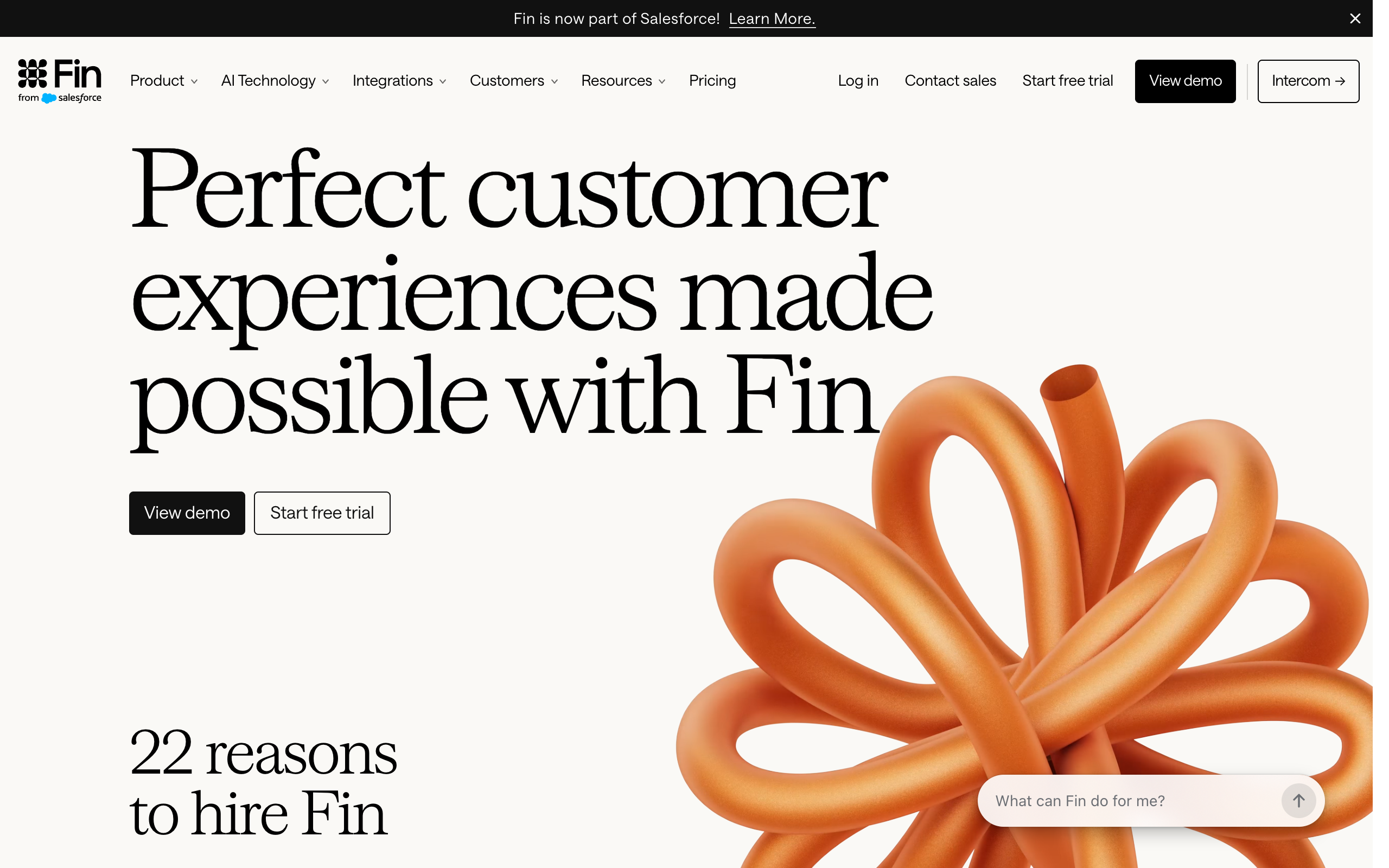
Lead triggers: Fin qualifies inside the conversation, using the criteria in its AI-generated playbook.
Booking: Fin books natively in the Messenger. In email or SMS it sends a Calendly link instead. Calendly booking needs a paid Calendly plan and shows the next 14 days.
CRM path: Intercom says Fin creates or updates leads and syncs context to a CRM.
Pricing: per the Fin pricing page, a qualification outcome costs $9.99. Disqualifications and self-serve routings cost $0.99 each. Fin with Intercom adds $19 per helpdesk seat a month. At 40 qualified leads a month, outcomes alone cost about $400.
Pros
- Strongest full path here: qualify, book, sync
- Works across web, email, WhatsApp, SMS, and social channels
- 14-day free trial
Cons
- Needs an Intercom plan from the latest pricing tiers
- Not available with Fin on other helpdesks
- Usage costs rise with lead volume, so the bill is harder to predict
Best forSales teams already on Intercom that want one agent to qualify, book, and sync leads.
The trade-offs against a flat-priced tool are in SiteGPT vs Intercom.
2. SiteGPT: best for capturing leads from conversations answered by your own content
SiteGPT trains a chatbot on your website, files, and connected apps, then answers visitors from that content. The lead form appears inside the conversation, so the visitor gets an answer before the ask.
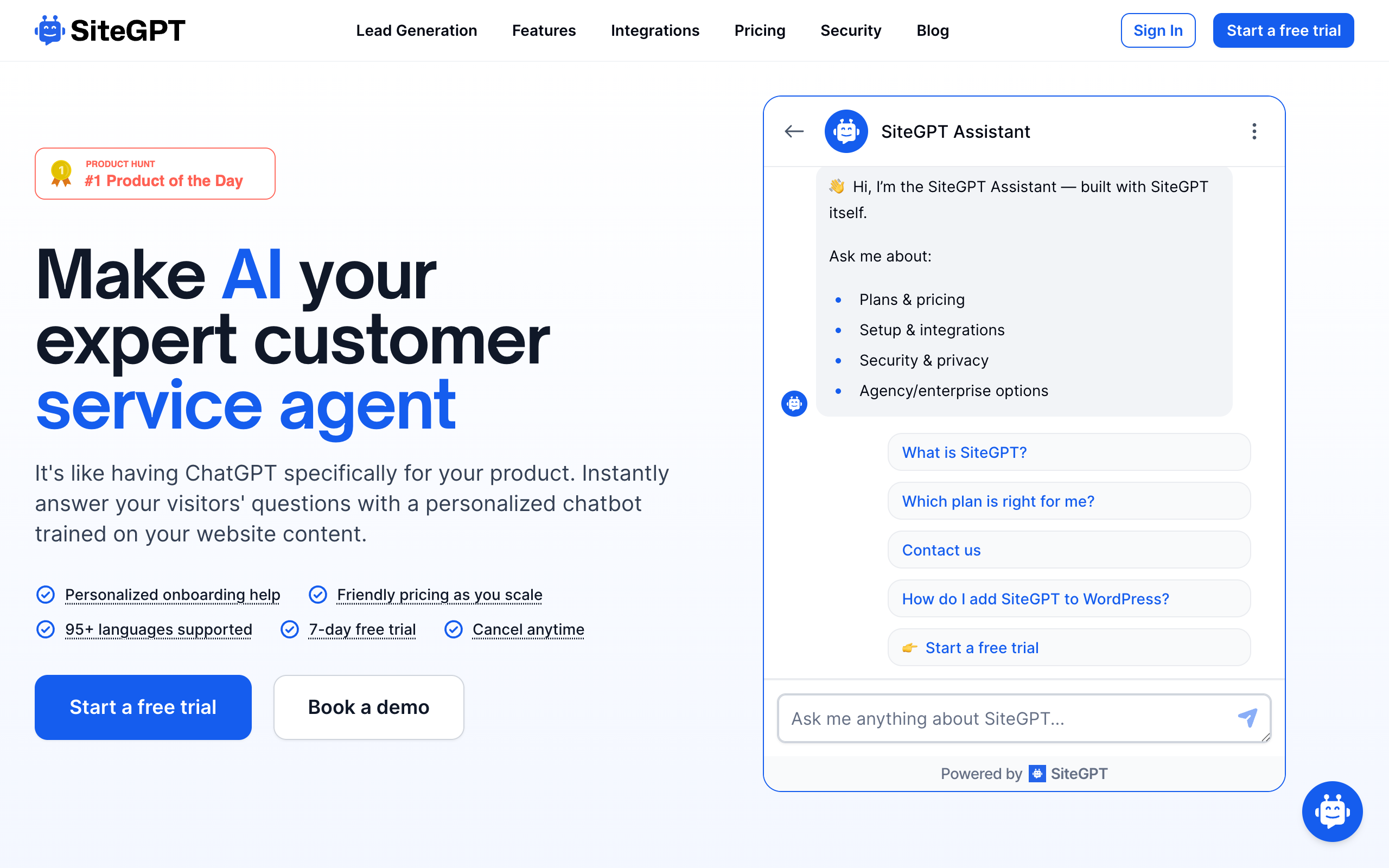
Lead triggers: the lead collection guide lists three: when the user shows interest, when the AI is unable to answer, and after N messages. Templates cover Dental, HVAC, Legal, Real Estate, Automotive, Healthcare, SaaS, E-commerce, and Consulting, plus a Custom option.
Booking: you enter a Booking System URL, and the chatbot gives the visitor the link when it collects the lead. The visitor books on your calendar page. SiteGPT does not read availability or book in chat.
CRM path: SiteGPT has no built-in CRM integration, per the docs. Email notifications and CSV export work on any plan. The leads webhook needs Scale or higher, and you connect it to a CRM through an automation tool.
After hours: the AI can keep answering and collecting leads. A Follow Working Hours schedule, added in October 2026, sends conversations to your team during set hours.
| Plan | Billed monthly | Billed yearly | Leads to CRM |
|---|---|---|---|
| Starter | $59/mo | $39/mo | Email and CSV |
| Growth | $129/mo | $79/mo | Email and CSV |
| Scale | $429/mo | $259/mo | Webhook, email, and CSV |
$240 a year saved on Starter with yearly billing
$39 a month against $59 billed monthly is a 34% saving. Moving from Starter to Scale for the webhook adds $2,640 a year on yearly billing.
Getting started takes three choices. Pick a template, paste your booking link, and leave the trigger on "When user shows interest". Every plan has a 7-day free trial, and a credit card is required.
Pros
- Three form triggers and nine industry templates on any plan
- Answers from your own content, with a fallback message when the content has no answer
- Human handoff on any plan, plus a working hours schedule with an away message
- 95+ languages
Cons
- No built-in CRM integration, and the webhook starts at Scale
- The webhook sends once and does not retry if your endpoint is down
- Booking is a link, so the visitor leaves the chat to pick a time
- No outbound, lead scoring, or routing rules
Best forSmall and mid-size businesses whose answers already live in their website and documents, and who want a predictable bill.
3. Chatbase: best for booking inside the chat on a small budget
Chatbase is a content-trained AI agent builder with actions. Its actions overview groups Collect leads, Collect data, and Custom form under lead capture.
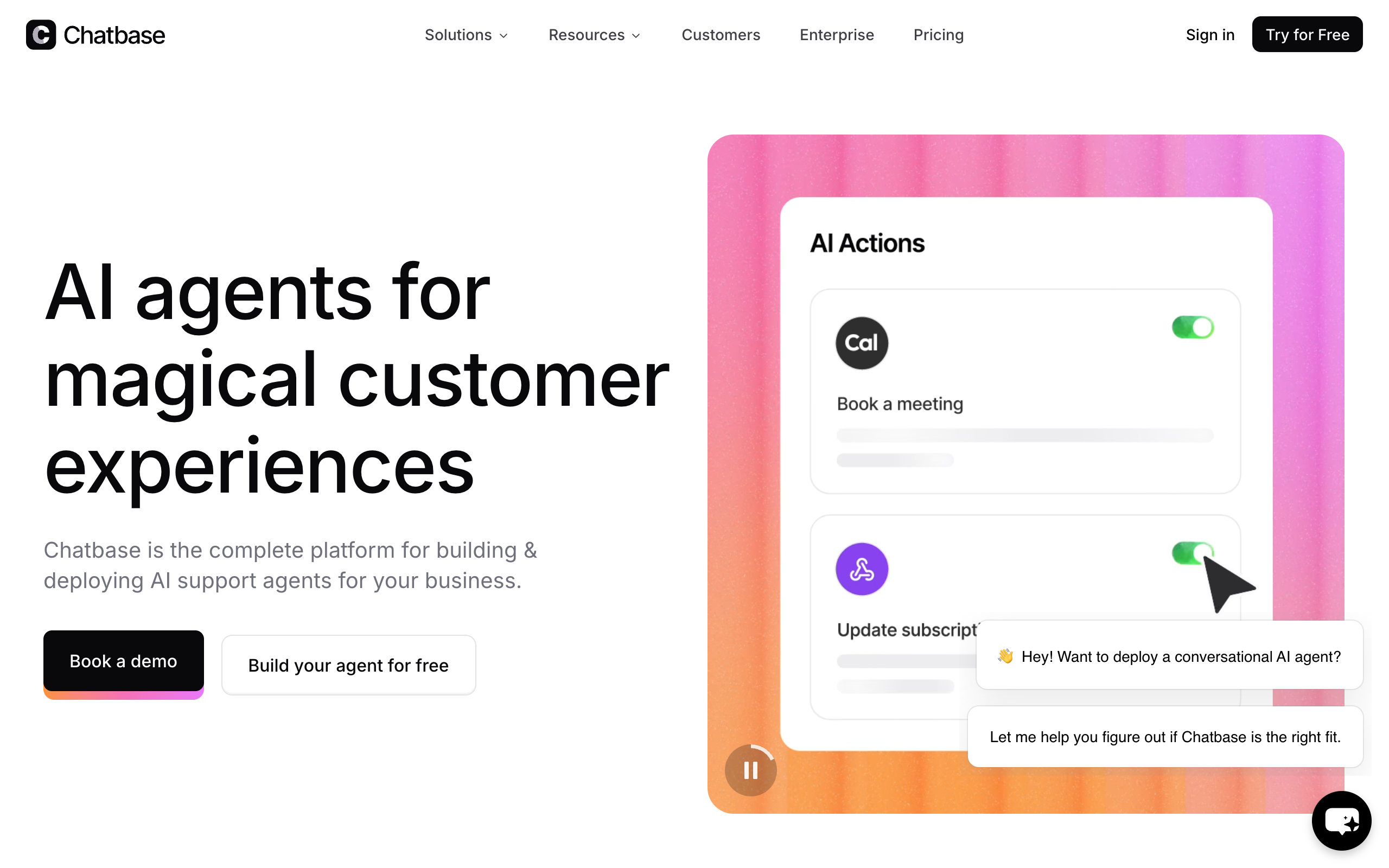
Lead triggers: you write a "When to use" rule for each action, and the agent decides when to run it.
Booking: the Cal.com action shows open slots, and the customer picks one in the chat. A Calendly action does the same after you connect your account. Both run on the chat bubble, help page, and Center Stage channels only.
CRM path: Collect Leads can send submissions to a webhook. The pricing page lists Salesforce among the integrations added on the Basic plan.
Pricing: Hobby is $32 a month billed yearly ($40 list) with 700 message credits. Basic is $120 a month billed yearly ($150 list) with 4,000 credits. Extra credits cost $40 per 1,000.
Pros
- Visitors pick a time inside the chat
- Calendly on every self-serve plan
- Trained on your own content
Cons
- Booking actions do not run on WhatsApp or other messaging channels
- Hobby includes 700 message credits a month
- Removing Chatbase branding costs $99 a month
Best forSmall teams that want the slot booked in the chat for under $50 a month.
The full comparison is in SiteGPT vs Chatbase.
4. Tidio: best for small stores that also want live chat
Tidio combines live chat, scripted Flows, and the Lyro AI agent. Scripted Flows collect details on a fixed path, and Lyro actions cover booking and contact creation.
Lead triggers: Flows start on rules you set. Lyro runs an action when your instructions tell it to.
Booking: the Lyro Action templates include "Book a call", which uses Calendly to send a scheduling link. Tidio's article says actions are still being tested and developed before a full release.
CRM path: a Lyro template creates HubSpot contacts, and others cover Mailchimp and Klaviyo.
Pricing: per the Tidio pricing page, Free covers 50 billable conversations. Starter is $24.17 a month, and Lyro starts at $32.50 a month for 50 conversations. Annual billing is advertised as two months free.
Pros
- Free plan and a 7-day trial with no credit card
- Live chat, Flows, and AI in one product
- HubSpot, Mailchimp, and Klaviyo action templates
Cons
- Lyro is priced by conversation on top of the plan
- Actions are described as still in development
- Booking is a link, and setup needs a Calendly access token
Best forSmall stores that want live chat first and AI lead capture second.
Feature differences are covered in SiteGPT vs Tidio.
5. HubSpot: best for teams that already run HubSpot CRM
HubSpot offers two options. The free rule-based chatbot runs a scripted path. The AI customer agent sits on paid Professional and Enterprise plans.
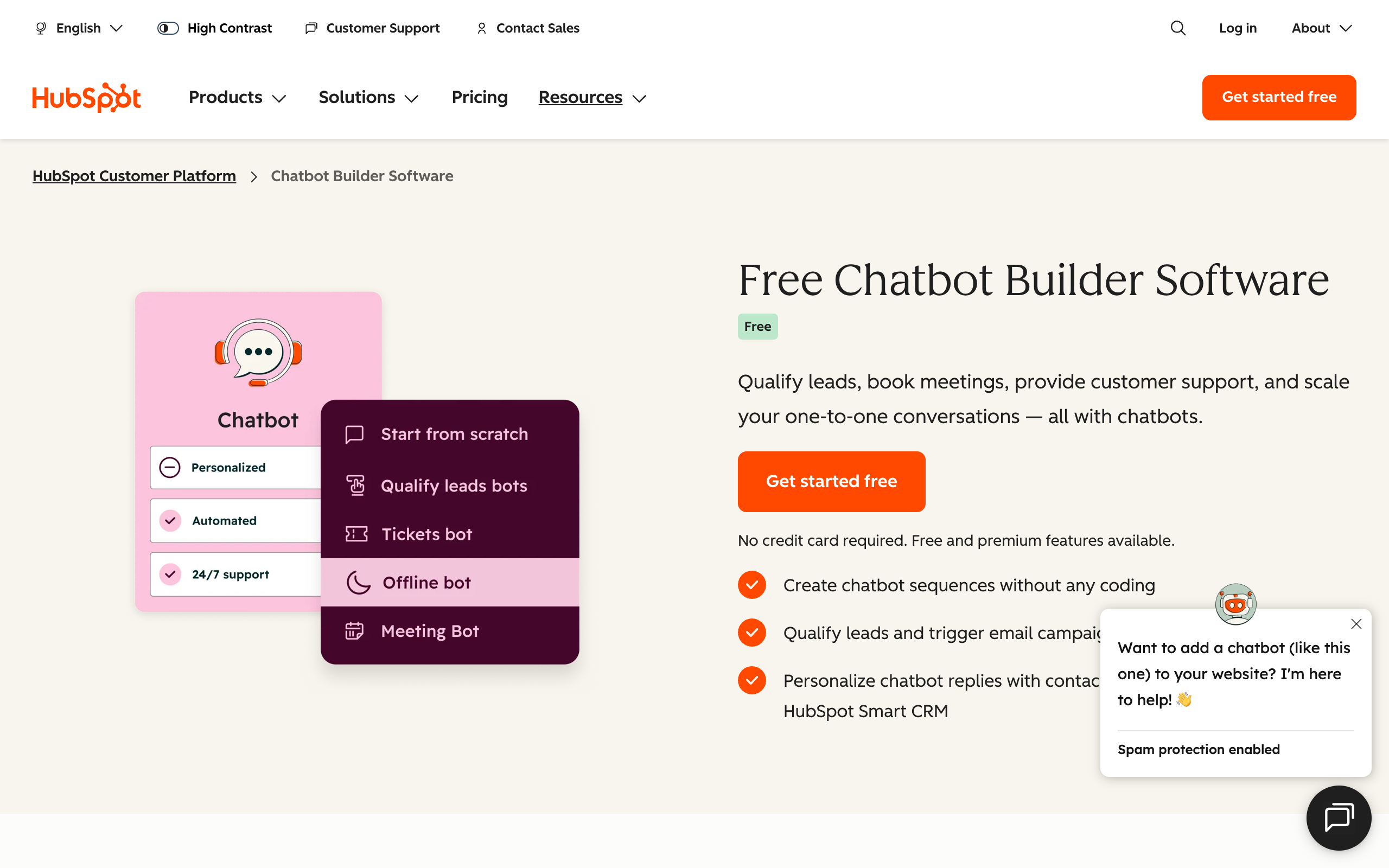
Lead triggers: the rule-based bot asks questions on a fixed path. The customer agent starts checking a lead against your criteria when a prospect shows interest, such as asking about pricing.
Booking: the Book a meeting action shares a meetings link through a chatbot message. If the meeting has custom form fields, the visitor goes to the booking page.
CRM path: this is HubSpot's clearest strength. Answers save to contact properties in the CRM.
Pricing: the rule-based bot is free. Marketing Hub Professional is $800 a month with an annual commitment, or $890 billed monthly, plus a $3,000 onboarding fee, per the pricing page. The customer agent also needs HubSpot Credits to run on channels.
Pros
- Native CRM records with no mapping
- Free rule-based chatbot
- Customer agent sorts leads into Qualified, Partially qualified, and Not qualified
Cons
- The free bot follows a script
- The AI agent needs a Professional or Enterprise hub
- Limited value if your CRM is something else
Best forTeams already on HubSpot that want leads in the CRM with no integration work.
6. Landbot: best for scripted qualification flows
Landbot is a visual no-code builder. You design each step, so the path is predictable and easy to review.
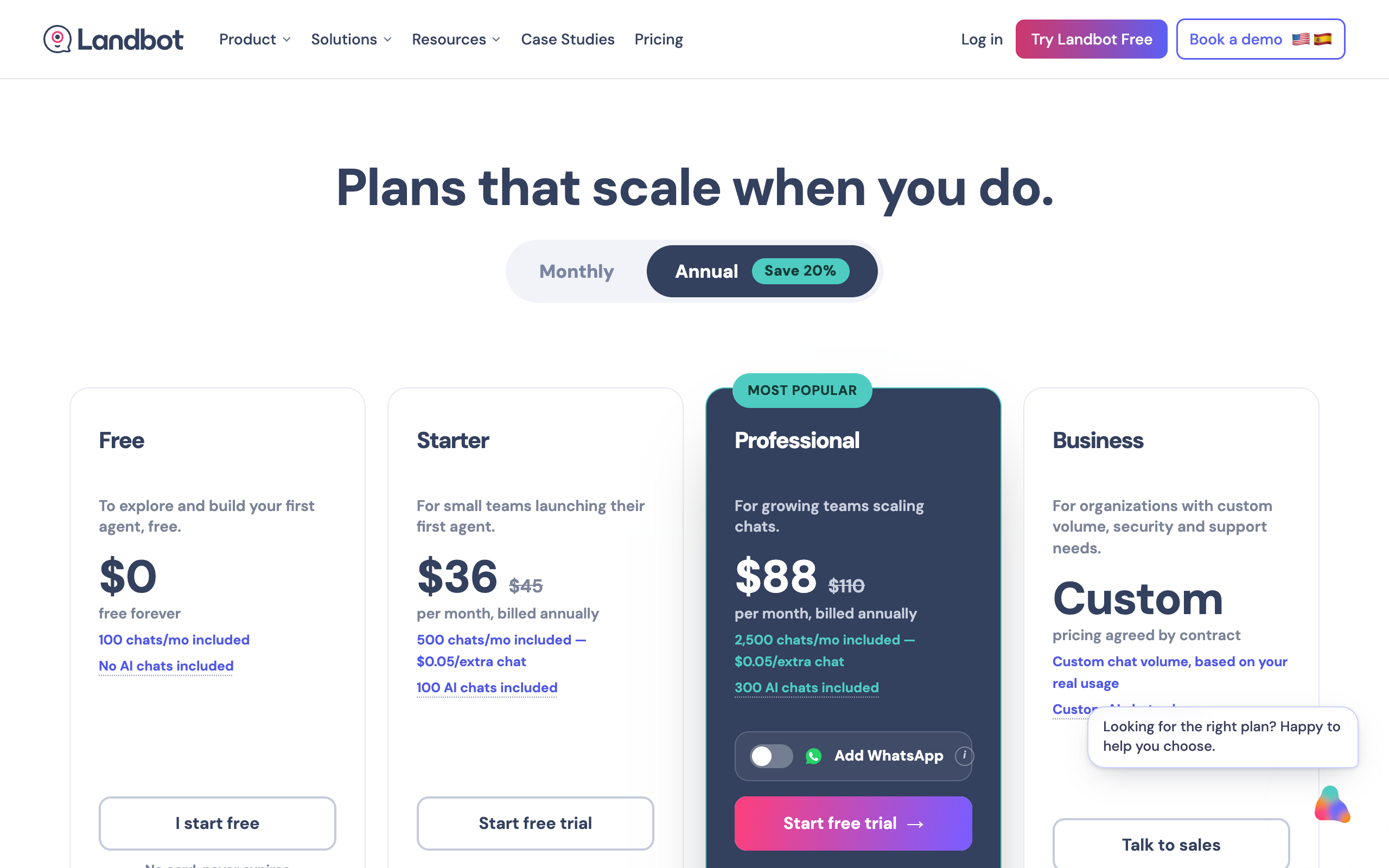
Lead triggers: the flow sets the trigger. Every visitor who starts it moves through your questions.
Booking: the Calendly block lets a user pick a slot inside the bot. It runs on web only and is listed for the Pro and Business plans.
CRM path: the HubSpot block creates, updates, and reads records. Per the pricing page, HubSpot and webhooks sit on Professional.
Pricing: Starter is €32 a month billed yearly or €40 monthly. Professional is €80 billed yearly or €100 monthly. Extra AI chats cost €0.10 each.
Pros
- Clear visual builder
- In-chat Calendly booking on web
- 14-day trial with no card
Cons
- You script each path by hand
- Calendly block does not run on WhatsApp or Messenger
- Priced in euros, with AI chats metered
Best forMarketing teams that want to control every question a visitor sees.
7. Qualified: best for Salesforce-centred enterprise pipeline
Qualified sells Piper, an AI SDR agent that meets website visitors by chat, voice, or video. Salesforce completed its acquisition of Qualified on 1 April 2026.
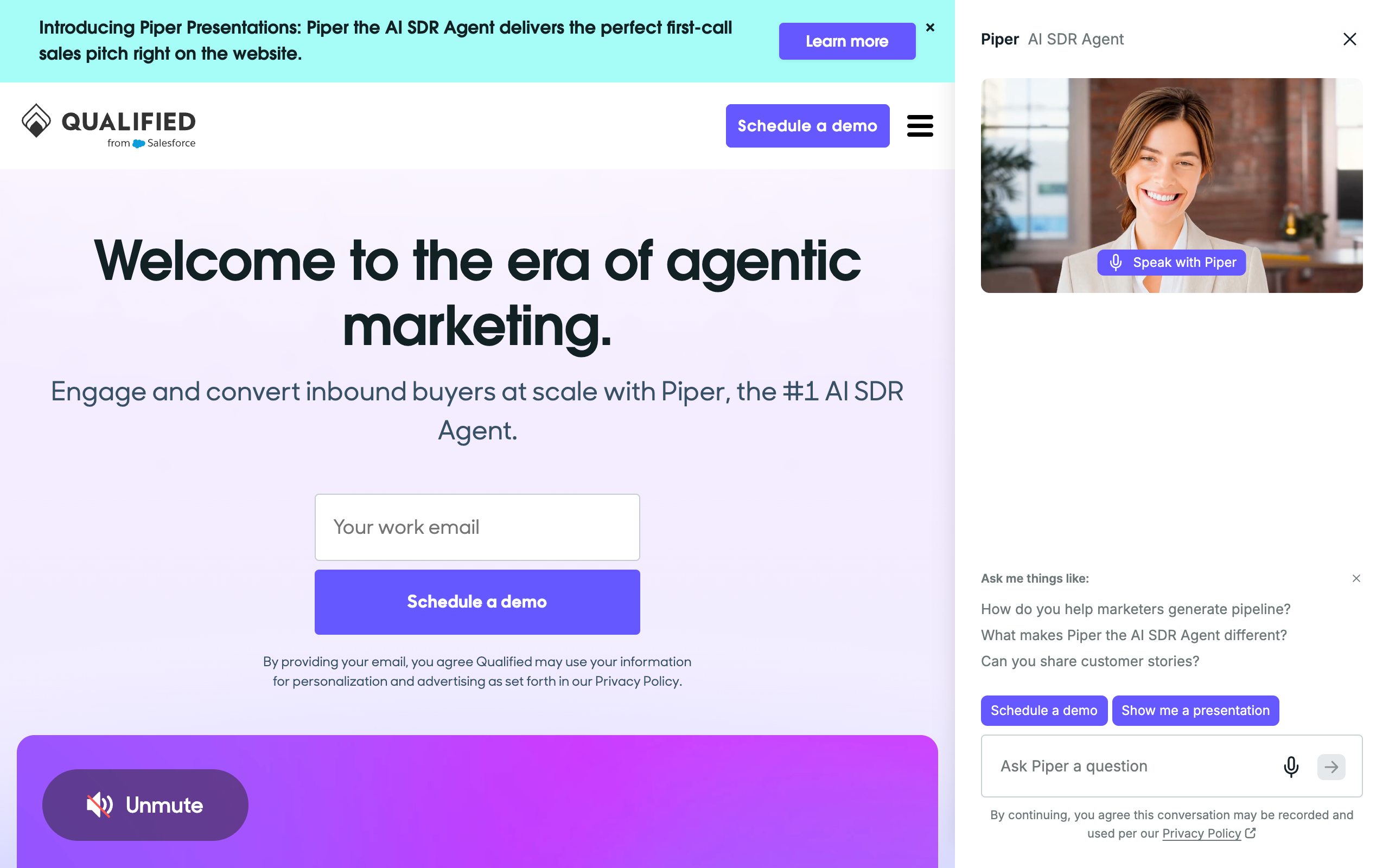
Lead triggers: Piper engages visitors in real time and turns forms and buttons into meetings.
Booking: meeting booking is on every plan, and Piper books during live chat.
CRM path: all plans include Salesforce CRM and more than 20 other go-to-market integrations.
Pricing: Qualified publishes three tiers (Premier, Enterprise, and Ultimate) and no prices. You need a demo to get a quote.
Pros
- Chat, voice, and video on the website
- Deep Salesforce fit
- Inbound email follow-up alongside web chat
Cons
- No public pricing or self-serve trial listed
- Built for larger traffic: Premier includes 250,000 web sessions a month
- More platform than a small team needs
Best forEnterprise marketing teams on Salesforce with high website traffic.
8. Chili Piper: best for B2B teams that want routing first
Chili Piper started in scheduling and routing. Its Chat AI answers, qualifies, routes, and books. Form Concierge turns form submissions into booked meetings with the right rep.
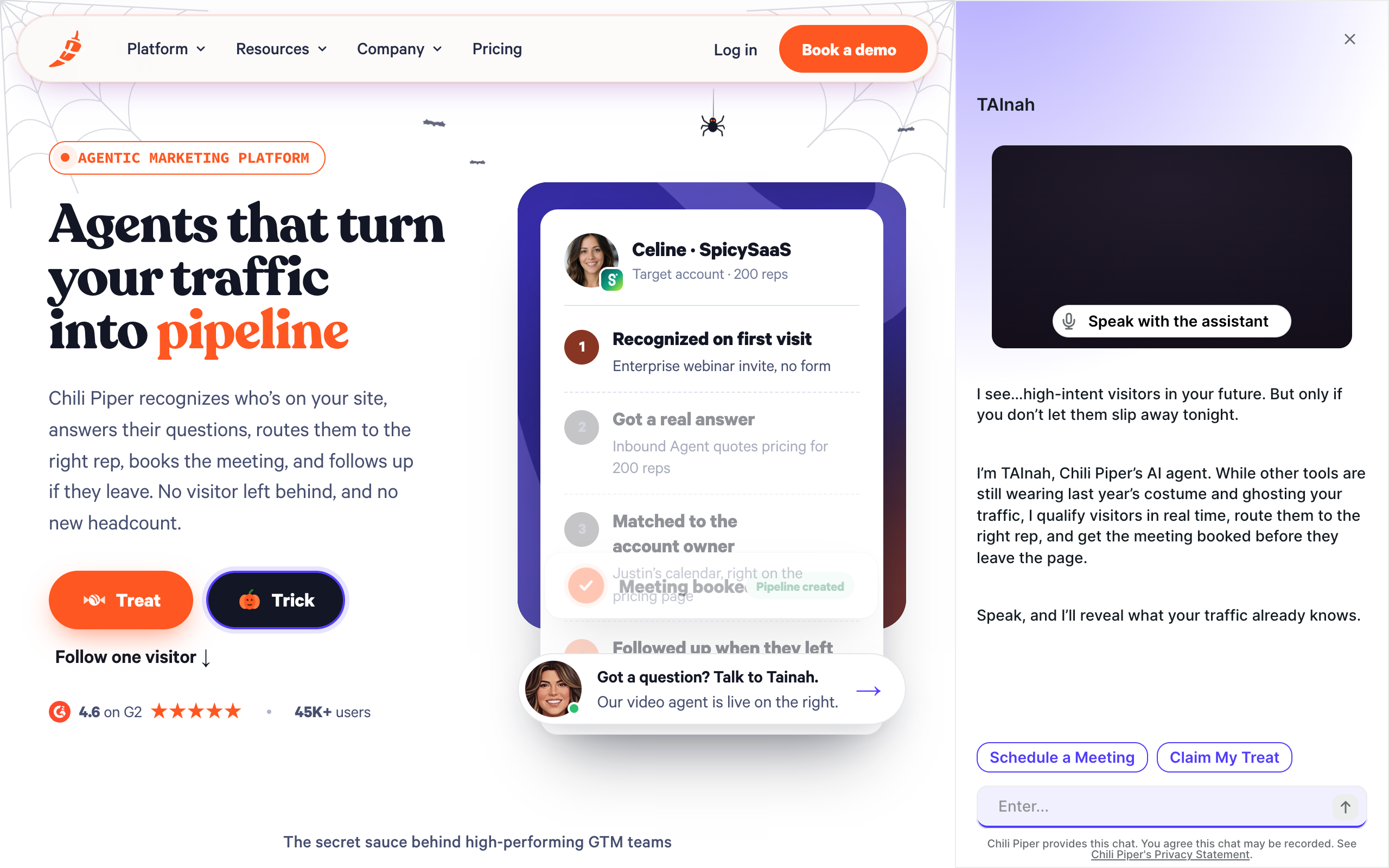
Lead triggers: forms and web experiences start the flow. 24/7 AI chat runs on the Scale plan.
Booking: meetings land on the right rep's calendar through routing rules.
CRM path: integrations include Salesforce and HubSpot.
Pricing: per the pricing page, Growth is $1,250 a month ($15,000 a year) with 15 seats. Scale, with 24/7 AI chat, is $3,500 a month ($42,000 a year) with 30 seats. All plans bill annually.
Pros
- Strong routing across reps and teams
- Forms and chat in one platform
- Works with Fin for Sales as a booking option
Cons
- Annual contracts only
- 24/7 AI chat sits on the $42,000 Scale plan
- Priced for sales teams of 15 or more
Best forB2B sales teams of 15 or more whose main problem is getting each lead to the right rep.
How do the eight tools compare side by side?
| Tool | Lead trigger | Booking | CRM path | Entry price |
|---|---|---|---|---|
| Fin for Sales | Playbook in conversation | In chat (Messenger) | Syncs to CRM | $9.99/qualified lead + seats |
| SiteGPT | Interest, unable to answer, after N messages | Calendar link | Webhook (Scale+), email, CSV | $39/mo billed yearly |
| Chatbase | "When to use" rule | In chat (web) | Webhook, Salesforce on Basic | $32/mo billed yearly |
| Tidio | Flow rules, Lyro instructions | Calendly link | HubSpot template | Free, then $24.17/mo |
| HubSpot | Scripted path or AI agent | Meetings link | Native | Free (rule-based) |
| Landbot | Scripted flow | In chat (web) | HubSpot block on Professional | €32/mo billed yearly |
| Qualified | Real-time web engagement | In chat | Salesforce and 20+ | Custom |
| Chili Piper | Forms and Chat AI | Routed to rep calendar | Salesforce, HubSpot | $15,000/year |
Chatbase and SiteGPT figures are billed yearly. HubSpot's figure is Marketing Hub Professional with an annual commitment, before credits and onboarding. Fin bills per outcome and Qualified publishes no price, so neither appears in the chart.
What should healthcare businesses check?
A US practice that handles protected health information (PHI) needs a Business Associate Agreement (BAA) with its chatbot vendor. On SiteGPT a HIPAA BAA is Enterprise-only, and it is not on Starter, Growth, or Scale.
A covered workspace also narrows the product. Connected apps and chat integrations are off. PHI stays in end-user conversations.
Industry lead templates are not available either. Details are at SiteGPT's HIPAA page and in the workspace docs.
What happened to Drift?
Drift popularized website chatbots for lead generation, and many older lists still rank it first. In March 2026 Salesloft announced a gradual sunset of Drift and said it will refer existing clients to 1mind as the successor.
Drift is not ranked here because of the sunset. If you are moving off it, options are compared in Drift alternatives.
Which lead generation chatbot should you pick?
| Scenario | Best pick | Why |
|---|---|---|
| You already run Intercom | Fin for Sales | Qualification, booking, and CRM sync sit in the inbox your team uses. |
| Answers live in your website and documents | SiteGPT | Answers from your content and shows a lead form on three trigger types. |
| You run a clinic, HVAC firm, or law office | SiteGPT | Industry templates include fields and a booking link. |
| You want a time picked inside the chat on a small budget | Chatbase | Calendly and Cal.com actions from $32 a month billed yearly. |
| You want live chat as well | Tidio | Live chat, Flows, and Lyro in one product, with a free plan. |
| HubSpot is your CRM | HubSpot | Answers save to contact properties with no mapping. |
| You want to script every step | Landbot | A visual builder with a Calendly block on web. |
| You are an enterprise on Salesforce | Qualified | Piper works chat, voice, video, and email. |
| Your main problem is routing leads to reps | Chili Piper | Routing rules sit at the center of the product. |
Does your team already use a platform with sales AI?
- If Intercom→Fin for Sales
- If HubSpot→HubSpot
- If Salesforce, at enterprise scale→Qualified
- If None of these→Go to the next question
Must the visitor pick a time inside the chat?
- If Yes, with AI answers→Chatbase
- If Yes, with a scripted flow→Landbot
- If A calendar link is fine→SiteGPT or Tidio
Once you have a tool, the questions that make a lead useful are covered in AI lead qualification tools compared. To put a number on slow replies, try the lead response time calculator. The wider funnel is in the conversational marketing playbook.
FAQ
What is the best chatbot for lead generation?
Fin for Sales is the strongest pick for a team already on Intercom.
SiteGPT suits a business that wants leads captured from conversations answered by its own content at a flat price. Chatbase suits a small budget that needs booking inside the chat. No tool on this list wins all four tests.
What is lead capture software?
Lead capture software collects a visitor's contact details and sends them to a sales process. It includes web forms, pop-ups, and chatbots.
An AI chatbot adds one step before the ask. It answers the visitor's question first, then shows a form or asks for details when the conversation calls for it.
Can a lead generation chatbot book meetings?
Yes, in two ways. Chatbase, Fin for Sales, Landbot, and Qualified show times and book inside the chat.
SiteGPT, Tidio, and HubSpot's rule-based chatbot send a calendar link, and the visitor books on the calendar page.
Which lead generation chatbots connect to a CRM?
HubSpot writes to its own CRM. Fin for Sales, Qualified, and Chili Piper list CRM integrations. Landbot has a HubSpot block on Professional, and Tidio has a Lyro template that creates HubSpot contacts.
SiteGPT has no built-in CRM integration. It sends leads by webhook on Scale and above, and by email or CSV export on any plan.
How much does an AI lead generation chatbot cost?
As of 2 November 2026, prices start at free on Tidio and HubSpot's rule-based chatbot. Chatbase starts at $32 a month billed yearly, and SiteGPT at $39 a month billed yearly or $59 billed monthly.
Chili Piper starts at $15,000 a year, and Qualified does not publish prices.
Do lead generation chatbots work after hours?
Yes. An AI chatbot answers and collects details at any hour, so the visitor gets a reply while interest is live. A person still has to follow up.
Check how the tool notifies your team and what it tells a visitor who asks for a human while nobody is online.
Is a chatbot better than a web form for lead capture?
A chatbot can answer the question that is blocking the visitor before it asks for details. A form cannot. A form is still simpler and cheaper to run.
Many teams keep the form for visitors who are ready and add a chatbot for visitors who still have questions.
Sources
- Lead response time study, Workato. Workato sells automation software, so read it as vendor research.
- SiteGPT: collect leads, send leads to other tools, October 2026 changelog, and pricing.
- Fin: Fin for Sales explained, Calendly booking, and pricing.
- Chatbase: Cal.com action, actions overview, and pricing.
- Tidio: Lyro Action templates and pricing.
- HubSpot: customer agent qualification, bot actions, and Marketing Hub pricing.
- Landbot: Calendly block, HubSpot block, and pricing.
- Qualified: pricing and AI SDR page. Salesforce: FY27 Q1 highlights.
- Chili Piper: pricing and homepage.
- Drift: Salesloft newsroom.